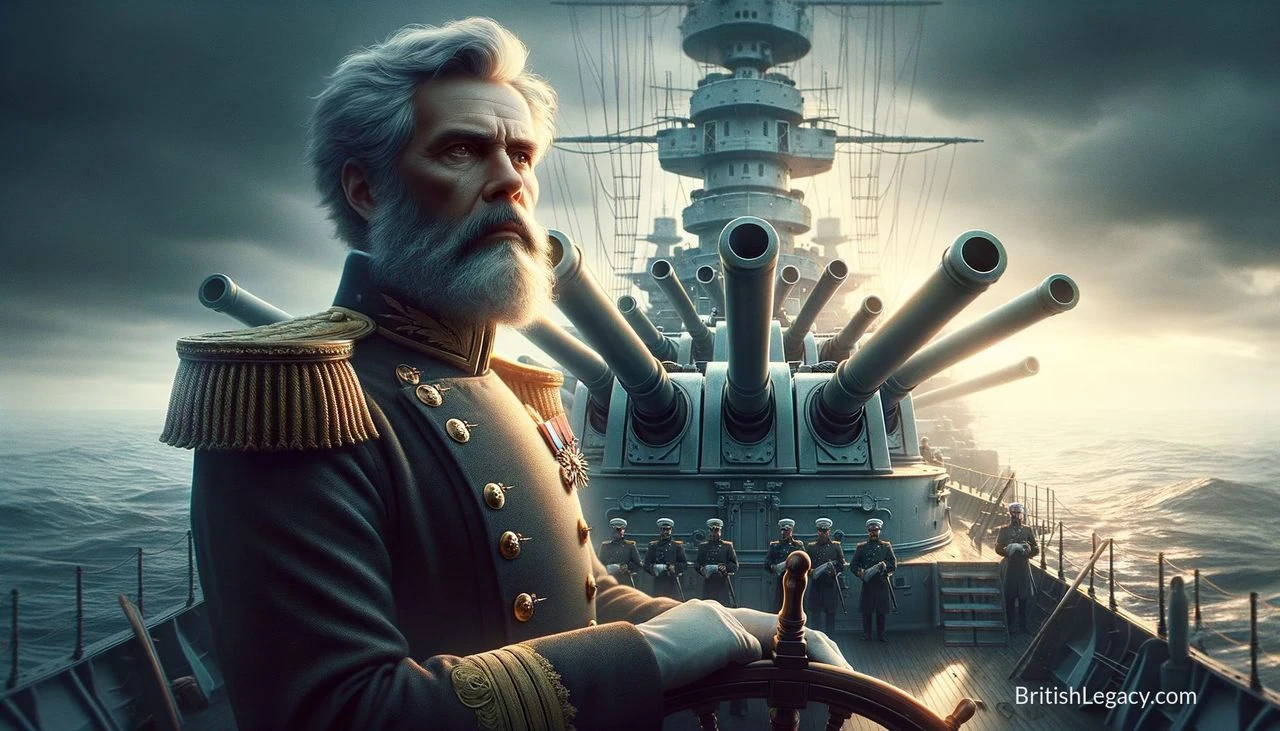
John “Jackie” Fisher is remembered above all for his association with HMS Dreadnought, the battleship whose all-big-gun armament and steam turbines established a new standard for naval design. Yet the ship was one part of a broader reforming programme. As First Sea Lord, Fisher pressed the Royal Navy to modernise its people, communications and fleet, including by retiring older vessels and directing resources towards newer ones.
From Ceylon to senior naval command
Fisher was born in Ceylon, now Sri Lanka, on 25 January 1841. He joined the Royal Navy at 13 and, according to the biographical account, had become a lieutenant by the age of 24. He served aboard several ships, gaining experience that preceded a career in senior naval office. The account gives few details of his early postings, but makes clear the speed of his rise through the service.
Fisher served as First Sea Lord from 1904 to 1910 and again during the early years of the First World War. In that role, he advocated adapting the Navy to changes in technology and naval warfare. His approach joined practical fleet decisions to a wider insistence that officers and sailors should be equipped to work with increasingly complex ships.
Reforming people, equipment and the fleet
Fisher’s reforms, as described in the account, extended from education and training to weapons and communications. He promoted changes in naval education and training, improved gunnery practice, new classes of ships, and advances in torpedoes and mines. The account also credits him with supporting wireless telegraphy, which offered the fleet a means of communicating across distance.
Modernisation also meant deciding what the Navy would stop using. Fisher retired older ships, a contentious measure that allowed resources to be concentrated on newer vessels. That policy makes the scale of his reforming ambition apparent: it was not simply a matter of adding technology, but of changing the fleet’s composition and directing investment towards ships regarded as more capable.
The available account characterises Fisher as uncompromising and contentious, and refers to rivalries with contemporaries and politicians. It does not name particular disputes or explain their course. What can be said from its account is that his programme involved choices that could provoke disagreement, especially when established ships and practices were set aside.
The Dreadnought and a new standard
Launched in 1906, HMS Dreadnought carried ten 12-inch guns in an all-big-gun arrangement and used steam turbines. The combination of concentrated firepower and turbine propulsion made it a striking design. Rather than repeat the claim that it made every earlier naval vessel obsolete, its significance can be described more precisely: it reset expectations for battleships and gave its name to a class of modern warships.
The ship’s arrival prompted other powers to seek comparable vessels and contributed to a naval arms race. Its significance was therefore not confined to British shipbuilding. The competition to match the new standard affected how other navies approached battleship design and fleet strength. Fisher’s association with Dreadnought connects his programme of Royal Navy reform with a wider contest over naval technology.
Why John “Jackie” Fisher deserves a place in British Legacy
Fisher’s place in British Legacy rests on two connected achievements: pressing for institutional change in the Royal Navy and being closely associated with a battleship that altered the terms of naval competition. The reforms attributed to him encompassed training, gunnery, communications, weapons and the renewal of the fleet. Taken together, they show modernisation as more than the construction of new ships. It also involved preparing personnel to operate complex equipment and deciding where limited resources should be directed.
HMS Dreadnought gives that reforming programme a tangible focus. Its all-big-gun armament and steam turbines set a new benchmark, while the effort by other powers to build comparable vessels carried the consequences beyond Britain. Fisher’s British connection is direct: his career was in the Royal Navy, and the reforms and ship associated with him helped shape the service’s response to technological change. His legacy is therefore not a general claim about national character, but a specific story of naval policy, engineering and international competition.