Chris Ofili’s paintings make their materials part of their meaning. Layers of paint, resin, glitter, beads, cut-outs and elephant dung create surfaces that are at once vivid and complex. His work draws on African and Caribbean culture, popular music and art history, while engaging with questions of race, sexuality and identity. After growing up in Manchester and studying in London, Ofili won the Turner Prize in 1998. He later represented Britain at the Venice Biennale and, after moving to Trinidad, developed a new body of work shaped by the island’s carnival culture.
From Manchester to art school
Ofili was born in Manchester on 10 October 1968 to parents of Nigerian descent. He attended St Pius X High School for Boys and Xaverian College before taking a foundation course in art at Tameside College. In 1988 he moved to London to study at the Chelsea School of Art, where he remained until 1991, and then continued his studies at the Royal College of Art from 1991 to 1993. A one-year exchange scholarship took him to Universität der Künste Berlin in 1992.
That same year, a scholarship enabled Ofili to travel to Zimbabwe, where he studied cave paintings. The encounter contributed to his developing visual language. His early work also drew influence from artists including Jean-Michel Basquiat, Georg Baselitz, Philip Guston and George Condo. Rather than treating painting as a flat field, he built images in layers, bringing together pigment and found or applied materials to make works with a pronounced physical presence.
A layered language, and a breakthrough
Ofili’s paintings combine oil or acrylic paint with resin, glitter, beads, collage and, in many works, lumps of elephant dung. The materials do more than decorate a surface: they help structure it, creating relief and drawing attention to how a painting is made. His use of cut-outs from pornographic magazines also brought popular imagery into compositions that could refer to religion, art history and racial representation at the same time.
During the 1990s, Ofili became associated with the Young British Artists group and gained wider attention through exhibitions organised by Charles Saatchi, including the travelling exhibition Sensation in 1997. In 1998, he won the Turner Prize. The award brought national recognition to a painter whose densely worked canvases resisted easy divisions between high art and popular culture.
One of his best-known paintings, No Woman No Cry (1998), depicts a grieving Black woman. Images of Doreen Lawrence, the mother of Stephen Lawrence, appear in the figure’s tears. The painting connects personal grief with a wider public history of racism and loss. Its layered construction asks viewers to look closely: an image that first reads as a portrait also carries a specific reference to a British family’s experience and to the public attention surrounding the murder of Stephen Lawrence.
The Holy Virgin Mary (1996) takes another route into questions of image-making and religious tradition. The painting depicts a Black Madonna and combines elephant dung with cut-outs from pornographic magazines and images associated with blaxploitation films. Its exhibition in New York in 1999, as part of Sensation, provoked a public dispute between the city’s mayor, Rudy Giuliani, and the Brooklyn Museum of Art. The argument centred on the exhibition and the painting’s treatment of religious imagery. The episode made clear that Ofili’s use of materials and references could prompt debate well beyond the gallery.
New settings, new bodies of work
Ofili’s work did not remain confined to the paintings that first brought him attention. From 1995 to 2005, he made a series of small watercolours, often completed in a single sitting. Many feature heads of men and women; others depict flowers and birds. In works that draw on blaxploitation films and gangsta rap, he used humour to question racial and sexual stereotypes. His Harems series, for instance, arranged a man among groups of women.
In 2003, Ofili represented Britain at the 50th Venice Biennale. His work for the British Pavilion was developed in collaboration with architect David Adjaye. The project marked a further stage in a career that had moved from London’s contemporary-art scene to an international platform while keeping painting at its centre.
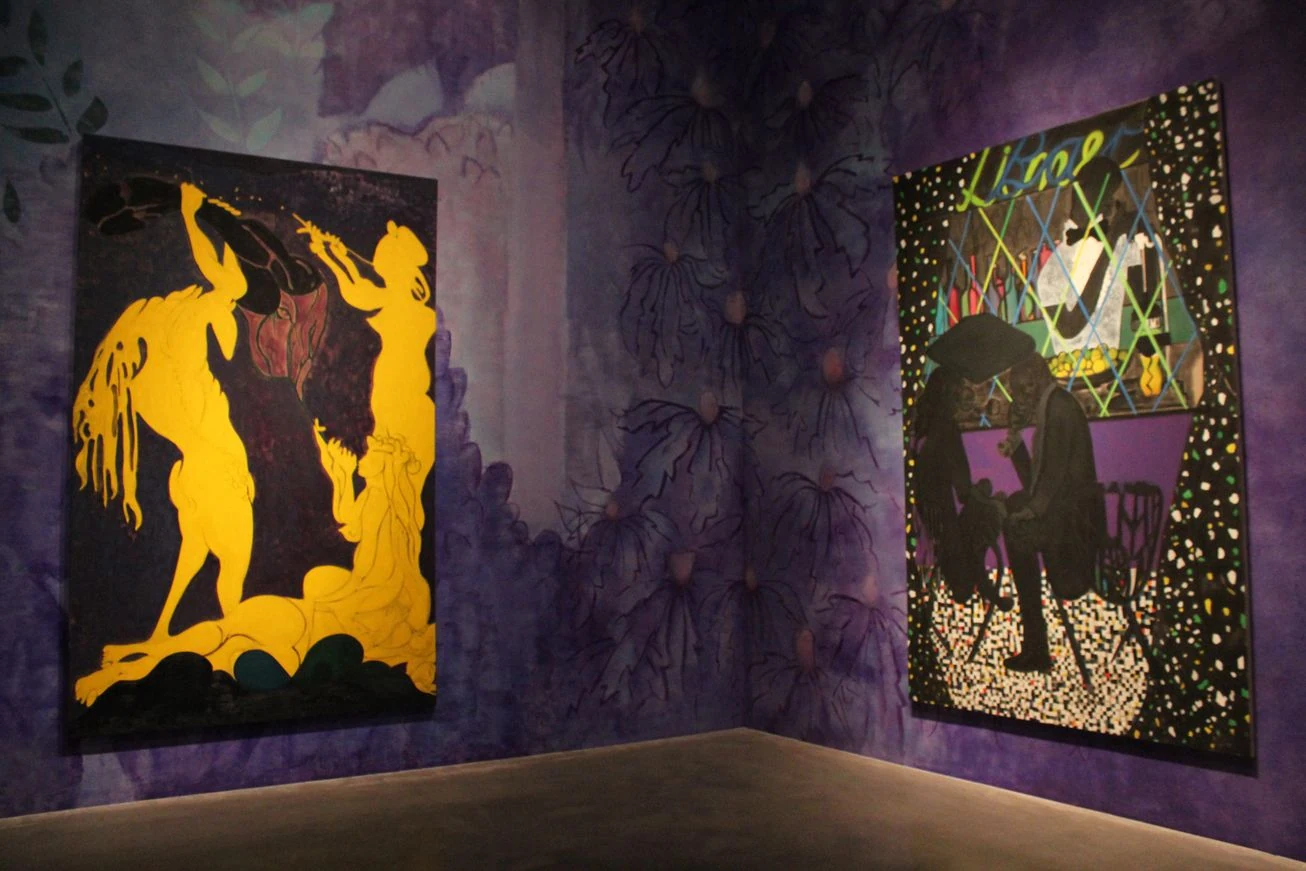
Ofili first visited Trinidad in 2000 and relocated there permanently in 2005. The change of home brought a marked shift in his work. He began making blue paintings inspired by the Jab Jab, or “blue devils”, who take part in Trinidad and Tobago’s Carnival, as well as by the German and Russian Expressionist group Der Blaue Reiter. These paintings often place dark oil pigment over a silver acrylic ground. In the New Museum’s exhibition Chris Ofili: Day and Night, later versions were installed in a dimly lit room, making the act of looking part of the encounter with the work.
Exhibitions and public debate
Ofili’s work has been shown in Britain and internationally. His exhibitions have included the 1995 group show Brilliant! New Art from London at the Walker Art Center, a solo exhibition at Southampton City Art Gallery in 1998, and a major presentation at Tate Britain in 2010. The New Museum in New York presented a major solo exhibition in 2014. These exhibitions have placed work from different periods alongside one another, making it possible to see how his materials, subjects and ways of composing have changed.
Public debate has also followed some of his work. The Upper Room is an installation of 13 paintings of rhesus macaque monkeys in a specially designed room. The Tate Gallery bought it in 2005, when Ofili was a Tate trustee. The Charity Commission censured the Tate in 2006 over the purchase. The episode raised questions about governance as well as about the place of a contemporary artist’s work in a national collection. It sits alongside the controversy around The Holy Virgin Mary as evidence that Ofili’s paintings have not simply been received as formal experiments: they have also entered arguments about institutions, religion and public culture.
Ofili was appointed a Commander of the Order of the British Empire in the 2017 New Year Honours for services to art. His career has included changes of place and subject, but the paintings remain rooted in a distinctive combination of close attention to materials and a willingness to bring different visual traditions into the same frame.
Why Chris Ofili deserves a place in British Legacy
Chris Ofili deserves a place in British Legacy because his career gives a concrete account of how contemporary British art can be shaped by several histories at once. Born in Manchester to Nigerian-descended parents, he trained in London, won the Turner Prize and represented Britain at the Venice Biennale. His work does not treat those connections as a simple blend. Instead, it makes viewers confront how images of race, religion and popular culture are constructed, and how material choices can alter the meanings of a painting.
No Woman No Cry gives that practice a particularly direct British reference through its images of Doreen Lawrence. Other works, from The Holy Virgin Mary to the paintings inspired by Trinidadian Carnival, show how Ofili has used collage, paint, glitter and elephant dung to bring varied cultural references into the gallery. His influence is not measured here by unsupported claims about what other artists have done; it is visible in the sustained attention his work has drawn from major exhibitions and public debate. The Tate’s presentation, the Venice Biennale and the controversies around individual works all point to an artist whose practice has made British art institutions contend with difficult questions as well as new forms. That combination of formal invention, specific cultural reference and public consequence gives his work lasting significance in the story of British visual art.
Sources
Chris Ofili — Wikipedia revision 1374857688
Adapted in part from Chris Ofili by Wikipedia contributors, under CC BY-SA 4.0. Text has been edited and combined with the existing article; this adapted text is shared under the same licence. Contributor history.