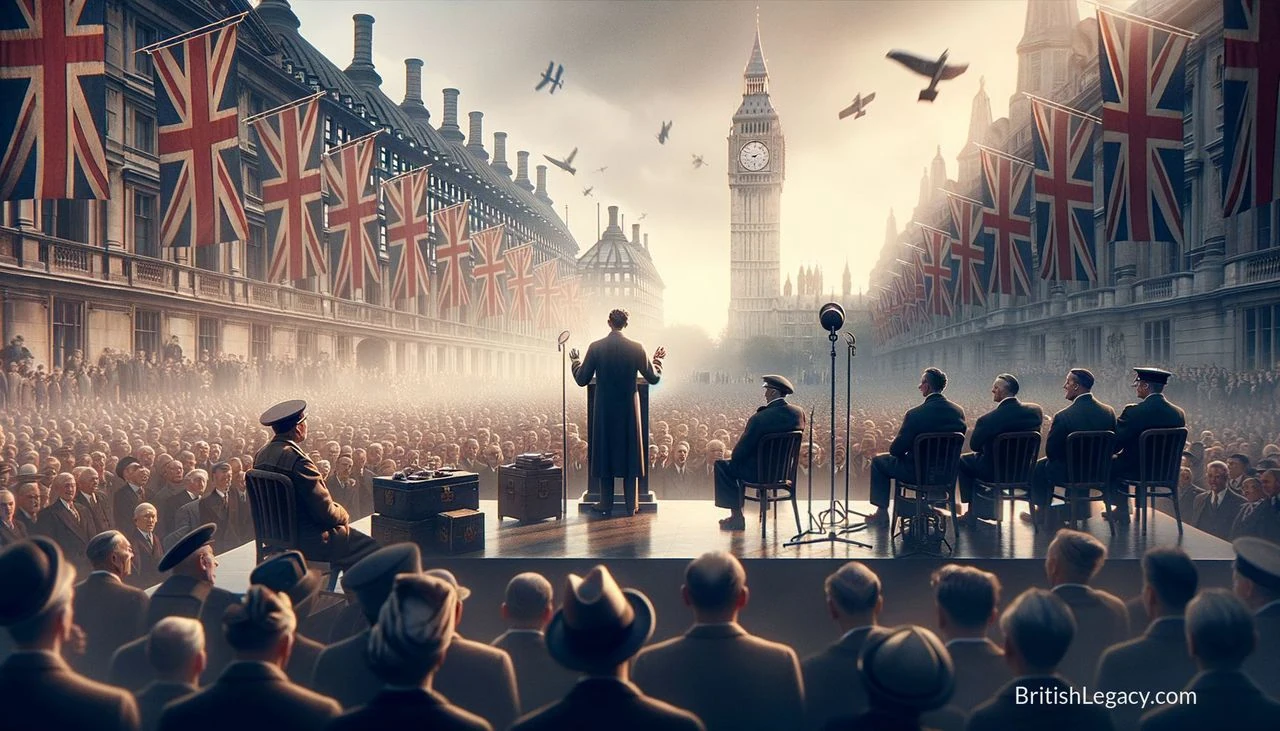
“The war is won, but the peace is not yet.” On Victory in Europe Day, 8 May 1945, Clement Attlee set celebration beside remembrance. His address gave thanks for the defeat of Nazi Germany and for the people whose courage and sacrifice had made victory possible. It also looked beyond the end of the fighting in Europe: building a better peace, he said, would be a task in its own right.
Victory, remembrance and a task ahead
The Allied acceptance of Nazi Germany’s unconditional surrender marked the end of the Second World War in Europe. For Attlee, Deputy Prime Minister in Winston Churchill’s wartime coalition government, the occasion brought both relief and sorrow. He began by paying tribute to the dead, then thanked the men and women of the country for their skill, devotion and courage.
His address widened that recognition to the Allies and to those who had worked in a common cause. Victory, in his telling, was not the achievement of one person or group. It had depended on contributions from many, and the work of peace would also require co-operation. Attlee urged his listeners to take the consequences of right and wrong seriously and to build a world worthy of what had been won.
“Let us now win the peace”
The address’s most memorable appeal turns on a distinction between military victory and what must follow it: “We have won the German war; let us now win the peace.” Attlee called peace a great task, harder still to win. He linked it to the aim of creating a new and better Europe, and argued that shared suffering should bind people to that work.
He also credited the armies and navies of the United Nations with co-operating in victory. The address therefore joined gratitude for the wartime effort to a practical, forward-looking challenge: the end of the fighting was not, by itself, a guarantee of a lasting peace.
The address
The full text supplied for this edition reads:
“Today is the day for which all have been waiting these long years. Today we give thanks to almighty God for a great deliverance. Speaking from these steps, I would like first of all to pay a tribute to our heroic dead. I think that we should never forget those who made this possible. This great deliverance could never have come and a free Europe could never have been saved without the contribution made by the rare heroism of those who fought for our cause.
Now we give thanks to all the men and women of this country, our pride in their skill and devotion and their invincible courage. We give thanks from the bottom of our hearts to all who have ensured our victory, to all the people who have sacrificed so much. We think of our gallant and brave allies, who stood with us through the darkest days, and of all those men and women who worked unselfishly in a common cause. The evil things we shall leave behind us have shown us not only the differences between right and wrong but also the appalling consequences of choosing the wrong.
The victory is complete. Peace has come back to an anxious world, and a great task lies before us. The war is won, but the peace is not yet. We have won the German war; let us now win the peace. A new and better Europe has always been our aim, and what we have suffered together in this war will bind us to that task. Armies and navies of all the United Nations have co-operated in this victory, but the peace will be even harder to win. Let this teach us to learn, and to live will be our victory. We must now turn to building a world worthy of the victory we have won.”
Why Clement Attlee deserves a place in British Legacy
Attlee’s VE Day address deserves a place in British Legacy because it records how victory was framed not simply as a cause for celebration, but as a moment of remembrance and responsibility. He paid tribute to the dead and acknowledged the courage and sacrifice of people at home, service personnel and allies. The speech presents victory as a collective achievement, recognising the many people who contributed to a shared cause rather than crediting a single leader.
Its lasting point is the distinction between ending a war and securing peace. Attlee’s call to “win the peace” made co-operation and the creation of a better Europe part of the work that followed victory. His words preserve both the relief of VE Day and a sober account of what that day could not, by itself, accomplish. For a British legacy, the address matters as a public statement of gratitude and as an appeal to turn shared sacrifice into a more peaceful future.