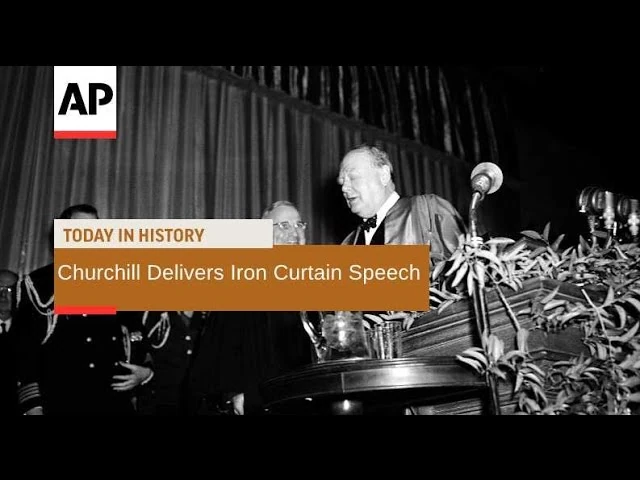
On 5 March 1946, Winston Churchill described a divided Europe to an audience at Westminster College in Fulton, Missouri. “From Stettin in the Baltic to Trieste in the Adriatic, an iron curtain has descended across the Continent,” he said. The image gave memorable form to his warning about Soviet influence in eastern Europe. Churchill was no longer Britain’s prime minister: after the Conservatives lost the 1945 general election, he led the opposition. His speech was his own political intervention, not a statement of the Attlee government’s policy.
Speaking from opposition
The address was formally titled The Sinews of Peace. Its setting mattered. Churchill had led Britain’s wartime government from 1940 until 1945, but the general election that year returned Clement Attlee’s Labour government. Churchill became Leader of the Opposition, a position from which he could argue publicly about foreign affairs without speaking for the government.
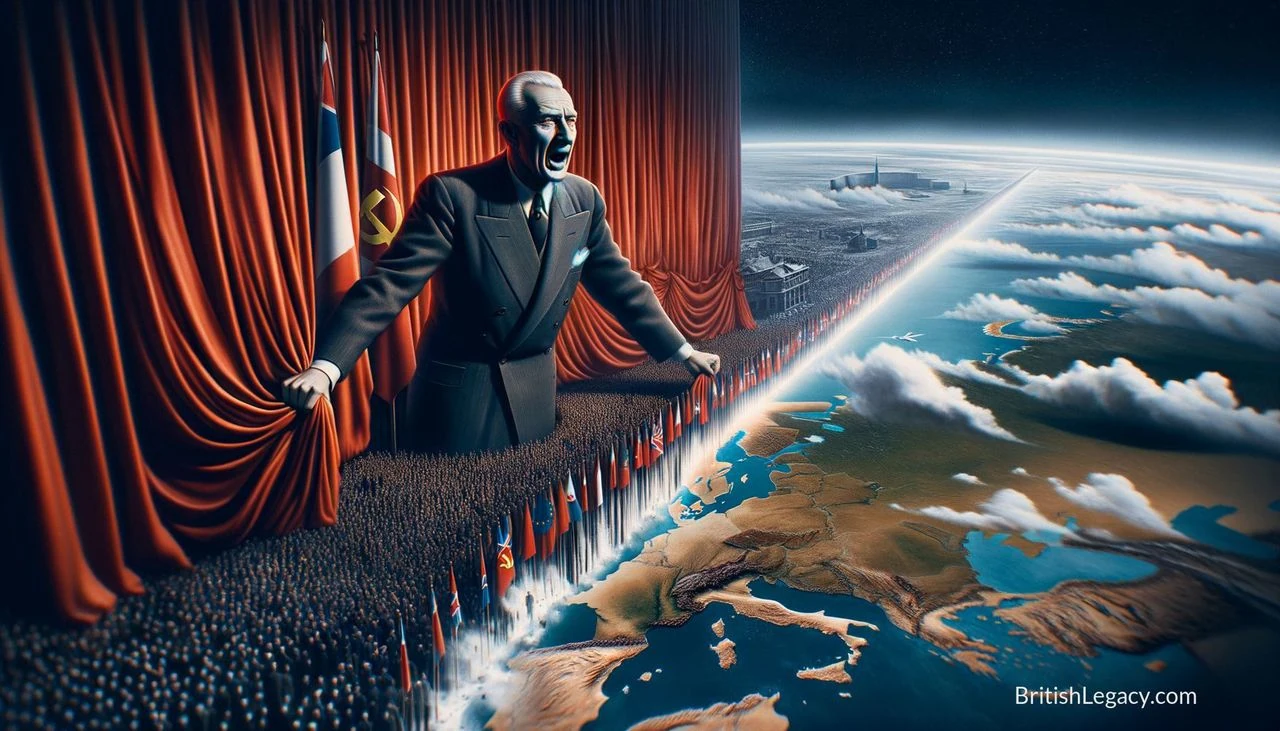
Europe was emerging from the Second World War, and the alliance that had joined the Soviet Union with Britain and the United States against Nazi Germany was giving way to suspicion. Churchill argued that Soviet power had created a dividing line across Europe. His reference to places from the Baltic to the Adriatic turned that argument into a geographical image: a barrier separating countries under Soviet influence from the West.
Churchill’s speech did not merely describe the division. It urged cooperation between the United States and the British Commonwealth and Empire, and called for unity in Europe. He also placed that cooperation within the framework of the United Nations Charter. His proposals combined a warning about Soviet influence with an appeal for a response built on relationships among Western countries and European nations.
An image, and a wider argument
The phrase “iron curtain” became the address’s most familiar element. Its force lies in its economy: it suggests a hard boundary while giving listeners a route across a map. The phrase helped Churchill explain the division he saw in post-war Europe, but it can also narrow the way the speech is remembered. His case was not only that a barrier had descended; he also argued that closer cooperation was needed to protect peace and freedom.
One of the quoted appeals in the supplied article is for “a new unity in Europe, from which no nation should be permanently outcast”. It complements his call for an association between the United States and the British Commonwealth and Empire. These points make the address more than a warning about the Soviet Union: it presents Churchill’s view of how countries might organise themselves in response to the changed balance of power.
Churchill also referred to earlier warnings that he believed had gone unheeded. The comparison recalled his opposition to the rise of Nazi Germany in the 1930s, but the circumstances in 1946 were different. His warning concerned the growth of Soviet influence and the future of relations among the former wartime allies. The supplied extract includes the line: “Last time I saw it all coming and I cried aloud to my own fellow-countrymen and to the world, but no one paid any attention.” In the speech, that recollection gave his new argument the urgency of a politician who thought delay could have serious consequences.
A British voice in an American setting
Churchill delivered the speech in the United States, but its British connection was central to its argument. He spoke as a former British prime minister with recent experience of wartime leadership, now outside government and advocating a particular course. His appeal for close Anglo-American ties reflected his belief that cooperation between the two countries could support peace and freedom. It did not make his address an official declaration by Britain.
The speech also belongs to a longer political career. Churchill had served as prime minister during the war, then became Leader of the Opposition after the 1945 election. The Conservatives returned to office in 1951, and he served again as prime minister until 1955. That chronology helps explain why a speech outside Britain attracted attention: its speaker was an experienced former head of government, but one whose authority in 1946 came from his public standing rather than executive office.
His record also included an earlier public campaign for rearmament in response to Nazi Germany. In 1946, he invoked the idea of having warned before, while addressing a new and unsettled political situation. The shift in circumstances is worth keeping clear. The address drew on Churchill’s experience of the 1930s, but it addressed the post-war division of Europe and the strain in relations with the Soviet Union.
The supplied extract and the speech
The supplied article presents a portion of the address under the heading “Full Original Text of the Speech”. The material shown includes Churchill’s opening remarks about Westminster College, a passage about his welcome in the United States and a passage on extremism. It then signals that the speech text continues. Those passages are therefore treated here as an extract from the supplied material, not as a complete transcript.
This distinction keeps the article’s account in proportion. The extracts offer some of Churchill’s language, while the speech’s best-known line and its principal political themes provide the focus of the feature. The article does not attempt to reproduce a complete address or to supply text that is absent from the material.
Why Winston Churchill’s Iron Curtain speech deserves a place in British Legacy
The speech belongs in British Legacy because it records a British political leader trying to define his country’s place in the post-war world. Churchill delivered it in the United States, but he argued specifically for cooperation between America and the British Commonwealth and Empire, alongside European unity. He spoke after Britain’s wartime prime minister had become Leader of the Opposition. That position matters: the address shows how a former head of government could influence debate without speaking on behalf of the government of the day.
Its lasting significance in this account rests on the connection between vivid language and political argument. The “iron curtain” image made Churchill’s interpretation of Europe’s division concise and memorable; his calls for Anglo-American association, European unity and cooperation through the United Nations set out the responses he favoured. The speech did not itself settle Europe’s future, and it should not be mistaken for a neutral description of every part of the post-war settlement. It does, however, offer a specific record of a British statesman addressing an international audience about Britain’s relationships with the United States, Europe and the Soviet Union. Remembering the address helps readers understand both the reach and the limits of political influence outside office.
Sources
Adapted in part from Winston Churchill by Wikipedia contributors, under CC BY-SA 4.0. Text has been edited and combined with the existing article; this adapted text is shared under the same licence. Contributor history.