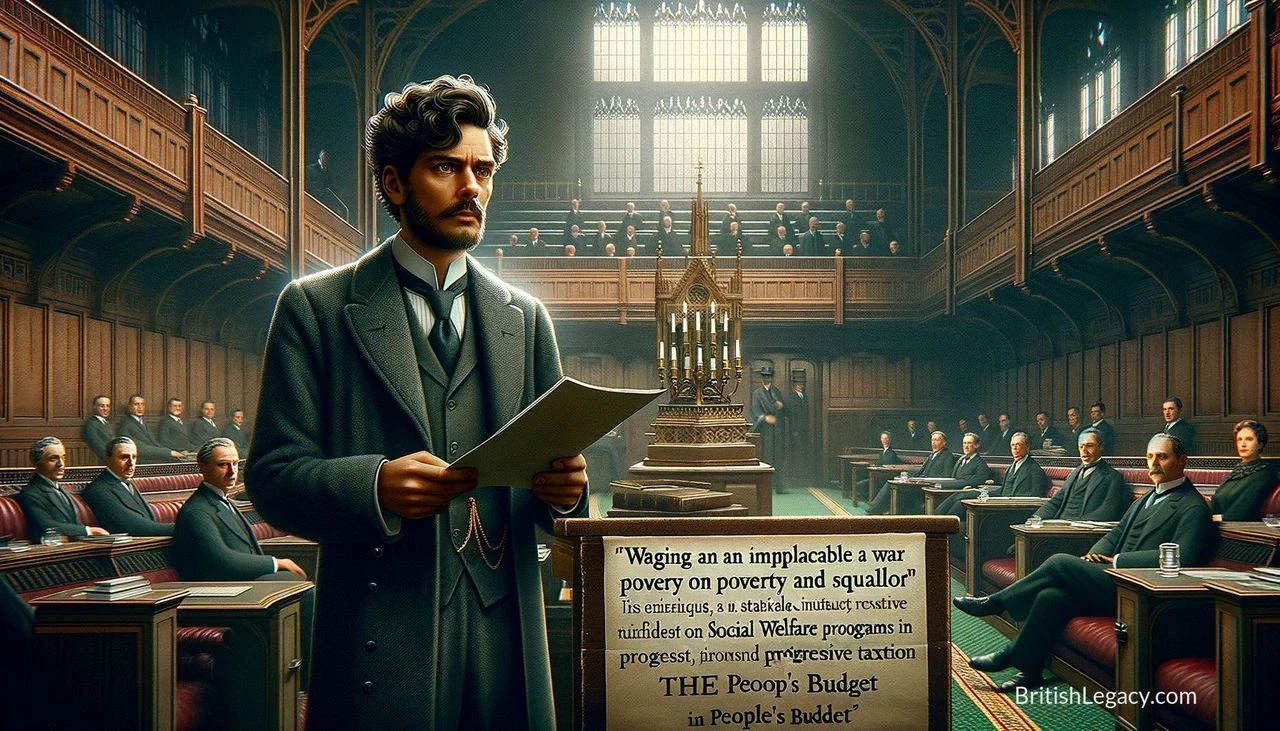
In 1909, David Lloyd George’s People’s Budget set out a radical answer to a practical political question: how could a Liberal government pay for social reform? As Chancellor of the Exchequer, he proposed new and higher taxes on land, high incomes and inherited wealth, among other measures. The Budget’s passage was contentious. The House of Lords rejected it, turning a dispute over taxation into a constitutional crisis that helped bring about a lasting change in the Lords’ powers.
Background and Circumstances
Lloyd George had arrived at the Treasury by a route that combined legal work, Welsh political concerns and a growing role in national government. Born in Manchester to Welsh parents, he was raised in Llanystumdwy in Wales. After qualifying as a solicitor, he entered the House of Commons in 1890 as the Liberal MP for Caernarfon Boroughs. He built his early reputation on issues including religious equality, Welsh concerns and land reform, while also becoming known as an energetic speaker.
In 1905 he joined Henry Campbell-Bannerman’s Cabinet as President of the Board of Trade. Among his achievements in that office was brokering an agreement between railway companies and unions: elected workers’ representatives sat on conciliation boards with company representatives, with arbitration available if they could not agree. When Herbert Henry Asquith became Prime Minister in 1908, Lloyd George succeeded him as Chancellor of the Exchequer.
The Liberal Government was pursuing social reforms, and the question of how to finance them sat alongside other pressures on public spending. Lloyd George had supported a reduction in armaments expenditure, but naval estimates were contested amid calls for more battleships. His Budget therefore addressed more than welfare: it sought revenue for social programmes and naval construction, while challenging the existing distribution of the tax burden.
Key Elements of the People’s Budget
The proposals were a package rather than a single tax. The Budget included a 20 per cent tax on increases in land values, payable when land was sold or on the owner’s death, and a charge on undeveloped land and minerals. It also raised death duties and income tax, introduced a super-tax on incomes above £3,000, and increased taxes on luxuries, alcohol and tobacco. The proposals were intended to make money available for new welfare programmes as well as battleships.
The measures drew particular anger from landowners, many of whom were represented in the House of Lords. Opposition was not simply a reaction to the amount of tax proposed. The Budget’s approach placed questions about property and the redistribution of wealth at the centre of a dispute about government finance. The imported article associates the Budget with the phrase, “This is a war Budget. It is for raising money to wage implacable warfare against poverty and squalidness.” That wording conveys the anti-poverty purpose attributed to the Budget in the supplied text; it is not necessary to treat the much longer passage reproduced there as an authenticated transcript of a speech.
The distinction between the Budget and other Liberal reforms matters. Old-age pensions had already been introduced under Asquith when he was Chancellor. The Budget was intended to help fund new welfare measures, but it did not itself introduce every form of social support later associated with the Liberal programme. Lloyd George’s role was significant, but the reforms were made through a government and Parliament, and through more than one piece of legislation.
Significance
In November 1909, the House of Lords rejected the Budget, breaking with the convention that it did not veto a government’s financial measure. The Budget had passed the Commons; its rejection by the Lords raised a fundamental question about the authority of the elected chamber over taxation and spending. A contested financial proposal had become a constitutional confrontation.
Two general elections in 1910 did not resolve the conflict at once. The Budget was eventually passed on 28 April 1910 and received royal assent the following day. The wider crisis continued. The Parliament Act 1911 removed the Lords’ power to block money bills and replaced its veto over most other legislation with a power to delay it. The Budget helped precipitate the crisis, but the change in parliamentary powers followed a longer political struggle and subsequent legislation; it should not be treated as an automatic or immediate result of the Budget alone.
The dispute gave lasting force to the question of who could determine the nation’s financial priorities. It also demonstrated how a proposal about revenue could expose the balance of power between the two Houses. The Budget was therefore both a fiscal programme and a test of parliamentary authority, with consequences extending beyond the year for which it was designed.
Reform beyond the Budget
Lloyd George’s work as Chancellor was part of a wider programme of Liberal reform. The National Insurance Act 1911 provided for sickness and invalidism and introduced unemployment insurance. These were later measures, not provisions that should be collapsed into the People’s Budget. Taken together, the Budget’s proposed taxes and subsequent legislation helped place progressive taxation and state-supported social provision among the central questions of British politics.
The Budget’s history is not a story of uncontested success. Its tax proposals provoked fierce opposition; the Lords’ rejection produced a constitutional crisis; and enactment came only after elections and further parliamentary conflict. Nor did one politician create the modern welfare state single-handedly. Asquith had introduced old-age pensions, while later insurance reforms depended on legislation beyond the Budget itself. Keeping those distinctions clear makes Lloyd George’s contribution more intelligible, not less important.
The supplied article’s broader account of the Budget as a response to poverty and inequality is best understood through these concrete events: the attempt to raise money through a more progressive tax system, the fight over the Lords’ role, the eventual passage of the Budget in 1910 and the later expansion of social insurance. Together they show how reform depended on both policy and political authority.
Why David Lloyd George deserves a place in British Legacy
The People’s Budget deserves a place in British Legacy because it made the financing of social reform a direct public and parliamentary issue. Lloyd George’s proposals targeted land values, high incomes and inherited wealth, alongside other forms of spending. They were intended to provide revenue for welfare programmes and naval construction. This was not simply a declaration of concern about poverty: it was a detailed attempt to change how the state raised money and to whom the costs of government fell. Its proposals provoked determined opposition precisely because they challenged established interests and assumptions about property and taxation.
The Budget also had a constitutional consequence. When the Lords rejected it, the dispute forced the question of the Commons’ authority over public finance into the open. The subsequent Parliament Act 1911 removed the Lords’ power to block money bills, while later Liberal measures, including the National Insurance Act 1911, extended social provision. These developments had multiple contributors and causes, but the Budget was a defining part of their political setting. Lloyd George’s legacy in this episode is therefore not a claim that one man created the welfare state. It is the more specific achievement of connecting progressive taxation, social reform and elected parliamentary authority in a conflict that reshaped British government.
Sources
David Lloyd George (revision 1379489807) · David Lloyd George
Adapted in part from David Lloyd George by Wikipedia contributors, under CC BY-SA 4.0. Text has been edited and combined with the existing article; this adapted text is shared under the same licence. Contributor history.