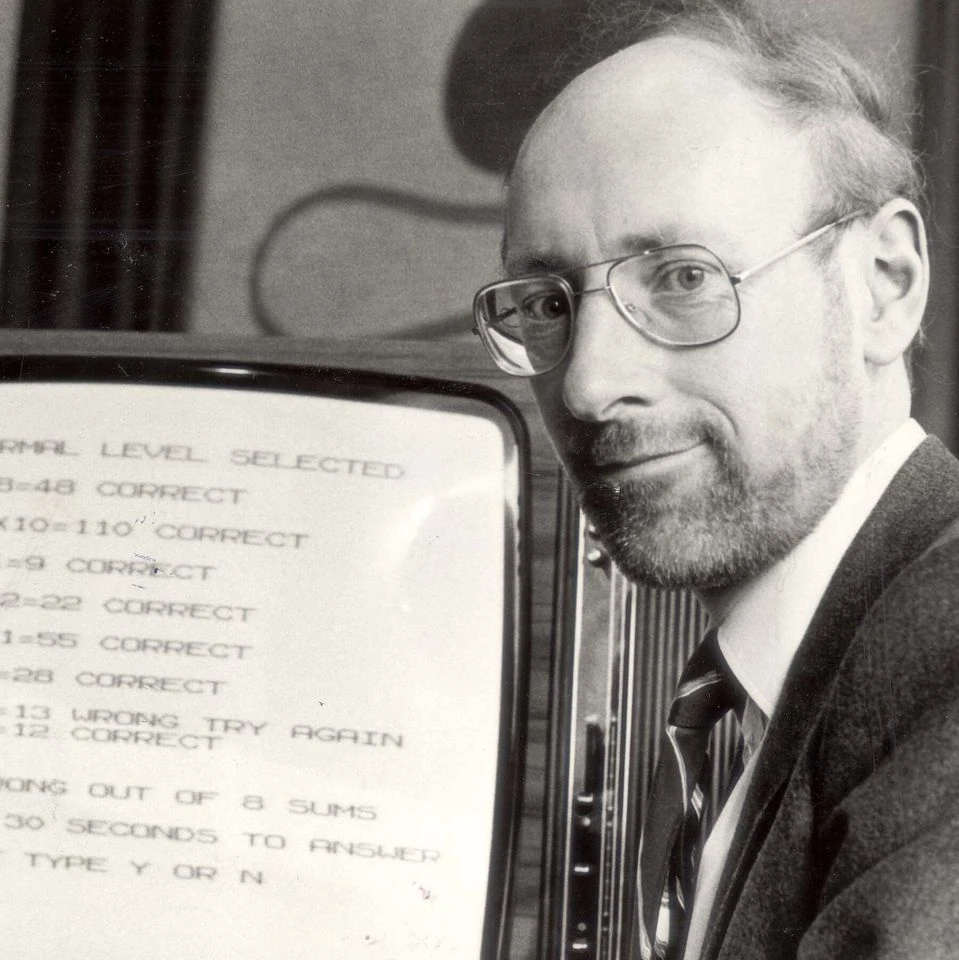
Clive Sinclair’s most influential computers were built around a demanding idea: that a useful machine could be made cheaply enough for people to own at home. The ZX80, ZX81 and ZX Spectrum brought computing within reach of a much wider market in Britain. They also gave a generation of young users a practical way to learn programming, make games and join a new industry. Sinclair’s career was not a straight line of success: the ambitious products that followed the computers included commercial failures. But his work changed what a home computer could cost, and who might use one.
An early start in electronics
Clive Marles Sinclair was born in Ealing, Middlesex, on 30 July 1940. His father and grandfather were engineers. Sinclair attended several schools as his family’s circumstances changed, and studied physics and mathematics at A-level. He began earning money from electronics while still young, writing for Practical Wireless and selling miniature electronic kits by mail order after leaving school at 18.
He also wrote practical books about transistor circuits and receivers. In 1961, he registered Sinclair Radionics, but raising the money to manufacture his designs was difficult. He joined the technical publishing company United Trade Press, working on Instrument Practice as an assistant editor from 1962. The job gave him access to information about components and manufacturers while he continued to develop and sell electronics.
Sinclair Radionics later made calculators, miniature televisions and the Black Watch digital wristwatch. The watch became a costly failure: it was inaccurate, difficult to service and had poor battery life. The company’s financial troubles brought it into conflict with the National Enterprise Board, which had invested in it. By 1979, the board was breaking the business up, and Sinclair left.
Making a computer for less
While Sinclair was still dealing with Radionics, he had helped establish Science of Cambridge as a separate company. Its 1978 MK14 microprocessor kit provided a starting point for the personal computer that followed. Sinclair wanted a computer to cost far less than the ready-made systems then on sale. Jim Westwood began work on the ZX80 in 1979; it launched in February 1980, priced at £79.95 as a kit and £99.95 ready-built. It was the first mass-market home computer in the UK to sell for less than £100.
The ZX80’s low price came with compromises, but it offered buyers a way into programming and computing at home. The ZX81 followed in 1981, again available as a kit or ready-built, at £49.95 and £69.95 respectively. Sinclair had hoped to make his machines the centre of the BBC’s planned television computing campaign, but the BBC selected Acorn instead. The competition helped accelerate the development of the ZX81; despite losing the BBC contract, Sinclair’s computers became a major presence in Britain and the United States.
In 1982, the ZX Spectrum added colour output to the ZX line. It launched at £125 for the 16-kilobyte version and £175 for the 48-kilobyte model. More affordable than several rival computers, it found buyers among families and young people as well as hobbyists. The machines became platforms for learning and experimentation: magazines, user groups and third-party accessories grew around them, and young programmers began making games to sell by mail order and word of mouth.
From bedroom programming to commercial setbacks
That informal market helped give rise to Britain’s video-game industry. The Spectrum’s accessible price and growing community meant that aspiring programmers could make and distribute their own work without beginning inside a large company. By 1984, more than 3,500 games had been released for the Spectrum. Its influence also extended beyond Britain: the computer became popular in Western Europe, while low-cost clones appeared in countries behind the Soviet bloc.
Sinclair Research continued the computer range with the ZX Spectrum and, in 1984, the Sinclair QL, aimed at business users. But the market was becoming more difficult. Price competition and missed sales targets put pressure on Sinclair Research, while the C5 electric vehicle added to Sinclair’s financial difficulties. Sinclair Vehicles had been founded in 1983; its only product, the C5, launched in January 1985. Its exposed, low-slung design, price and need for the rider to pedal on steep hills drew criticism. About 4,500 were sold before production ended in August.
Another commercial disappointment was the TV80, a portable, flat-screen television that used a cathode-ray tube. In April 1986, Sinclair sold most of Sinclair Research to Amstrad for £5 million. The sale marked the end of his control of the company’s main computer business, though Sinclair Research continued in a much smaller form.
Later inventions and recognition
Sinclair remained interested in personal transport. Later projects included the Zike electric bicycle and the A-bike, a folding bicycle designed to be small enough to fit in a handbag. He announced the Sinclair X-1, a revised electric vehicle, in 2010, but it did not reach the market. His work ranged widely, yet the same challenge recurred: how to make a compact, affordable product that offered something different from established designs.
In 1983, Sinclair was knighted for his contribution to the personal computer industry in the UK. He also received honorary doctorates from the universities of Bath, Heriot-Watt and Warwick, and was made a fellow of Imperial College London in 1984. Away from product development, he was a keen poker player and chaired Mensa from 1980 to 1997.
Sinclair died in London on 16 September 2021, aged 81, after an illness related to cancer. His most enduring public association remained with the ZX computers, whose comparatively low prices made them part of everyday life for many British households.
Why Clive Sinclair deserves a place in British Legacy
Sinclair deserves a place in British Legacy because he helped make home computing a practical purchase rather than an expensive specialist interest. The ZX80’s sub-£100 price was a clear challenge to the cost of ready-made computers, and the ZX81 and Spectrum extended that approach. These were not simply products that reached shops: they gave people a means to experiment with programming in their own homes. User groups, magazines and accessories grew around the machines, building a community of learners and makers.
The Spectrum’s contribution to British culture and industry is especially tangible. Its accessible hardware helped young programmers create games and sell them directly, an early route into the British video-game business. That achievement sits alongside the failures of the C5 and other products, which make Sinclair’s story more instructive than a simple tale of triumph. His career shows both the power and the risk of trying to bring unfamiliar technology to a mass market. He was knighted for his contribution to the UK personal-computer industry, but his legacy is also visible in the users who began as hobbyists and in the games they made. British Legacy can remember him as an inventor whose designs widened access to computing and helped create new possibilities for British developers.
Sources
Clive Sinclair — Wikipedia, revision 1365510578
Adapted in part from Clive Sinclair by Wikipedia contributors, under CC BY-SA 4.0. Text has been edited and combined with the existing article; this adapted text is shared under the same licence. Contributor history.