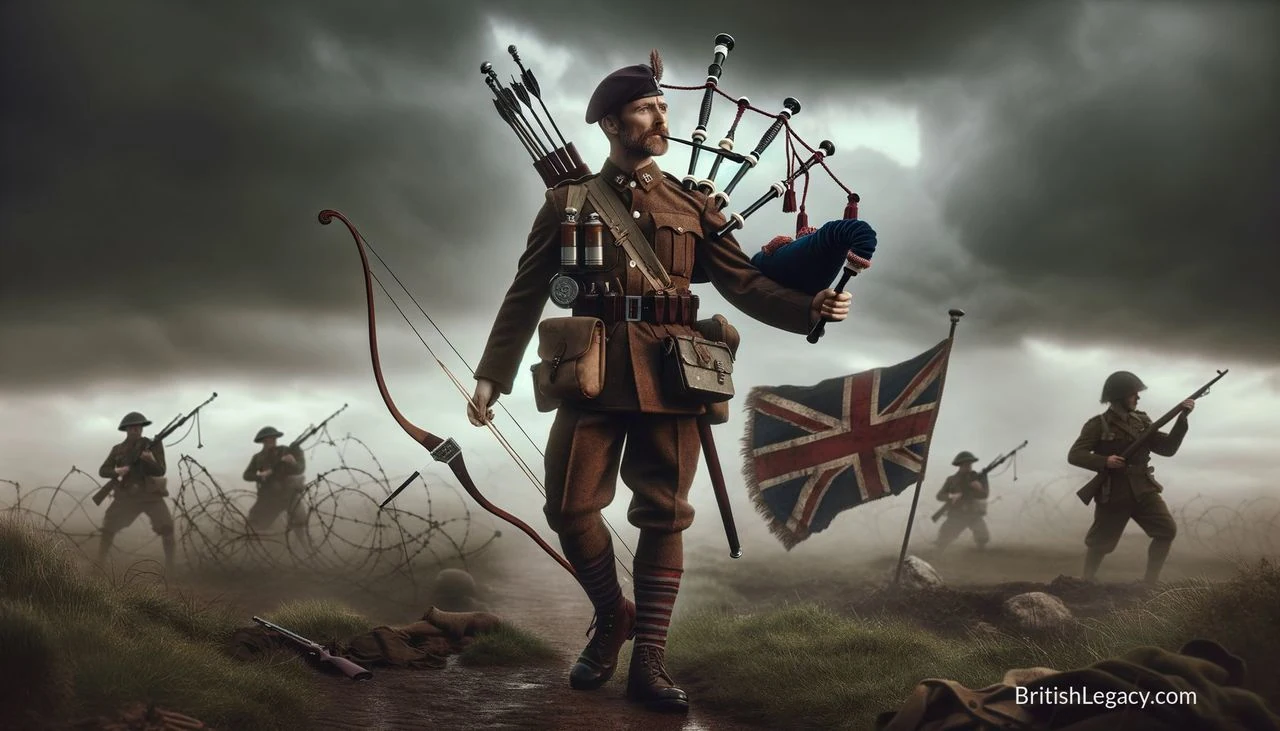
John Malcolm Thorpe Fleming Churchill became one of the Second World War’s most distinctive British officers by carrying weapons and instruments associated with older forms of warfare into modern campaigns. Known as “Mad Jack” and “Fighting Jack”, he served with the Commandos in Norway, Italy and Yugoslavia. The familiar image of Churchill advancing with a broadsword and playing the bagpipes has a factual basis, but some of the most repeated stories about his wartime exploits require care: his own account, for example, did not support the claim that he killed a German soldier with a longbow in France.
From Ceylon to the Manchester Regiment
Churchill was born in Colombo, then in British Ceylon, on 16 September 1906. His father, Alec Fleming Churchill, worked in the Ceylon Civil Service and later became Director of Public Works in Hong Kong. The family moved to Hong Kong in 1910 and returned to England in 1917. Churchill attended King William’s College on the Isle of Man before graduating from the Royal Military College, Sandhurst, in 1926. He was commissioned into the Manchester Regiment and served in Burma.
He left the Army in 1936 and worked in Nairobi as a newspaper editor and model. His interests extended beyond military service: he placed second in a piping competition at the Aldershot Tattoo in 1938, and represented Great Britain at the World Archery Championships in Oslo the following year, finishing 26th. His archery also brought him a small part in the 1940 film The Thief of Bagdad.
After Germany invaded Poland in 1939, Churchill resumed his commission and joined the British Expeditionary Force in France. A story that he killed a German soldier with a longbow has often been attached to his service there. Churchill later said that a lorry had crushed his bows earlier in the campaign, so the episode should not be repeated as established fact. He fought at Dunkirk and then volunteered for the Commandos.
Bagpipes at Vågsøy
Churchill’s wartime equipment included a Scottish broadsword, a longbow and arrows, and bagpipes. These were not simply props for a public image: he carried them on operations, though the account of each action matters more than the legend built around them. In December 1941, he was second in command of No. 3 Commando during Operation Archery, the raid on the German garrison at Vågsøy, Norway.
As the landing craft ramps fell, Churchill and the commandos moved forward. He played “March of the Cameron Men” on his bagpipes as they went ashore. The force overran the garrison in less than ten minutes, killing or capturing the enemy soldiers they encountered. The episode explains why his pipes became inseparable from accounts of his military service, without needing to turn the raid into a fable of solitary heroics.
In July 1943, Churchill commanded No. 2 Commando in Sicily and led men from their landing site at Catania. Their orders took them towards a German observation post near Molina, controlling a pass leading down to the Salerno beachhead. With a corporal, Churchill infiltrated the town and captured the post, taking 42 prisoners, including a mortar squad. He led the prisoners and his men back down the pass; German prisoners pushed carts carrying the wounded. Churchill called the scene “an image from the Napoleonic Wars”. He was appointed a Companion of the Distinguished Service Order for the action at Salerno.
His sword was lost in hand-to-hand fighting, and he later returned to retrieve it. On the way he encountered an American patrol moving towards enemy lines. When the patrol’s non-commissioned officer would not turn back, Churchill continued on his own, saying he would not come back for a “bloody third time”. The incident offers a glimpse of his forceful manner, as well as the confusion that could accompany operations in the field.
Capture in Yugoslavia
In 1944, Churchill took part in the Maclean Mission in Yugoslavia, where British commandos supported Josip Broz Tito’s Partisans. In May he led an operation against the German-held island of Brač. The force included Partisans, 43 Commando and a troop from 40 Commando. The landing met no resistance, but the Partisans postponed the attack after seeing the German positions. Churchill’s pipes signalled the commandos who remained ready to fight.
After an RAF Spitfire strafed the area, Churchill decided to withdraw for the night and renew the attack the next morning. The planned assault then broke down: the Partisans stayed at the landing area, and only Churchill and six others reached the objective. A mortar shell killed or wounded the others. Churchill was playing “Will Ye No Come Back Again?” as German troops advanced; grenades knocked him unconscious, and he was captured.
German intelligence had him flown to Berlin for interrogation, believing he might be related to Winston Churchill. He was not. In late April 1945, he was among about 140 prominent concentration-camp inmates transferred to Tyrol under SS guard. A German Army unit intervened after prisoners told senior officers that they feared execution. The SS guards withdrew, leaving the prisoners behind. This account differs materially from the often-repeated story that Churchill escaped from Sachsenhausen and was recaptured: he was captured in Yugoslavia, and the documented account describes his later transfer and release from SS custody in Tyrol.
Service after the war
Churchill was posted to British Palestine in 1948. There he helped defend a train convoy against a force of 250 men with just 12, and later helped coordinate the evacuation from Hadassah Hospital in Jerusalem. His service therefore extended beyond the better-known Commando operations of the Second World War.
He retired from the Army in 1959. In civilian life he enjoyed sailing coal-fired ships on the Thames between Richmond and Oxford, and making radio-controlled model warships. He died in Chertsey, Surrey, on 8 March 1996, aged 89. His life was also commemorated in a 2014 book by the Royal Norwegian Explorers Club, which named him among what it described as the finest explorers and adventurers of all time.
Why John “Mad Jack” Churchill deserves a place in British Legacy
Churchill’s place in British history rests on more than the striking contrast between his traditional weapons and the machinery of twentieth-century war. His record includes command and operational service: at Vågsøy he served as second in command of No. 3 Commando; in Sicily he led No. 2 Commando in the capture of an observation post and 42 prisoners; and in Yugoslavia he led men in an operation supporting Tito’s Partisans. The Distinguished Service Order awarded for his leadership at Salerno recognises an achievement grounded in those actions, rather than in the romantic image alone.
His story also connects Britain’s military institutions and overseas history. Born in British Ceylon, educated on the Isle of Man and at Sandhurst, he served in the Manchester Regiment, the Commandos and later in British Palestine. His pipes, archery and broadsword made him memorable, but the fuller chronology includes the difficult realities of war: a failed assault, capture, interrogation and transfer among prisoners held under SS guard. Keeping those details alongside the better-known image makes his legacy more accurate and more human. Churchill deserves a place in British Legacy as an unusual British Army officer whose documented service was substantial, and whose story shows why historical courage should be described with both colour and precision.
Sources
Adapted in part from Jack Churchill by Wikipedia contributors, under CC BY-SA 4.0. Text has been edited and combined with the existing article; this adapted text is shared under the same licence. Contributor history.