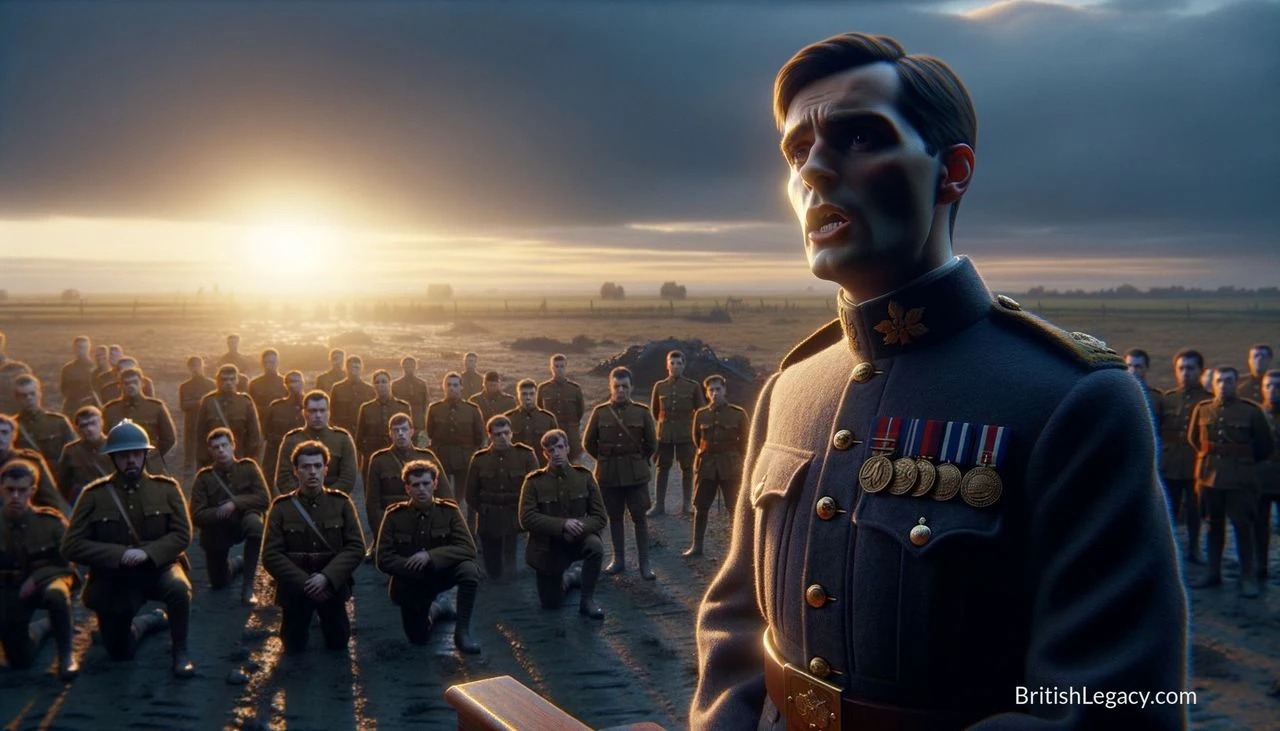
On 19 March 2003, in Kuwait, Lieutenant Colonel Tim Collins addressed the soldiers of the 1st Battalion, Royal Irish Regiment, before they entered Iraq. His speech did not disguise the violence ahead. It warned that some would die, demanded ferocity against those who chose to fight and insisted on restraint towards civilians, casualties and prisoners. One instruction became its enduring refrain: “If you are ferocious in battle remember to be magnanimous in victory.”
The address was extemporised and recorded in shorthand by journalist Sarah Oliver; Collins later said that no recording or film existed. Its memorable lines have often stood apart from the military career and difficult realities of the Iraq War that gave them context. Collins’s life also includes service in other conflicts, work after leaving the Army and a later, unsuccessful attempt to enter Parliament.
From Belfast to the British Army
Timothy Thomas Cyril Collins was born in Belfast on 30 April 1960 and grew up there during the Troubles. He attended the Royal Belfast Academical Institution and then Queen’s University Belfast, where he studied economics. After graduating, he went to the Royal Military Academy Sandhurst and was commissioned into the Royal Signals as a second lieutenant in October 1981.
His early service took him through several regiments. He transferred to the Royal Irish Rangers in 1982, became a captain in 1985 and passed selection for the Special Air Service in 1988. He served two operational tours with the SAS and a further tour at its headquarters. He was promoted to major in 1992 and lieutenant colonel in 1999. In 2001, he became commanding officer of the 1st Battalion, Royal Irish Regiment.
Collins received the Queen’s Commendation for Valuable Service for a tour in Northern Ireland between October 2001 and March 2002. His next prominent command was in Iraq. He was promoted to colonel and moved to the General Staff in June 2003; in October that year he was appointed an Officer of the Order of the British Empire for his service in Iraq. He was invested in April 2004.
The address in Kuwait
Collins spoke to his battalion on Wednesday 19 March 2003, as it prepared to cross into Iraq. The speech set out the purpose he wanted the soldiers to follow: “We go to Iraq to liberate not to conquer.” He told them not to fly British flags and to respect the people they would encounter. His appeal to restraint was not a denial of combat. He told soldiers to be ready to fight, while stressing that victory did not excuse cruelty or contempt.
His instructions were concrete. He spoke of the country’s history and the hospitality Iraqis might offer despite poverty, telling the troops to “tread lightly” and not to treat people as refugees in their own country. He asked them to give the dead dignity, bury them properly and mark their graves. If an enemy surrendered, he said, the soldier had a right under international law to do so and should one day be able to return to his family. Collins also warned that taking a human life was not to be done lightly.
The speech contained both compassion and menace. Collins told his soldiers that some might not survive the campaign and said he intended to bring everyone home, while acknowledging that he might fail. He threatened the destruction of enemy forces and told his men to show them no pity. The address was therefore more than a polished appeal to humanitarian conduct: it held the prospect of lethal violence alongside rules for the way that violence should be exercised.
Its words reached a much wider audience than the battalion. The speech was widely reported, and United States President George W. Bush later had a copy displayed in the White House’s Oval Office. The “Mark of Cain” line also inspired the title of the 2007 Film4 drama The Mark of Cain. Collins disavowed the film after its planned broadcast date coincided with the 2007 seizure of Royal Navy personnel by Iran. Kenneth Branagh performed a version of the address in the final episode of the 2008 television series 10 Days to War.
After military service
Collins left the British Army on 5 August 2004. He later presented the BBC Northern Ireland documentary series Ships That Changed the World and appeared in the BBC’s 2011 Panorama programme Forgotten Heroes. For that programme, he met veterans struggling with civilian life and slept rough in Brighton with a former soldier. He also wrote Rules of Engagement, published in 2006.
His public comments on military affairs were not limited to his celebrated speech. In a 2008 interview on the BBC’s Today programme, he said that the Army had already been undermanned for its commitments when he left in 2004. He later criticised the Iraq War, saying that British and American forces had poured blood and treasure into overseas campaigns that seemed to lack an end or goal, and that he had been naïve.
Collins subsequently became chairman of Horus Global, a specialist security company he co-founded. He also entered electoral politics. In 2024, he stood for the Ulster Unionist Party in North Down at the United Kingdom general election, finishing third with 15.6 per cent of the vote. His speech made him a prominent public figure, but this later work and political activity show a career that did not end with the Iraq campaign.
Why Tim Collins deserves a place in British Legacy
Collins’s place in British Legacy rests most clearly on the address he gave as a serving British Army officer to the 1st Battalion, Royal Irish Regiment, before it entered Iraq. Its historical importance is not simply that it produced memorable quotations. Collins spoke to soldiers facing combat and addressed the obligations that could not be set aside once fighting began: respect for civilians, humane treatment of the dead and recognition of a surrendering enemy’s right under international law. Those instructions give the speech a specific value as an account of military leadership under pressure.
The speech also deserves to be remembered in its full tension. It urged restraint and dignity, but also prepared troops for lethal force and described the destruction of enemy forces. Treating it as a frictionless statement of national virtue would obscure what Collins actually said. Its continuing public life—in press coverage, a film title and a television dramatisation—shows how a battlefield address can enter wider British culture, while his later criticism of the Iraq campaign complicates any simple portrait of an unchanging public hero. Alongside that legacy, his service in the Army, work on military and veterans’ issues, writing and later public career make Collins a subject through whom British readers can consider both the authority of military leadership and the responsibilities that accompany it.
Sources
Tim Collins (British Army officer), revision 1379819878 · Tim Collins (British Army officer)
Adapted in part from Tim Collins (British Army officer) by Wikipedia contributors, under CC BY-SA 4.0. Text has been edited and combined with the existing article; this adapted text is shared under the same licence. Contributor history.