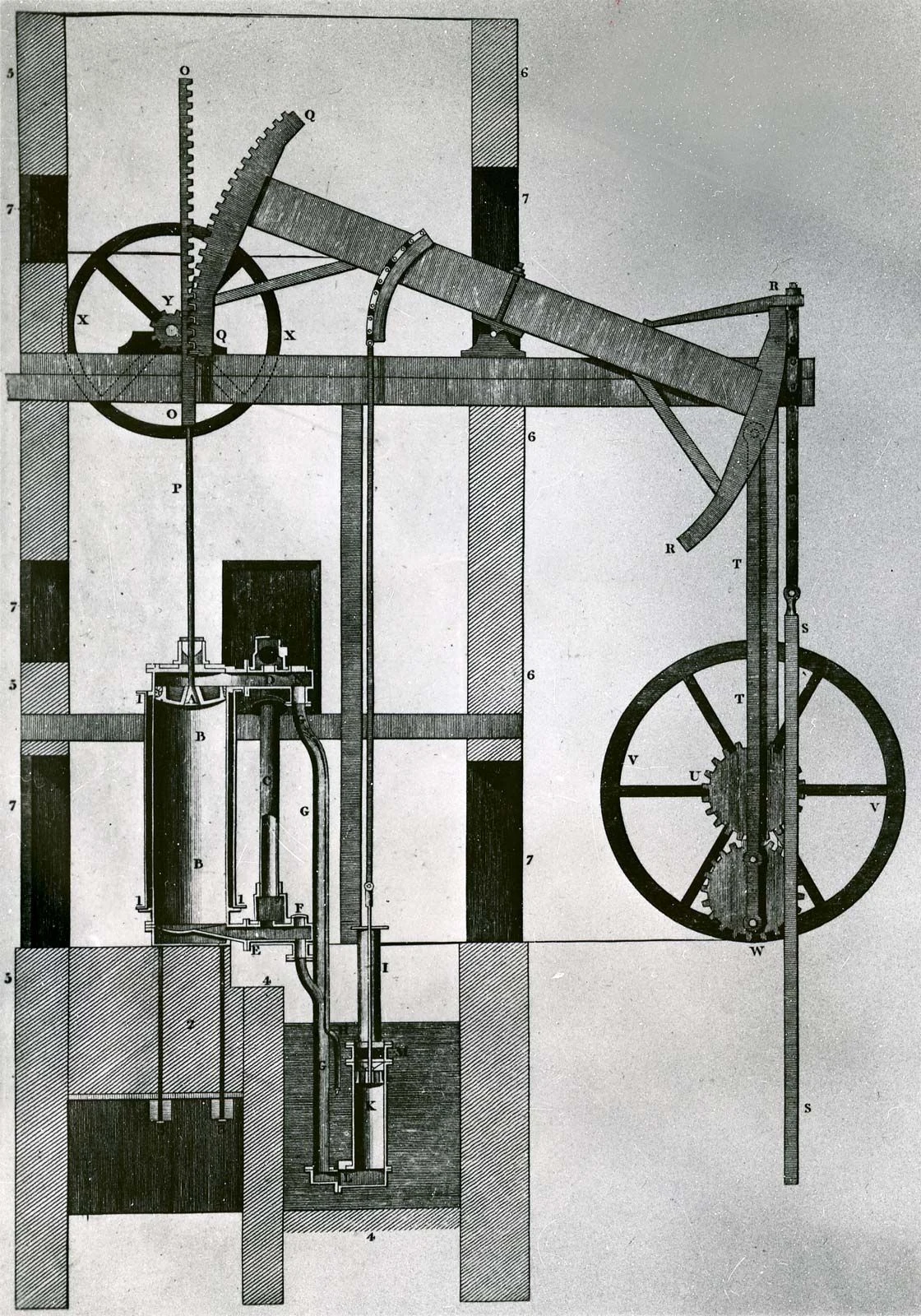
Before steam engines could drive machinery in factories, they had to solve a more immediate problem: how to lift water out of mines. Thomas Newcomen’s atmospheric engine, developed around 1712, used steam and atmospheric pressure to operate a pump. It was neither fuel-efficient nor the last word in steam engineering. But it worked, spread through important mining districts and gave later engineers a practical machine to improve.
An ironmonger in Dartmouth
Newcomen was born in Dartmouth, Devon, in February 1664, into a merchant family. He worked as an ironmonger, designing, making and selling tools for the mining trade. His business placed him close to the practical difficulties miners faced, particularly the persistent problem of water collecting underground. Newcomen also had a religious life: he was a lay preacher and teaching elder in a local Baptist church, and after 1710 became pastor of a local Baptist group.
His work on pumping drew on ideas already in circulation. Thomas Savery had devised a steam-powered “fire engine” that used condensation to create a vacuum and draw water from a mine sump. But its reach was limited: it could not pump effectively from beyond around 30 feet. Newcomen’s achievement was not to begin the story of steam pumping from nothing, but to develop a different arrangement capable of driving a mine pump through a piston and beam.
How the atmospheric engine worked
Newcomen and his partner John Calley developed their engine around 1712. In its working cycle, steam entered a cylinder containing a piston. When the steam was condensed, the resulting vacuum allowed atmospheric pressure to push the piston down. The piston moved a large beam, which in turn operated a pump at the bottom of the mine. As the cylinder was filled with steam again, the machinery’s weight helped draw water into the pump, ready to be forced up a pipe to the surface.
The first successful engine of this type was built at the Conygree Coalworks at Tipton, in the West Midlands. It was a substantial, beam-driven machine, designed to do one job: raise water from workings that would otherwise be difficult to drain. The account of its development connects Newcomen’s engineering with the experience of miners and tradesmen, rather than presenting the engine as an isolated flash of inspiration. Its purpose was practical, and its value lay in doing work that existing methods could not manage at the same depth and scale.
Newcomen’s engine was often called an atmospheric engine because atmospheric pressure supplied the force on the piston. It was also far from efficient. Condensing steam inside the cylinder repeatedly cooled it, wasting heat each time the cycle began again. Where cheap, unsaleable small coal was available, as at some collieries, this was less of a disadvantage. In places such as Cornwall, where fuel was dearer, the cost mattered much more.
From a mine-pumping solution to a widely used machine
By 1733, about 125 Newcomen engines had been installed under the terms of Savery’s patent, which had been extended until that year. They were used in mining districts in Britain and on the Continent: draining coal mines in the Black Country, Warwickshire and near Newcastle upon Tyne; tin and copper mines in Cornwall; and lead mines in Flintshire and Derbyshire. The engine remained in use without major change for roughly 75 years, spreading gradually to further parts of Britain and mainland Europe.
The scale of that use is a more reliable measure of its importance than the claim that it single-handedly began the Industrial Revolution. Newcomen’s machine addressed a recurring industrial constraint and became a workable option in many mining areas. Its reach depended on practical engineering, available materials and local fuel costs. It was not well suited to every setting, and its design continued to evolve in use.
At first, engine cylinders were made of brass, an expensive material that limited their size. Iron casting techniques developed by the Coalbrookdale Company in the 1720s made larger cylinders possible. By the 1760s, cylinders could reach about six feet in diameter. Engineers also refined the machinery’s construction. John Smeaton built large Newcomen-type engines in the early 1770s, and his improvements were rapidly adopted. By 1775, about 600 Newcomen engines had been built, although many had already worn out, been abandoned or been replaced.
Watt’s improvements and the engine’s afterlife
James Watt’s separate condenser addressed one of the atmospheric engine’s central weaknesses. By condensing steam in a separate chamber rather than cooling the working cylinder, Watt’s design used fuel more efficiently. It gradually displaced Newcomen engines in places where fuel was expensive, particularly Cornwall. Watt and his partner Matthew Boulton were able to charge royalties based on the fuel their engines saved.
That change did not instantly make Newcomen’s machine obsolete. Newcomen engines were cheaper and less complicated, and they remained useful where fuel economy mattered less. Many continued to be built during the life of Watt’s patent, which lasted until 1800; the source account estimates that of more than 2,200 engines built in the eighteenth century, about 450 were Watt engines. Elements of Watt’s design, including the separate condenser, were also added to some Newcomen-type engines. Later, flywheels and improved engineering helped address the uneven motion caused by a single power stroke, allowing steam engines to drive machinery in settings including mills.
The engine’s significance, then, lies in both its early practical success and its place in a longer sequence of changes. It provided a useful solution to mine drainage, prompted refinements in design and materials, and remained in service alongside newer engines. The later history of steam power was not a simple replacement of one inventor’s machine by another’s, but an accumulation of improvements and adaptations.
Engines remembered in museums and collections
Newcomen-style engines survive in collections including the Science Museum in London and the Ford Museum in Dearborn, Michigan. A Newcomen engine at Hawkesbury Junction in Warwickshire was transferred to Dartmouth in 1964. The Newcomen Memorial Engine there, dating from about 1725, can be seen moving, though it is operated hydraulically rather than by its original steam boiler. Its surviving parts include later additions as well as the original engine.
At the Black Country Living Museum in Dudley, a working modern replica gives visitors another way to see the beam-and-pump arrangement in motion. The Elsecar Heritage Centre in South Yorkshire preserves a Newcomen-style engine described as the last of its kind to be used commercially and the last remaining on its original site. It was restored to working condition between 2012 and 2015 and unveiled in May 2016. These examples make the technology’s physical scale and operating principle more tangible than a written description alone.
Newcomen died at the house of his Baptist contact Edward Wallin in London on 5 August 1729. He was buried at Bunhill Fields, though the exact location of his grave is unknown. In 2012, the Royal Mail included his atmospheric steam engine on a stamp in its “Britons of Distinction” series.
Why Thomas Newcomen deserves a place in British Legacy
Thomas Newcomen’s place in British history rests on a specific engineering achievement: he developed an atmospheric engine that could pump water from mines more effectively than the earlier steam-pumping arrangement described in the historical account. Its beam, piston and pump turned steam condensation into useful work. The engine was not efficient by later standards, but it was practical enough to be adopted across mining districts in Britain and on the Continent. That combination of a defined industrial problem and a workable mechanical response is more revealing than broad claims that one invention created modern industry by itself.
His legacy also shows how engineering advances accumulate. Newcomen’s machines were adapted, enlarged and improved; Smeaton refined their construction, and Watt’s separate condenser addressed a major source of wasted heat. Newcomen engines continued to be built and used alongside later designs, in part because they were comparatively simple and inexpensive. The surviving examples in Dartmouth, Dudley and Elsecar connect this history to places where people can still see the machinery’s form and scale. Remembering Newcomen in British Legacy means recognising both the reach of his practical invention and the continuing work of engineers who developed what came after it.
Sources
Thomas Newcomen (revision 1370063093) · Thomas Newcomen
Adapted in part from Thomas Newcomen by Wikipedia contributors, under CC BY-SA 4.0. Text has been edited and combined with the existing article; this adapted text is shared under the same licence. Contributor history.