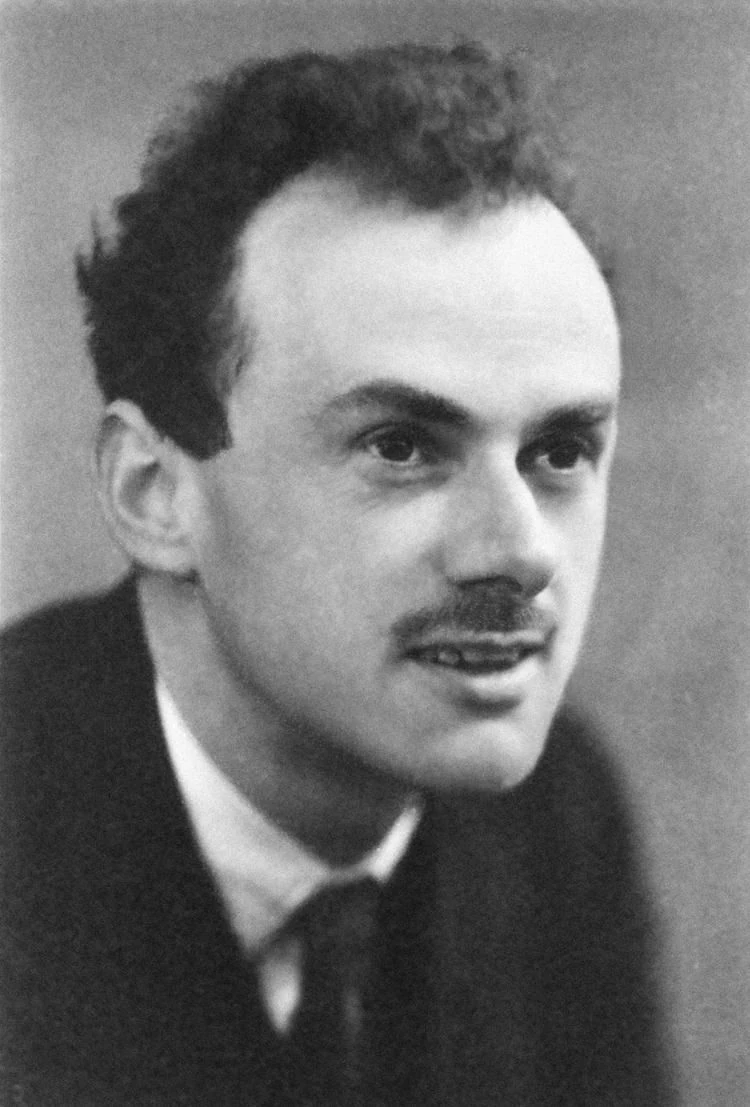
In 1928, Paul Dirac joined quantum mechanics to special relativity in an equation for the electron. Its mathematics pointed to something not then known to exist: an antiparticle. The positron was observed four years later. This result became the best-known part of a career that also helped establish quantum electrodynamics, advanced the mathematical framework of quantum mechanics and gave theoretical physics tools still in use.
A Bristol education, then Cambridge
Paul Adrien Maurice Dirac was born in Bristol on 8 August 1902. His father, Charles, was a French teacher who had emigrated from Saint-Maurice in Switzerland; his mother, Florence, came from a Cornish Methodist family. Dirac attended Bishop Road Primary School and the Merchant Venturers’ Technical College, where the emphasis on technical subjects was unusual for the period. He later credited that education with giving him a useful practical foundation.
At the University of Bristol he studied electrical engineering, graduating with first-class honours in 1921. The post-war depression made it difficult to find engineering work. He therefore continued at Bristol, taking a mathematics degree and graduating in 1923. His interests included projective geometry and relativity. He then went to St John’s College, Cambridge, where he pursued theoretical physics under the supervision of Ralph Fowler. Dirac completed his doctorate in 1926 with a thesis on quantum mechanics, the first doctoral thesis on the subject to be submitted anywhere.
His route into quantum theory began with a paper by Werner Heisenberg that Fowler asked him to study. Dirac recognised that a mathematical structure in Heisenberg’s work resembled the Poisson brackets of classical mechanics. From that connection he developed a new formulation using non-commuting variables and what became known as Dirac brackets. It offered a general way to express the rules of quantum mechanics and helped establish the mathematical language he would use throughout his career.
The equation and its consequences
Dirac’s 1928 equation described the electron in a way consistent with both quantum mechanics and special relativity. It accounted for the electron’s spin and implied the existence of a corresponding antiparticle. Dirac initially interpreted the result through a model known as the Dirac sea; the positron’s discovery by Carl Anderson in 1932 supplied experimental evidence for antimatter. The equation became a landmark because it did more than describe known behaviour: its mathematical structure led to a prediction that could be tested.
Dirac also helped develop quantum electrodynamics, the theory describing interactions between light and matter, and was the first to use that name. His work included a quantum account of radiation in which light quanta could be emitted and absorbed. He introduced the idea of vacuum polarisation and contributed to the theoretical foundations later developed by other physicists. He did not accept the renormalisation methods that made the theory produce highly accurate experimental results, arguing that the treatment of infinities was mathematically unsatisfactory. His reservations did not prevent later physicists from making quantum electrodynamics one of the most successful theories in physics.
Other contributions ranged across the field. With Enrico Fermi, Dirac developed the statistical description of identical particles with half-integer spin, now called Fermi–Dirac statistics. His work on the quantum mechanics of radiation and on the general structure of quantum theory influenced later research in particle and field physics. In 1931, he proposed that a magnetic monopole—a particle with a single magnetic pole—could explain why electric charge appears in discrete amounts. No monopole has been detected.
Dirac’s book The Principles of Quantum Mechanics, published in 1930, brought together the emerging subject in a unified mathematical treatment. It became a standard text and introduced the delta function in this context. Later editions helped popularise bra–ket notation, a compact way of writing quantum states and operations. His preference for mathematical clarity was not merely a matter of style: mathematical structure was central to how he formulated and judged physical theories.
Cambridge, wartime work and recognition
In 1932, Dirac became Lucasian Professor of Mathematics at the University of Cambridge, a post he held until 1969. Among his students were Homi J. Bhabha, Fred Hoyle, John Polkinghorne and Freeman Dyson. His reach as a teacher is also reflected in Subrahmanyan Chandrasekhar’s account of attending Dirac’s quantum mechanics course repeatedly. In 1933, Dirac shared the Nobel Prize in Physics with Erwin Schrödinger for the discovery of new productive forms of atomic theory.
During the Second World War, Dirac contributed to Tube Alloys, Britain’s programme for research into atomic bombs. His theoretical work addressed uranium enrichment by gas centrifuge, and he introduced the separative work unit in 1941. This practical wartime application sat alongside his more abstract work, but the two drew on the same mathematical approach to physical problems.
Dirac continued to work on gravitation and cosmology, including the quantisation of the gravitational field and his large numbers hypothesis. In the late 1950s he applied Hamiltonian methods to general relativity. He remained committed to fundamental questions about the foundations of quantum theory, publishing criticism of its accepted methods late in life. After retiring from Cambridge in 1969, he moved to Florida and joined Florida State University, where he continued to teach and publish. He died in Tallahassee on 20 October 1984, aged 82.
A lasting scientific presence
Dirac received the Royal Medal in 1939 and the Copley Medal in 1952, as well as the Max Planck Medal that year. His honours reflect work extending well beyond the equation most associated with his name. His formulations helped give quantum mechanics a systematic mathematical basis; his contributions to quantum electrodynamics and particle statistics became part of the language physicists use to describe matter and radiation.
His name remains attached to concepts and tools including the Dirac equation, Dirac delta function, Dirac operator and Dirac notation. The Institute of Physics awards the Paul Dirac Medal for outstanding contributions to theoretical physics, and the International Centre for Theoretical Physics established an annual Dirac Medal. In Bristol, a blue plaque marks his childhood home, while a commemorative marker at Westminster Abbey bears the equation. These memorials join a wider scientific legacy: the ideas are remembered not only in awards and names, but in their continuing place in the study of nature.
Why Paul Dirac deserves a place in British Legacy
Dirac’s place in British Legacy rests on a clearly evidenced connection: he was born and educated in Bristol, completed his early degrees at the University of Bristol, and spent nearly four decades as Lucasian Professor at Cambridge. Those institutions formed the setting for work that changed the development of physics. His 1928 equation connected quantum mechanics with special relativity and predicted antimatter; the later discovery of the positron showed how mathematical theory could reveal a physical possibility before experiment did. His work on quantum mechanics, quantum electrodynamics and particle statistics also gave later researchers frameworks for describing fundamental interactions and the behaviour of matter.
His influence was not confined to original research. The Principles of Quantum Mechanics helped generations of physicists learn a new subject, while students he taught went on to make substantial contributions of their own. During the Second World War, his theoretical skill also served British research into uranium enrichment. The Bristol plaque, Westminster Abbey marker and medals named for him show how his achievements have been commemorated, but the strongest evidence of his legacy lies in the continuing use of the concepts and mathematical tools associated with his name. Dirac’s story therefore links British education and scholarship to an international body of scientific work, without reducing that contribution to a general claim about national character.
Sources
Paul Dirac — Wikipedia, revision 1372471093
Adapted in part from Paul Dirac by Wikipedia contributors, under CC BY-SA 4.0. Text has been edited and combined with the existing article; this adapted text is shared under the same licence. Contributor history.