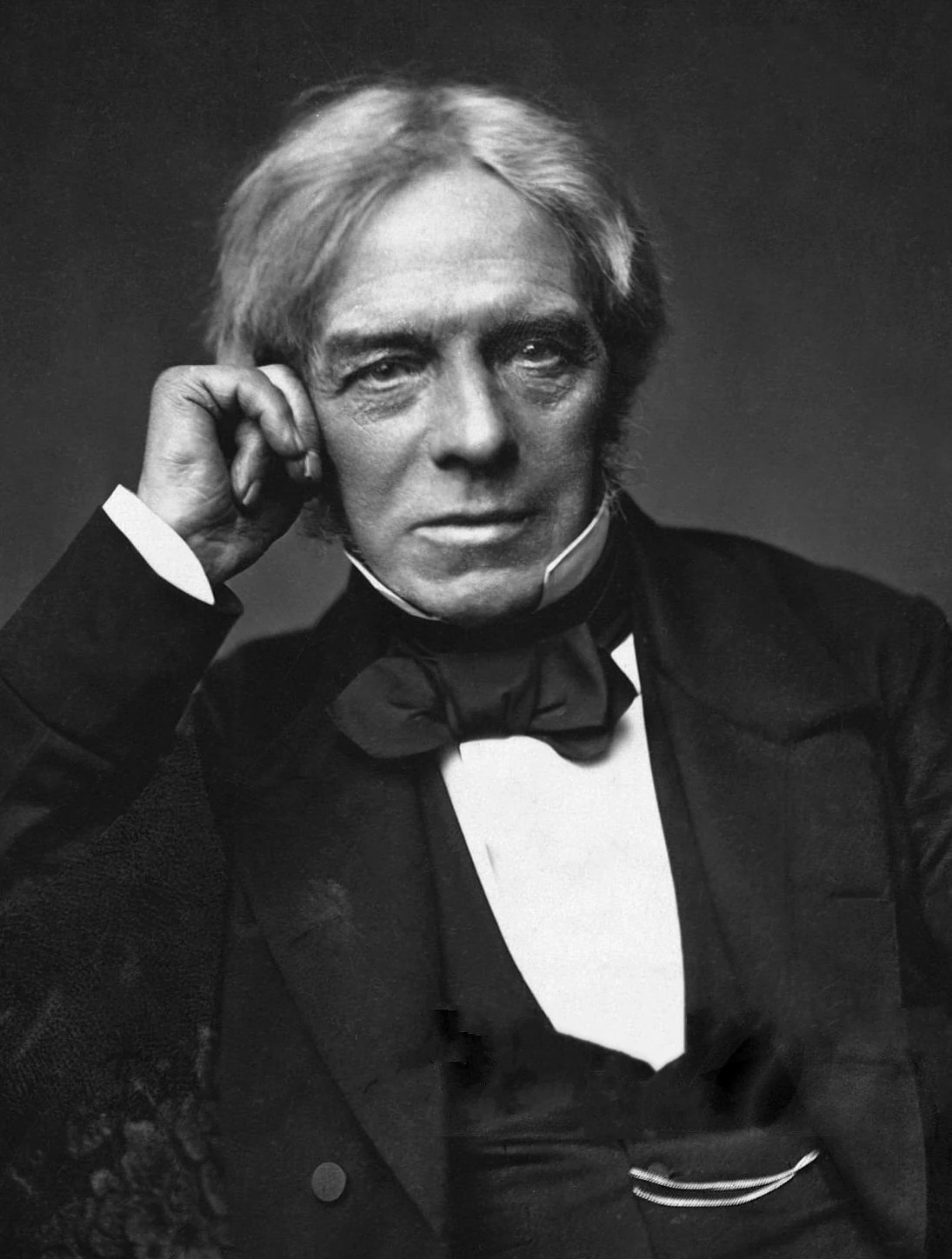
Michael Faraday began his working life as a bookbinder’s apprentice and became one of the nineteenth century’s most influential experimental scientists. At the Royal Institution in London, he investigated the relationship between electricity and magnetism, discovered electromagnetic induction and developed the laws of electrolysis. His experiments helped make electricity practical; his lectures brought scientific ideas to audiences beyond the laboratory.
A bookbinder’s education
Faraday was born on 22 September 1791 in Newington Butts, Surrey, now part of the London Borough of Southwark. His family had limited means, and he received only basic schooling. At 14, he became an apprentice to George Riebau, a bookbinder and bookseller in Blandford Street. Reading during his seven-year apprenticeship, including works on chemistry and the improvement of the mind, helped him build an education for himself.
He also sought out scientific discussion. Faraday attended lectures at the City Philosophical Society and, in 1812, heard Humphry Davy speak at the Royal Institution and the Royal Society. He sent Davy a book of notes he had made from the lectures. The following year, after Davy injured his eyesight in a chemical accident, he hired Faraday as an assistant at the Royal Institution. The appointment brought Faraday into experimental chemistry and into an institution that would remain central to his working life.
Faraday’s route into science did not follow the conventional path of formal training. He became known for careful experiments and clear explanations, rather than advanced mathematics. He was elected a Fellow of the Royal Society in 1824 and became director of the Royal Institution’s laboratory in 1825. In 1833, he took up the post of Fullerian Professor of Chemistry, which he held for life.
Making electricity move
Faraday’s best-known work grew from questions about how electricity and magnetism interact. In 1821 he built devices that produced continuous electromagnetic rotation. One, now called the homopolar motor, used a current-carrying wire and a magnet to create circular motion. These experiments helped establish the foundations of electromagnetic technology and electric motors.
A decade later, Faraday investigated whether magnetism could produce electricity. In 1831, he wrapped two insulated coils around an iron ring. When current passed through one coil, a momentary current appeared in the other. He also showed that moving a magnet through a loop of wire, or moving the loop over a stationary magnet, produced a current. The central finding was that a changing magnetic field could induce an electric current.
This phenomenon, electromagnetic induction, underlies electric generators and transformers. Faraday used the principle to construct an early electric dynamo, a forerunner of modern power generators. James Clerk Maxwell later expressed Faraday’s findings mathematically in his account of electromagnetic fields. The widespread use of electricity came later, but Faraday’s experiments supplied a crucial scientific foundation for generating it by mechanical means.
His investigations reached beyond induction. In 1845 he found that a magnetic field could rotate the plane of polarisation of light, an effect now known as the Faraday effect. He also identified diamagnetism: the weak repulsion of some materials by a magnetic field. These findings showed that magnetism could affect both matter and light, revealing connections between phenomena often considered separately.
Chemistry, charge and public service
Faraday’s chemistry was as extensive as his work on electricity. He discovered benzene, liquefied gases and investigated compounds of chlorine and carbon. His laws of electrolysis relate the quantity of a substance deposited or dissolved at an electrode to the electric charge passed through an electrolyte. He also helped establish the language used in the field: terms such as electrode, ion, anode and cathode were popularised through his work, with several proposed by William Whewell.
His investigations of electrical charge included the ice-pail experiment of 1843. Faraday demonstrated that charge on a conductor resides on its exterior and that the resulting shielding protects the interior from external electrostatic influence. This principle is associated with the Faraday cage. In 1836, he demonstrated the shielding effect by entering an electrified enclosure and showing that he was protected inside it.
Faraday’s work also served public and industrial needs. He investigated lighthouse lighting and the corrosion of ships’ bottoms, and helped prepare optical glass for lighthouse use. With the geologist Charles Lyell, he examined a colliery explosion at Haswell, County Durham, in which 95 miners died. Their report identified coal dust as a factor that intensified the explosion and demonstrated how ventilation could help prevent such disasters.
He investigated industrial pollution at Swansea and air pollution at the Royal Mint. In 1855 he wrote to The Times about the foul condition of the River Thames. These projects show how Faraday applied experimental attention to infrastructure, public safety and environmental problems as well as to questions in the laboratory.
A lecturer for the public
Faraday’s influence also travelled through his teaching. He founded the Royal Institution’s Friday Evening Discourses in 1825 and, between 1827 and 1860, delivered 19 Christmas lecture series for young people. Demonstrations made difficult ideas visible, inviting audiences to observe and think through experiments rather than depend on technical language alone. The lectures helped establish public science as a continuing part of the Royal Institution’s work.
Faraday valued direct experience of experiments. He declined an offer to publish his lectures, preferring that readers recreate the demonstrations for themselves. His visual, experimental approach also gave other scientists material to develop: Maxwell later translated Faraday’s ideas about lines of force into mathematical form, helping to shape the theory of electromagnetism.
Faraday’s scientific standing brought honours, but he refused a knighthood and twice declined the presidency of the Royal Society. He married Sarah Barnard in 1821. In later life, he lived at Hampton Court in a grace-and-favour house awarded in 1848. He died there on 25 August 1867, aged 75, and was buried in the non-Anglican section of Highgate Cemetery.
Why Michael Faraday deserves a place in British Legacy
Faraday’s British legacy rests on discoveries that connected patient laboratory work with technologies that changed how electricity could be produced and used. Electromagnetic induction provided the principle behind generators and transformers; his early electromagnetic devices helped establish the foundations of electric motors. His laws of electrolysis clarified the relationship between electric charge and chemical change, while his investigations of magnetism and light revealed further connections between physical forces. These discoveries became part of the scientific basis for power generation and distribution, technologies whose effects extend far beyond the laboratory in which Faraday studied them.
That reach gives substance to the wider influence often associated with his name: electric lights and motors, and the systems that carry electrical signals, depend on the broader development of electrical technology to which his work contributed. Faraday’s own contribution was experimental rather than a claim to have created every later application. He also made science part of public life through the Royal Institution’s Friday Evening Discourses and Christmas lectures, and applied his expertise to lighthouses, ship corrosion, mine safety and pollution. His career joined original research to public explanation and practical service. That combination, built through a British scientific institution and grounded in work with lasting technical and social consequences, makes Michael Faraday a fitting subject for British Legacy.
Sources
Michael Faraday (revision 1377565269)
Adapted in part from Michael Faraday by Wikipedia contributors, under CC BY-SA 4.0. Text has been edited and combined with the existing article; this adapted text is shared under the same licence. Contributor history.