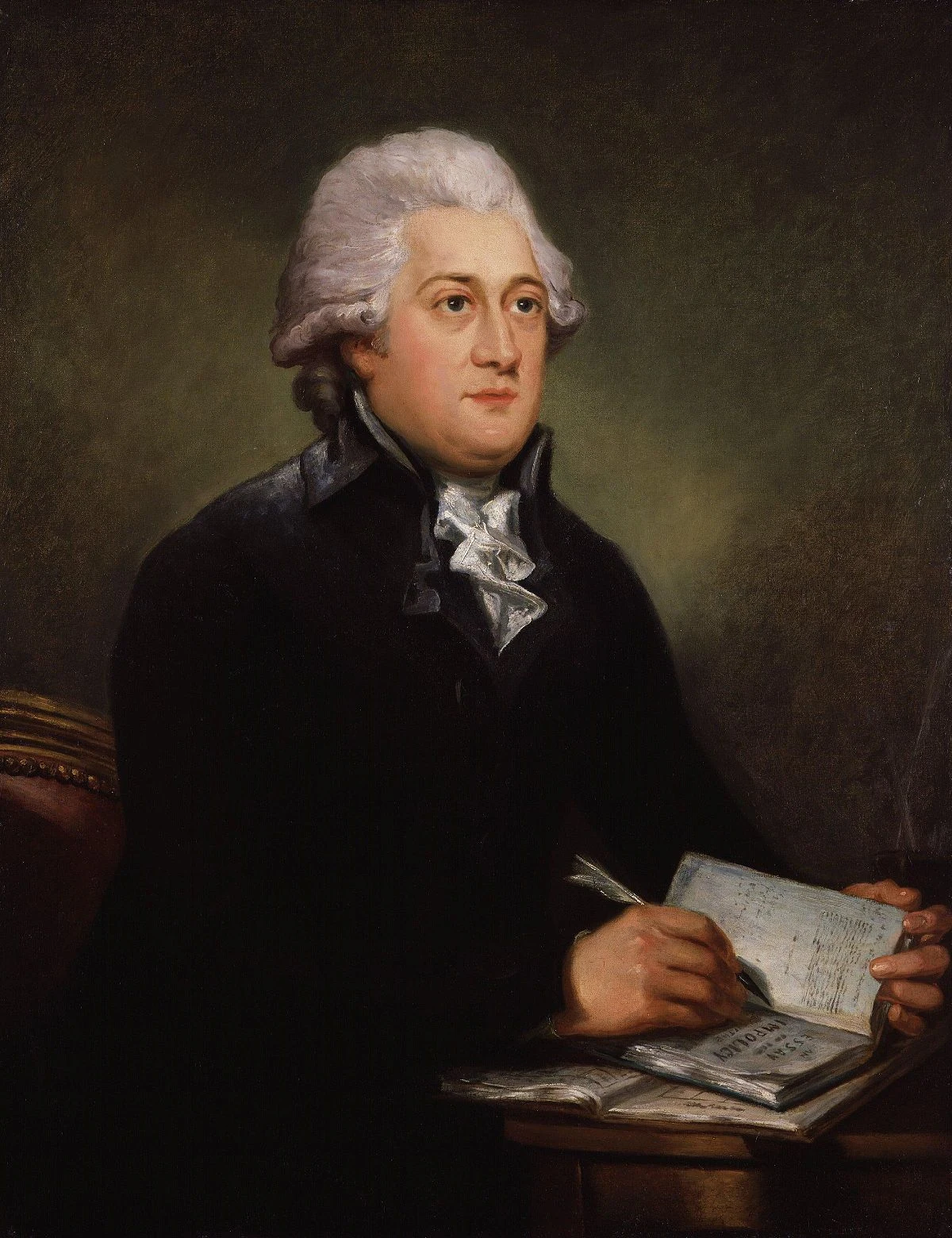
Thomas Clarkson was not the abolition movement’s leading voice in Parliament. His work was done largely on the road: interviewing sailors, collecting evidence, displaying objects and helping local supporters turn opposition to the slave trade into a national campaign. Born in Wisbech and educated at Cambridge, he connected the testimony of people with experience of the trade to public meetings and parliamentary pressure. The Slave Trade Act of 1807 did not end slavery, but it marked a major victory for the movement whose case Clarkson had helped build.
A university question becomes a life’s work
Clarkson was born in Wisbech on 28 March 1760, the elder son of the Reverend John Clarkson, a Church of England priest and headmaster, and Anne Ward. He attended Wisbech Grammar School before going to St Paul’s School in London in 1775. In 1779 he entered St John’s College, Cambridge, where he took his Bachelor of Arts degree in 1783. His father’s example pointed towards the Anglican ministry: Clarkson was ordained a deacon that year, although he did not proceed to priest’s orders.
In 1785, a Latin essay competition at Cambridge changed the direction of his life. The question, set by the university’s vice-chancellor, Peter Peckard, asked whether it was lawful to make slaves of others against their will. Clarkson read accounts of the African slave trade and slavery, including works by the Quaker abolitionist Anthony Benezet, and sought the testimony of people who had direct experience of the trade. He won the competition, but the research, rather than the prize, proved decisive.
On the journey from Cambridge towards London, Clarkson later recalled stopping near Wadesmill in Hertfordshire. He had become so disturbed by what he had learned that he questioned whether he could remain a bystander if the evidence was true. The episode became a turning point: within a year he had set aside the prospect of a clerical career and made his argument available beyond the university. In 1786 he published an English version of his essay as An Essay on the Slavery and Commerce of the Human Species, particularly the African.
The pamphlet helped connect Clarkson with people already working against the trade, including Quakers, nonconformists and campaigners such as Granville Sharp. Opposition to the trade did not begin with Clarkson, and the first petition against it had been presented to Parliament by Quakers in 1783. His contribution was to help bring existing efforts into a wider, organised campaign, and to develop ways of making the case visible to people who might otherwise have encountered it only as a distant political question.
Taking evidence into the ports and meeting rooms
In May 1787 the Committee for the Abolition of the Slave Trade was formed. Clarkson was one of its twelve founding members, alongside nine Quakers and the Anglicans Granville Sharp and Philip Sansom. Sharp was its chairman. Clarkson took a leading role in the committee’s work and was assigned to gather evidence. He travelled to ports including Bristol, Liverpool and London, where he spoke to sailors, surgeons and others who knew the trade at first hand.
The extent of the task is reflected in the figures associated with his research: he interviewed around 20,000 sailors and travelled some 35,000 miles. The work was not simply the accumulation of dramatic testimony. Clarkson collected accounts and material evidence that could inform public argument and parliamentary debate. He wrote and published about what he found, including A Summary View of the Slave Trade and of the Probable Consequences of Its Abolition in 1787, followed by further works drawing on information from those who had taken part in the trade.
Objects gave that evidence a physical presence. Clarkson gathered handcuffs, leg-shackles, thumbscrews and branding irons, and displayed equipment used on slave ships at public meetings. A wooden chest carried these objects, making it a practical campaigning tool as well as a container. He also collected African-made goods and materials, including textiles, ivory, beeswax, spices and produce. Their workmanship helped him make the case that African commerce could rest on goods and skills rather than the enslavement and sale of people.
Clarkson’s visits could be dangerous. Liverpool was a major centre for slave-trading syndicates, and in 1787 he was attacked there and narrowly escaped being killed. The hostility he faced showed the strength of the interests he was challenging. In Manchester, by contrast, his address at the collegiate church on 28 October 1787 helped galvanise local opposition. He supported the establishment of local anti-slave-trade societies and helped turn separate conversations into an organised network.
Images, like objects, could make a complex system easier to grasp. In 1791 Clarkson arranged for a plan of the slave ship Brooks to be turned into an image showing enslaved people packed aboard. He used the image in lectures and supplied it, along with other material, to William Wilberforce for use in Parliament. It placed the human consequences of the trade before audiences in a form that words alone could not reproduce. Together, testimony, printed arguments, meetings and displays helped the committee make a case that could be seen as well as heard.
From local support to parliamentary pressure
Clarkson’s evidence-gathering served a broader purpose: it could equip public supporters to press Parliament. The committee drew on Quaker networks while seeking to make the campaign wider than one religious group. That breadth mattered in a political system where Quakers were generally barred from the Commons by the requirements for MPs to receive the sacrament according to the rites of the Church of England. Clarkson approached William Wilberforce, an Anglican MP who could take the argument into the House.
The two men’s roles were complementary, not interchangeable. Wilberforce became a prominent parliamentary spokesman; Clarkson supplied evidence, wrote, travelled and helped mobilise support beyond Westminster. His research informed Wilberforce’s first major speech on the issue in 1789. In turn, parliamentary debate gave the campaign a focal point around which local meetings and petitioning could gather.
Petitions offered a route into public life for people who had little or no access to the vote. Clarkson’s tours helped encourage local groups to organise and communicate their opposition to Parliament. That work made abolition more than a question for MPs or a committee in London: it became a cause through which people in towns and cities could seek to influence national policy. The campaign’s methods—local societies, public meetings, printed arguments, objects and petitions—gave moral opposition an organised political form.
Yet progress was neither immediate nor assured. Wilberforce’s first abolition bill was defeated in 1791, by 163 votes to 88. The outbreak of war with France then helped keep the issue from sustained parliamentary consideration. Clarkson continued writing and campaigning, but years of travel and effort took a toll on his health. By 1794 he had withdrawn from the work, exhausted, and went to live in the Lake District, where he bought an estate beside Ullswater. There he became a friend of William Wordsworth and his sister Dorothy.
Return to the campaign and the 1807 Act
When the campaign revived in 1804, Clarkson returned to the road. He travelled across Britain again, canvassing support and persuading MPs to back abolition. A further parliamentary failure in 1805 did not end the effort. Instead, the committee strengthened its petitioning campaign, and public pressure continued alongside parliamentary work.
The Slave Trade Act received Royal Assent on 25 March 1807. It ended the British trade in enslaved people; it did not abolish slavery itself. The distinction matters. Clarkson had helped build the movement that made the Act possible, but the law was a step in a longer struggle, not the end of it. After 1807 he worked to support enforcement and to extend opposition to the trade beyond Britain.
His account of the campaign, The History of the Rise, Progress, and Accomplishment of the Abolition of the African Slave-Trade by the British Parliament, appeared in 1808. It recorded how evidence, organisation and parliamentary action had combined. Clarkson’s writing preserved a record of the process as well as its outcome, emphasising that legislation had been won through years of work rather than a single debate or speech.
He also sought international agreement. Clarkson travelled to Paris in 1814 and to Aix-la-Chapelle in 1818 to promote abolition of the trade elsewhere in Europe. In 1816 he became a pacifist and helped found the Society for the Promotion of Permanent and Universal Peace with his brother John and others. His attention remained on the wider consequences of the trade and on the possibility of extending reform beyond Britain.
From ending the trade to ending slavery
In 1823 the Society for the Mitigation and Gradual Abolition of Slavery was formed. Clarkson again travelled to build support, covering long distances and activating networks of anti-slavery societies formed in earlier years. The campaign helped deliver 777 petitions to Parliament calling for the emancipation of enslaved people. When the society adopted a policy of immediate emancipation, Clarkson and Wilberforce appeared together in support.
The Slavery Abolition Act was passed in 1833. Emancipation in the British colonies was completed on 1 August 1838. These developments followed the 1807 abolition of the British slave trade, but they were not the same legal change: stopping British participation in the trade had not itself freed people already enslaved. Clarkson lived to see the later legislation and the completion of emancipation in the colonies, though slavery remained a matter of international concern.
In 1840, as an elderly campaigner, Clarkson was the principal speaker at the opening of the first World Anti-Slavery Convention in London. Delegates came from Britain, the United States, France, Haiti and Jamaica. Benjamin Robert Haydon’s commemorative painting of the convention shows Clarkson addressing the gathering, a record of the veteran campaigner speaking to a movement with international ambitions. In 1846 he hosted Frederick Douglass, the American abolitionist who had escaped slavery, during Douglass’s first visit to England.
Clarkson died at Playford in Suffolk on 26 September 1846, aged 86, and was buried at St Mary’s Church in the village. He had married Catherine Buck in 1796; their son, Thomas, was born that year. His life had moved from Wisbech and Cambridge through the ports and political networks of Britain, and later into a campaign whose reach was international.
Objects, places and a continuing record
Clarkson’s campaigning left tangible traces. The chest and the collection associated with him are displayed at Wisbech & Fenland Museum, where they preserve the physical evidence he carried to meetings. Wisbech also remembers him through a memorial and other local commemorations; a monument at Wadesmill marks the place associated with his decision in 1785. In 1839 he received the Freedom of the City of London. A memorial tablet was dedicated to him in Westminster Abbey in 1996, and in 2007 he appeared on a British commemorative stamp marking the abolition of the slave trade.
Such memorials are not substitutes for understanding the history. The 1807 Act ended Britain’s legal trade in enslaved people, but slavery persisted in the British colonies until the 1833 Act and the completion of emancipation in 1838. Remembering Clarkson well means keeping those stages distinct, and acknowledging that the campaign was built by many people, including those who had experienced enslavement and spoke against it. Clarkson’s importance lies not in having acted alone, but in the work he did to collect, organise and circulate evidence in partnership with others.
Why Thomas Clarkson deserves a place in British Legacy
Thomas Clarkson deserves a place in British Legacy because his life shows how a reform campaign can be built from practical work. He gathered testimony from sailors and others with direct knowledge, travelled to ports where the trade was entrenched, and carried physical evidence into public meetings. His chest of equipment and African-made goods made the trade and its alternatives visible. His work on the image of the Brooks helped turn the conditions aboard a slave ship into a public argument that could be shared in print, lectures and Parliament.
His British connection is specific: born in Wisbech, educated at Cambridge and active in ports and towns across the country, he helped connect local opposition to a national petitioning movement and parliamentary action. He worked alongside Quakers, other reformers and Wilberforce, whose parliamentary role complemented Clarkson’s organising and research. The 1807 Act was a major achievement, but not the abolition of slavery; Clarkson also supported the later campaign that led to the 1833 Act and emancipation in the British colonies in 1838. His example is valuable not because it makes Britain’s history innocent, but because it records people challenging a system from within the society that sustained it. The methods he helped develop—evidence, public education, local organisation and pressure on representatives—show how sustained civic action can contribute to change.
Sources
Thomas Clarkson — Wikipedia, revision 1372277222
Adapted in part from Thomas Clarkson by Wikipedia contributors, under CC BY-SA 4.0. Text has been edited and combined with the existing article; this adapted text is shared under the same licence. Contributor history.