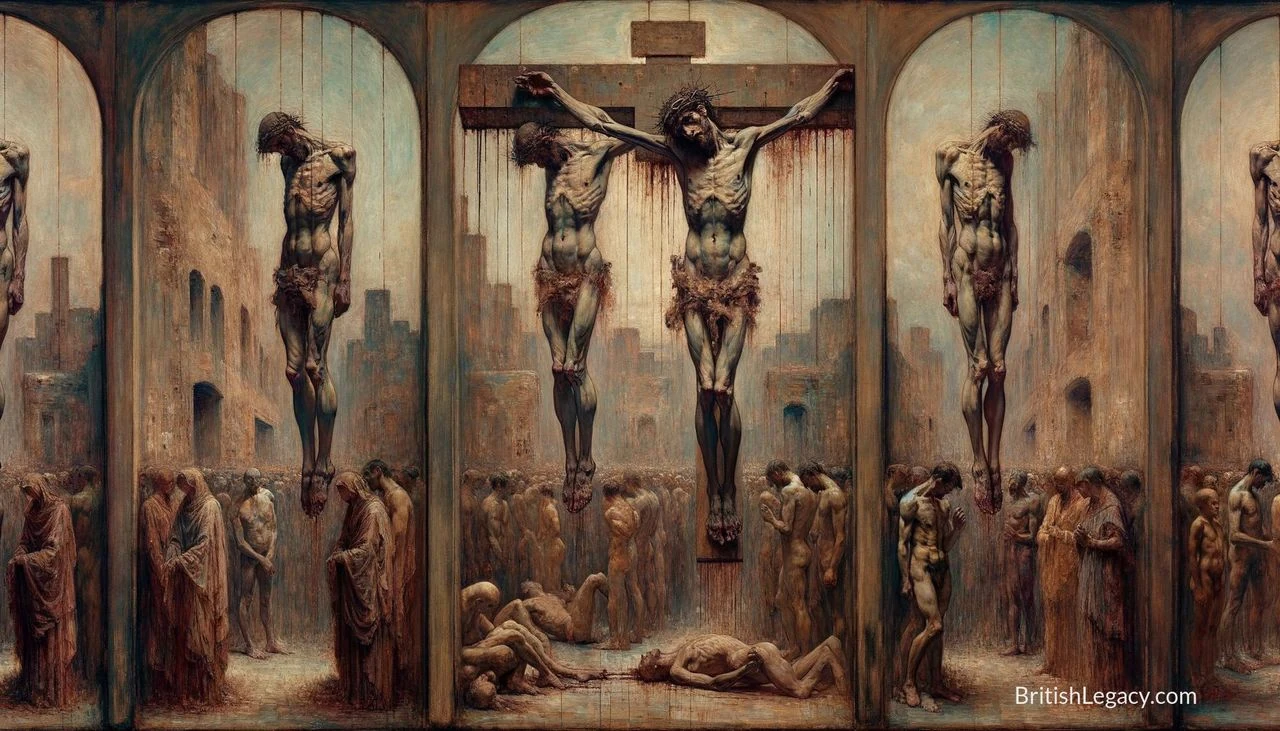
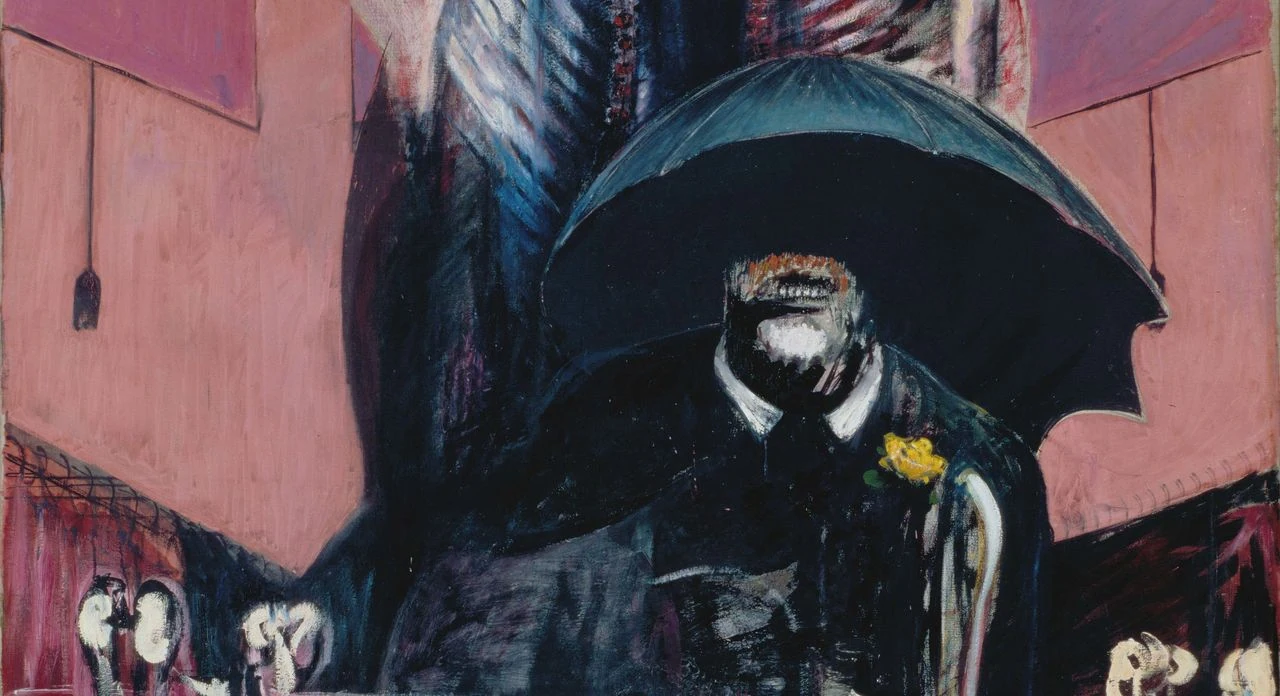
Francis Bacon did not begin to paint seriously until his late twenties. When he found his subject, he returned to it in series: a pope isolated in a cage-like space, a mouth opened in a scream, a friend’s face turned into a study of movement and time. His paintings made the human figure at once recognisable and strange. The 1944 triptych Three Studies for Figures at the Base of a Crucifixion brought his work to wider attention and established a bleak, original vision that would shape one of the most prominent careers in post-war British painting.
Dublin, London and a delayed start
Bacon was born in Dublin on 28 October 1909. His father, Anthony Edward Mortimer Bacon, was an English-born army officer, and his mother, Christina Winifred Firth, was heir to a Sheffield steel business and coal mine. The family moved between Ireland and England during Bacon’s childhood; that repeated displacement remained a feature of his sense of his early life. His formal education was intermittent. He attended Dean Close School in Cheltenham from 1924 to 1926, but was expelled from the family home in Ireland after his father found him wearing his mother’s clothes.
In 1926 Bacon spent time in London, then went to Berlin and Paris. In Paris he visited galleries and saw Nicolas Poussin’s Massacre of the Innocents, a painting he later recalled as important to him. He returned to London in 1928 or 1929 and worked as an interior decorator, designing furniture and rugs as well as making paintings. The move into painting was gradual: he later said that he had delayed his artistic career by spending too long looking for subject matter that could sustain his interest.
His early work did not immediately bring recognition. Crucifixion, painted in 1933, attracted some public attention, but was not well received; Bacon became disillusioned and abandoned painting for much of the following decade. He destroyed or suppressed many early works. His later art drew on varied sources, including classical painting, photographs and film. An image of a screaming nurse from Sergei Eisenstein’s Battleship Potemkin, which he saw in Paris in 1935, became one of the references behind his recurring use of the open mouth.
The triptych that established his reputation
By 1944 Bacon had developed a more assured approach. Three Studies for Figures at the Base of a Crucifixion brought together concerns he had explored earlier, including the crucifixion, biomorphic forms and the Furies of Greek mythology. Its three distorted figures do not retell a conventional religious scene. Instead, Bacon used the crucifixion as a structure through which to explore human behaviour and bodily vulnerability. The work caused a sensation when exhibited in 1945 and established him as a major post-war painter.
Bacon often built paintings in groups, returning to a subject through variations rather than treating each canvas as a wholly separate undertaking. He described seeing images “in series”; many of his works took the form of triptychs or diptychs, and his output is estimated at about 590 surviving paintings, alongside works he destroyed. In the 1940s he painted heads isolated in rooms or geometric enclosures. From the late 1940s, the screaming mouth became a recurring motif. In the 1950s, he developed his series of popes, drawing especially on Diego Velázquez’s portrait of Pope Innocent X. These figures, enclosed and apparently trapped, transformed a familiar image of authority into an exploration of isolation and distress.
His work evolved without abandoning its central attention to the body. Animal paintings and solitary figures appeared in the 1950s; crucifixions returned in the early 1960s. From the middle of that decade, portraits of friends became prominent. Bacon frequently used photographs and other images as starting points, but his portraits were not straightforward likenesses: he distorted and reworked faces to give them a sense of movement and instability. His chosen formats and recurring subjects gave his career a structure, while changes in handling and mood kept the paintings from becoming repetitions.
Soho, portraits and changing themes
London was central to Bacon’s working life and social world. In the 1950s he was a regular at the Colony Room, a private drinking club in Soho, where he encountered writers, photographers and fellow artists, including Lucian Freud and John Deakin. Bacon also formed important connections with the art critic David Sylvester and the gallerist Erica Brausen, who represented him at the Hanover Gallery. He held his first one-man exhibition there in 1949. In 1958 he began a long association with Marlborough Fine Art, which became his sole dealer.
Among Bacon’s most important later subjects was George Dyer, whom he met in 1963. Dyer appeared in numerous portraits. After Dyer died in Paris in October 1971, Bacon made several portraits of him and a group of three “Black Triptychs”, which evoke events around his death. The loss marked a darker turn in work already preoccupied with vulnerability and mortality. Across his career, Bacon also returned to self-portraiture, particularly in the 1970s, and continued working into the 1980s.
Bacon died in Madrid on 28 April 1992, aged 82, after a heart attack. His estate passed to John Edwards, his heir. In 1998, Edwards and Brian Clarke arranged for the contents of Bacon’s London studio at 7 Reece Mews to be donated to the Hugh Lane Gallery in Dublin. The studio was surveyed and reconstructed there, preserving not just a working space but the accumulated material around which Bacon’s art had developed.
A studio, a method and an international reputation
The reconstructed studio offers a practical counterpart to the paintings. Its contents included books, photographs, torn pages, correspondence and art materials: the visual and physical resources among which Bacon worked. The Hugh Lane Gallery opened the relocated studio to the public in 2001 and created a database documenting its objects. The project made a dense, private working environment available for public study, while returning an important part of Bacon’s story to the city where he was born.
Bacon’s reputation also grew well beyond Britain and Ireland. His paintings entered major international collections, including the Museum of Modern Art in New York. His large triptychs and portraits became prominent on the art market, with several sales reaching exceptional prices. A five-volume catalogue raisonné published in 2016 documented 584 paintings. Such records and collections show the scale of his output, but his artistic importance rests more fundamentally on the way he made recurring subjects change under sustained examination.
Why Francis Bacon deserves a place in British Legacy
Bacon deserves a place in British Legacy because he became a defining figure in post-war British painting through an artistic language that was unmistakably his own. Born in Dublin, he spent much of his working life in London, where Soho, his galleries and his circle of artists and writers formed a lasting part of his context. His 1944 triptych marked a decisive breakthrough; the series that followed showed how a painter could revisit the same subject without simply repeating it. Crucifixions, popes, friends and self-portraits became means of testing what paint could do to the image of a human being.
That achievement has a continuing public life. Bacon’s works are held and studied internationally, while his reconstructed studio in Dublin makes the materials and circumstances of his practice accessible to visitors. His career also gives British art history a more complex geography: an Irish-born painter, working principally in London, whose art became part of an international conversation. The enduring value of his work is not a general claim that it is unsettling or important, but its capacity to make viewers reconsider how a face, body or familiar cultural image can carry movement, isolation and vulnerability. Bacon’s place in British Legacy rests on that specific artistic achievement and on the cultural record his paintings and studio continue to provide.
Sources
Francis Bacon (artist), revision 1374145571 · Francis Bacon (artist)
Adapted in part from Francis Bacon (artist) by Wikipedia contributors, under CC BY-SA 4.0. Text has been edited and combined with the existing article; this adapted text is shared under the same licence. Contributor history.