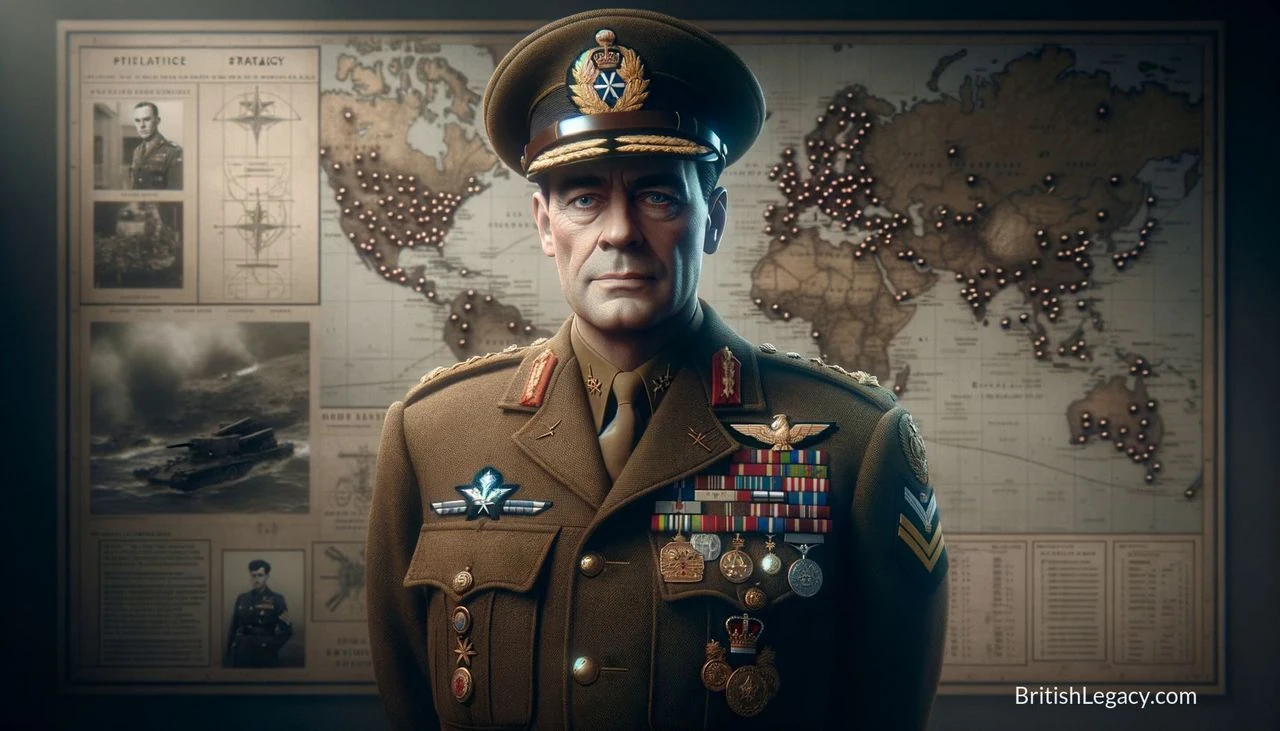
Brian Horrocks’s wartime reputation was made in campaigns across North Africa and north-west Europe, but it was not built on unbroken success. He commanded XXX Corps during Operation Market Garden, the Allied attempt to cross the Rhine through the Netherlands, and later led it into Germany. His career also included captivity in two wars, a serious wound that ended his active military service, and a post-war public life that took him from the House of Lords to television.
Early service, capture and sport
Brian Gwynne Horrocks was born in Ranikhet, British India, on 7 September 1895. His father, Sir William Horrocks, was a doctor in the Royal Army Medical Corps. After returning to Britain, Brian was educated at Bow School in Durham and Uppingham School in Rutland. He entered the Royal Military College, Sandhurst, in 1912 and received his commission as a second lieutenant in the Middlesex Regiment on 8 August 1914, shortly after the outbreak of the First World War.
Sent to France with a draft of replacements, Horrocks joined the British Expeditionary Force during its retreat after the Battle of Mons. On 21 October 1914, while defending Maisnil during the Battle of Armentières, he was wounded and taken prisoner by the Germans. He spent the rest of the war in captivity and made repeated attempts to escape, once getting close to the Dutch border before being recaptured. He learned Russian while held with Russian officers, and was later awarded the Military Cross for his resistance as a prisoner.
In 1919, Horrocks was posted to Russia as part of the Allied intervention in the Russian Civil War. His duties included helping train and equip White Russian forces. Captured by the Red Army in January 1920, he spent ten months as a prisoner and narrowly survived typhus before returning to Britain. His service also took him to Germany and Ireland. In 1924 he represented Britain in the modern pentathlon at the Paris Olympics, finishing nineteenth among 38 competitors.
Between the wars, Horrocks held a series of regimental and staff appointments, including study and instruction at the Staff College, Camberley. He also served with the Territorial Army, an experience he valued for the insight it gave him into citizen soldiers. In 1928 he married Nancy Kitchin; they had a daughter, Gillian. When the Second World War began, he was an instructor at Camberley.
From France to North Africa
In May 1940, Horrocks went to France to command the 2nd Battalion, Middlesex Regiment, during the retreat towards Dunkirk. After 17 days he was given temporary brigadier rank and command of the 11th Brigade. Back in Britain, he commanded the 9th Brigade and then the 44th (Home Counties) Infantry Division, which was stationed in Kent to meet the threat of invasion. In 1942 he took command of the newly formed 9th Armoured Division, despite his infantry background, and trained it in armoured warfare.
That year Horrocks was sent to Egypt to command XIII Corps in the Eighth Army under Bernard Montgomery. At Alam el Halfa, his force helped repel Erwin Rommel’s attack in August. For the subsequent Second Battle of El Alamein, Horrocks remained with XIII Corps, which was assigned a diversionary role to the south while the main attack went forward elsewhere. He later took command of X Corps, leading it during the advance west after the fall of Tripoli.
In March 1943, Horrocks’s X Corps carried out a flanking manoeuvre during Operation Supercharge II in Tunisia after an earlier attack had failed to breach the Mareth Line. The movement helped make the German position untenable. Horrocks subsequently took command of IX Corps for the final Allied offensive in Tunisia, which captured Tunis and brought the campaign to an end. His time in North Africa was cut short in June 1943, when he was seriously wounded in an air attack at Bizerte. He underwent five operations and spent 14 months recovering.
XXX Corps and Operation Market Garden
Horrocks returned to active command in 1944, taking over XXX Corps in north-west Europe. The corps advanced through Belgium and captured Brussels. Its rapid progress, however, placed it far ahead of its supply lines. In early September, XXX Corps was diverted towards Antwerp to secure the city’s docks and harbour. The port fell to the 11th Armoured Division, but the advance then paused short of the Albert Canal. German forces used the time to strengthen their positions along the Scheldt, where the First Canadian Army would later fight a costly campaign to open the port.
In September, Montgomery’s Operation Market Garden aimed to seize a series of bridges in the Netherlands and establish a route across the Rhine. XXX Corps was to advance north along a corridor held by airborne forces and link up with the British 1st Airborne Division at Arnhem. The plan depended on speed, but the ground force was channelled along a narrow raised road through low-lying and often flooded country. German counter-attacks repeatedly interrupted the advance, and the bridge at Nijmegen was not captured as planned on the first day. XXX Corps helped take it after reaching the city, adding a further delay.
The British 1st Airborne Division held on at Arnhem for several days but was largely destroyed or captured. The operation did not secure its central objective. Later assessments have differed over the causes, including the strength of German forces in the area, shortcomings in Allied intelligence and the pace of the ground advance. Horrocks accepted responsibility for his command, while also describing the obstacles faced by his troops. The result belongs in any account of his career: his command was central to a major Allied operation, but it did not deliver the intended crossing of the Rhine.
XXX Corps continued to fight in the campaign in north-west Europe. During the Battle of the Bulge, Horrocks was temporarily relieved of command and sent to Britain to rest. In early 1945 his corps took part in Operation Veritable, the advance towards the Rhine. Horrocks had accepted the use of a heavy Bomber Command attack on Cleves to support the operation; he later described that decision as the most terrible of his life. XXX Corps crossed the Rhine in March and advanced through Germany as the war ended. On 15 April 1945, British forces liberated Bergen-Belsen. Horrocks had helped arrange a no-fire zone around the camp and organised the delivery of food, water and medical support for its inmates.
Black Rod, broadcasting and books
After the war, Horrocks served as General Officer Commanding-in-Chief of Western Command and briefly commanded the British Army of the Rhine. The effects of his 1943 wounds led to his early retirement from the army in 1949. That year he became Gentleman Usher of the Black Rod, a role he held until 1963. Black Rod’s duties included supervising the administration of the House of Lords, controlling admission and taking part in parliamentary ceremonies.
Horrocks developed a second career as a writer and broadcaster. He wrote about military affairs for newspapers and magazines, then presented television programmes including British Castles, Men in Battle and Epic Battle. He was also interviewed for the documentary series The World at War. His books included the autobiography A Full Life, published in 1960, and Corps Commander, a 1977 account of his campaigns in north-west Europe. He served as a military consultant on the film A Bridge Too Far and was portrayed in it by Edward Fox.
Horrocks died on 4 January 1985, aged 89. A memorial service was held at Westminster Abbey. His cremated remains were later buried at St Paul’s Church in Mill Hill by the Princess of Wales’s Royal Regiment, a successor to his own Middlesex Regiment.
Why Brian Horrocks deserves a place in British Legacy
Horrocks’s place in British military history rests on a career that crossed several distinct theatres and kinds of service. In the First World War he was wounded and captured; in the Russian Civil War he was captured again. In the Second World War he commanded formations from brigade to corps level, from the defence of Britain to campaigns in North Africa and the advance into Germany. His record includes successful operations, such as the flanking movement at Mareth, as well as the failure of Market Garden to secure Arnhem. Retaining both sides of that record makes his story more instructive than a simple celebration of victory.
His legacy also extends beyond the battlefield. Horrocks’s role in organising emergency supplies for Bergen-Belsen’s liberated inmates connects military command with the immediate human responsibilities of liberation. After leaving the army, he served as Black Rod, explaining military history to television audiences and writing for readers beyond the armed forces. These activities gave the public access to an officer’s perspective on war and its conduct. His British connection is direct: he served in the British Army, represented Britain at the 1924 Olympics, held a senior parliamentary office and was remembered by a successor regiment. Taken together, those achievements make Horrocks a subject for British Legacy not because every operation succeeded, but because his life illuminates military service, its costs and the wider public duties that followed it.
Sources
Brian Horrocks (revision 1379835009)
Adapted in part from Brian Horrocks by Wikipedia contributors, under CC BY-SA 4.0. Text has been edited and combined with the existing article; this adapted text is shared under the same licence. Contributor history.