
Aneurin Bevan’s path to the founding of the National Health Service began in the mining communities of South Wales. He knew the insecurity of working life there, entered miners’ union politics as a teenager and became an MP with a reputation for challenging authority. As Minister of Health in Clement Attlee’s post-war government, he turned the principle of care according to need, rather than ability to pay, into a national service. The NHS was not his only concern: housing fell within his ministerial brief, and his turbulent political career continued long after its launch.
Growing up in a mining town
Bevan was born on 15 November 1897 in Tredegar, Monmouthshire, in the South Wales coalfield. His father, David, was a coal miner; his mother, Phoebe, was a seamstress. The family had ten children, five of whom died in infancy or childhood. Bevan attended Sirhowy Elementary School and left at 14. His father later died of pneumoconiosis, a lung disease caused by inhaling coal dust. The illness was not then recognised as an industrial disease under the relevant compensation legislation, and no compensation was paid.
Bevan worked briefly as a butcher’s boy before going down the pit. He joined the Tredegar branch of the South Wales Miners’ Federation and became head of his local Miners’ Lodge at 19. His union activity brought him into conflict with colliery management. He was dismissed from one job in a dispute his union treated as victimisation, and later challenged another dismissal after refusing work he considered unsafe. These experiences gave him a direct understanding of the bargaining power employers held over miners.
In 1919, Bevan was selected as a Labour delegate in a local election and won a scholarship, sponsored by the South Wales Miners’ Federation, to study at the Central Labour College in London. He returned to Tredegar in 1921 but struggled to find steady work. After a period of unemployment, he became a paid union official in 1926, just as the General Strike began. He helped lead local miners, organise strike pay and establish a Council of Action to raise money and provide food during the six-month dispute.
Bevan had developed a severe stammer in childhood. His brother Billy and local miner Walter Conway were among those who encouraged him to practise speaking. The young union activist who worked to overcome that difficulty became known for the force of his speeches. In 1928 he won a seat on Monmouthshire County Council; the following year he was elected Labour MP for Ebbw Vale, the constituency he represented for the rest of his life.
A combative voice in Parliament
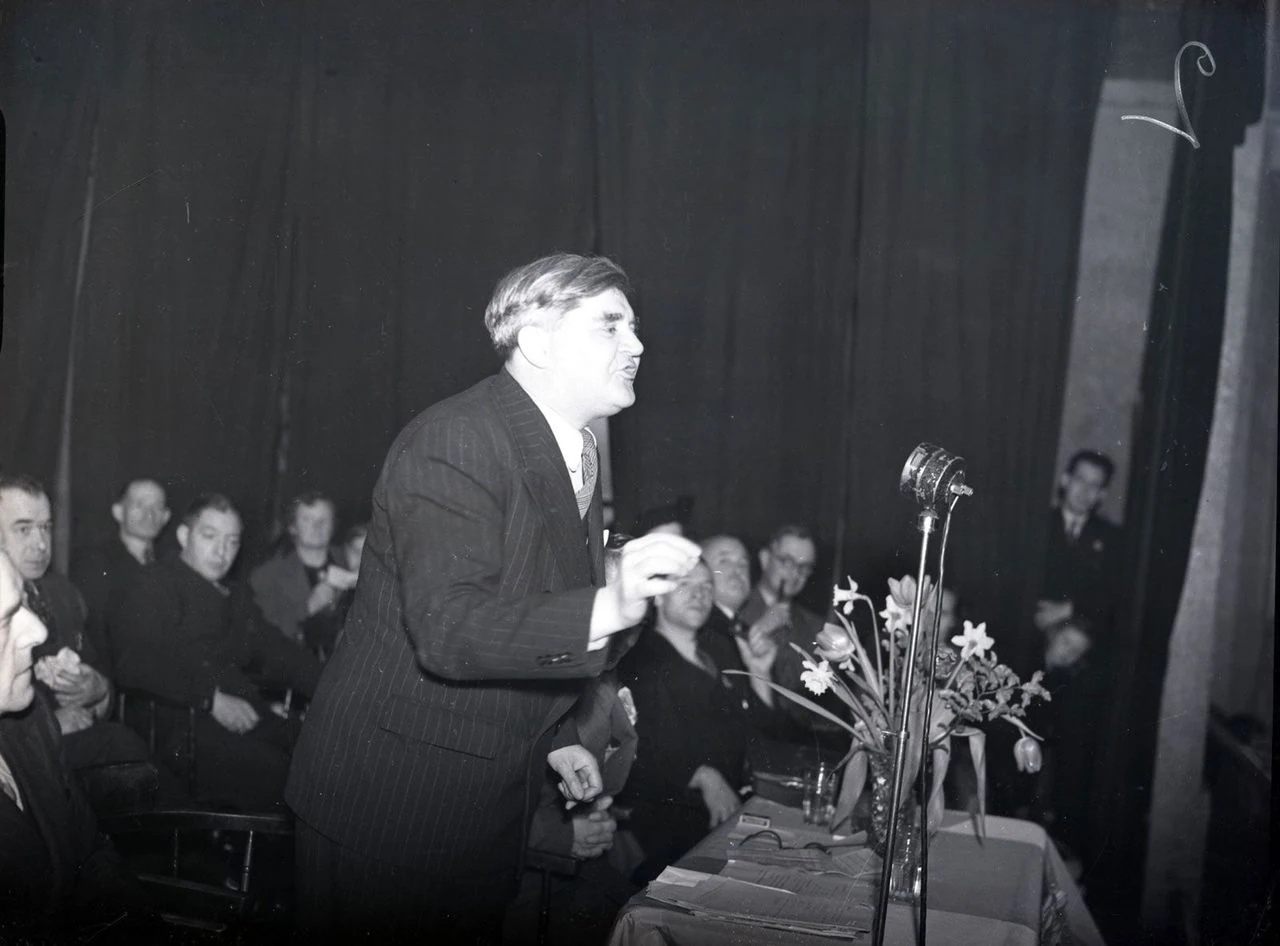
In the Commons, Bevan became a sharp critic of governments and political opponents across party lines. During the Second World War, he challenged the wartime coalition over censorship, civil liberties and military policy, and repeatedly criticised Winston Churchill. His opposition could make him unpopular, but it established him as one of the most prominent voices on Labour’s left. He argued that defeating fascism should also create an opportunity to build a fairer society at home.
Bevan’s political career included conflict within his own party. In 1939, he was expelled from Labour after campaigning for a united front of left-wing parties, then readmitted later that year after agreeing to abide by party policy. He married fellow socialist MP Jennie Lee in 1934. In 1936 he joined the board of the socialist newspaper Tribune, and he and Lee supported the Spanish Republic during the Spanish Civil War.
Labour’s victory in the 1945 general election brought Bevan into government as Minister of Health, with housing also among his responsibilities. He was 47 and the youngest member of Attlee’s Cabinet. The task was formidable: the country faced a serious housing shortage, while medical care remained divided among services with different arrangements and costs. Bevan’s approach to health policy drew on a local example. In Tredegar, the Medical Aid Society used subscriptions to provide members and their dependants with access to services including nursing and dental care.
Making the NHS a national service
Bevan’s central purpose was to establish a health service in which people could receive treatment according to need, without being denied care because they lacked money. The National Health Service Act 1946 provided the legislative basis. The service came into operation on 5 July 1948, the day Bevan attended a ceremony at Park Hospital in Trafford, now Trafford General, and symbolically received the hospital’s keys.
Creating the NHS required negotiation as well as legislation. The British Medical Association opposed the plan, and doctors withheld their support in the months before the launch. Bevan eventually secured the backing of most of the medical profession through concessions, including allowing consultants to retain private practices and preserving payment for doctors through capitation fees rather than salaries. The compromises did not remove the service’s underlying principle. Under Bevan’s scheme, hospitals in England and Wales were brought under public control, with the aim of replacing a patchwork of municipal and voluntary institutions with a more consistent national service.
The service’s first year brought costs above budget, a concern that prompted Attlee to address the public by radio. Bevan argued that the initial pressure reflected years of underinvestment; by the start of the 1950s, the early overspending had ended. The NHS also became a source of political dispute within Labour. In 1951, Bevan resigned as Minister of Labour after the government proposed charges for dental care and spectacles and increased military spending. He opposed the charges as a breach of the principle on which the service had been founded.
Bevan’s health portfolio had included housing, but the work of addressing the post-war shortage was constrained by bomb damage, limited building materials and a lack of skilled labour. He wanted public housing to offer good standards and to serve people beyond a narrowly defined working class. The figures recorded during his time in government show a rapid rise in completions: 55,600 new homes in 1946, 139,600 in 1947 and 227,600 in 1948. Bevan’s preference for larger, better-built homes formed part of his social vision, though those standards and his divided ministerial workload limited what could be achieved.
From minister to Labour deputy leader
After leaving government, Bevan became a leading figure on Labour’s left. His supporters, known as Bevanites, argued for lower defence spending and better relations with the Soviet Union. Bevan published In Place of Fear in 1952, setting out his political outlook. He stood unsuccessfully for the Labour leadership in 1955, when Hugh Gaitskell won, and later served as Shadow Colonial Secretary and Shadow Foreign Secretary.
His views did not always fit a simple left-versus-right division. At the 1957 Labour conference, Bevan rejected unilateral nuclear disarmament, arguing that it would leave Britain without influence or allies in international negotiations. He was also a prominent critic of the British government’s intervention in the Suez Crisis. In 1959 he became Deputy Leader of the Labour Party, a post he held until his death.
Bevan died of stomach cancer at his home in Chesham, Buckinghamshire, on 6 July 1960, aged 62. His body was cremated at Gwent Crematorium in a private family ceremony; a public, open-air service was held in Ebbw Vale. Jennie Lee said he had chosen a non-religious funeral in keeping with his humanist convictions. Political opponents and colleagues paid tribute to him, and accounts of his death described an outpouring of public mourning.
Why Aneurin Bevan deserves a place in British Legacy
Bevan’s place in British Legacy rests first on a specific political achievement: he led the creation of a national health service whose organising principle was that access to treatment should not depend on personal wealth. He did not accomplish that by announcing an ideal and leaving it there. As Minister of Health, he carried legislation through Parliament, confronted opposition from the medical profession, negotiated changes that secured doctors’ participation and brought hospitals in England and Wales under public control. The service launched on 5 July 1948. Its creation made a lasting institutional form for an argument about public responsibility that had particular roots in Bevan’s South Wales home and its Medical Aid Society.
His legacy also deserves a fuller account than the title of NHS founder alone. Bevan came to national politics through mining and trade union organisation, and the conditions he encountered in those communities shaped his interest in collective provision. His work on housing reflected a related ambition: decent homes and public services should not be privileges reserved for a narrow class. The scale and limits of the post-war housing programme show the practical difficulties as well as the intention. Bevan’s later resignation over proposed charges demonstrates how fiercely he defended the NHS’s founding principle, even at political cost. His story connects a Welsh mining town, the Labour movement and a national institution whose founding remains a major part of Britain’s public life.
Sources
Adapted in part from Aneurin Bevan by Wikipedia contributors, under CC BY-SA 4.0. Text has been edited and combined with the existing article; this adapted text is shared under the same licence. Contributor history.
.jpg)