
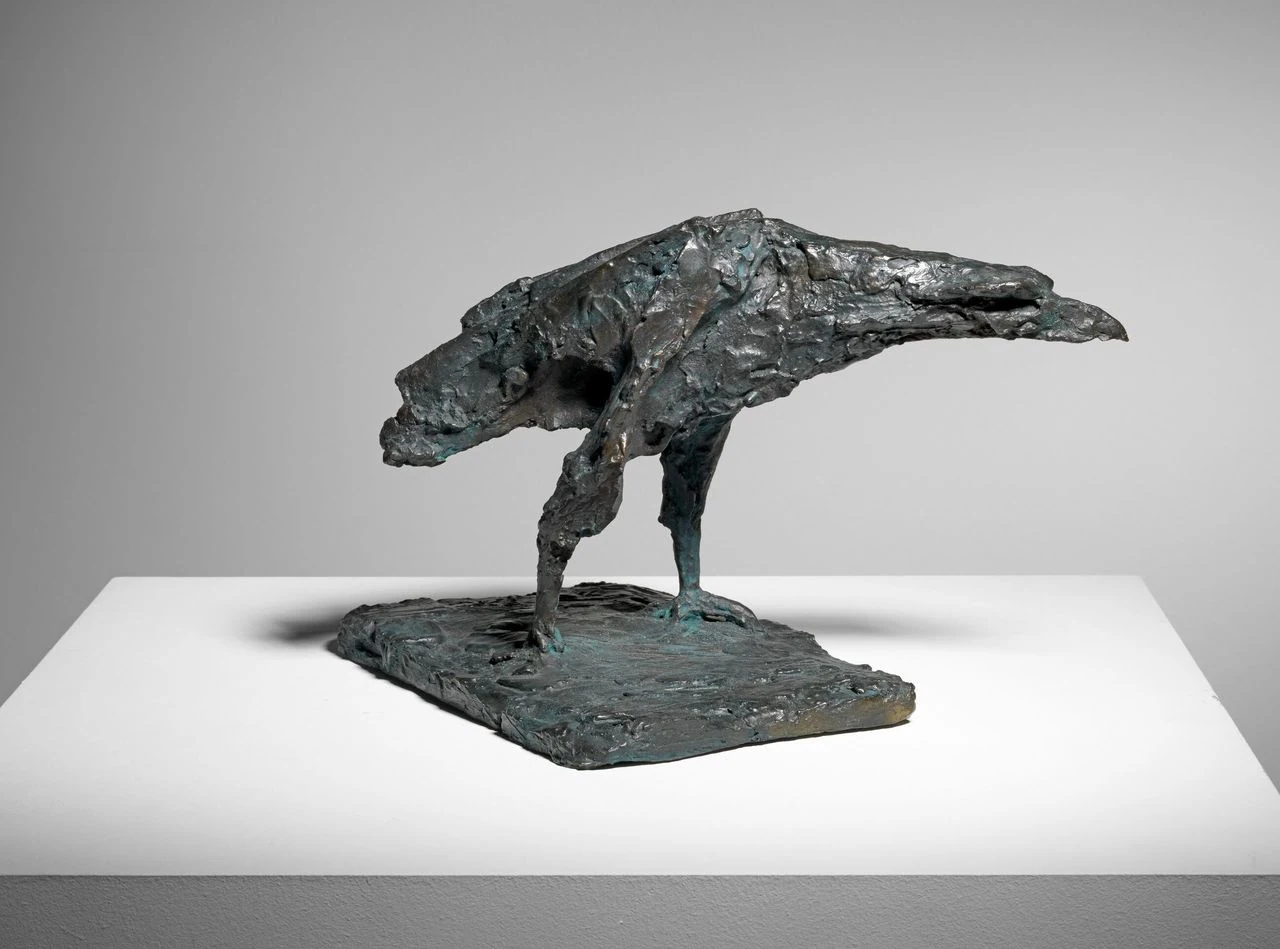
Dame Elisabeth Frink made sculpture that looked worked rather than polished into submission. Her bronze figures and animals carry a cut, pitted surface, a physical trace of the process that formed them. Men, birds, dogs, horses and religious subjects recurred across her work, which joined close attention to bodily form with questions of strength, fear and vulnerability. Frink became one of post-war Britain’s leading figurative sculptors, but her career was not confined to bronze: she also made prints, drawings and works for public and religious settings.
War, childhood and art school
Elisabeth Jean Frink was born on 14 November 1930 at her paternal grandparents’ home, The Grange, in Great Thurlow, Suffolk. Her father, Ralph Cuyler Frink, was a career army officer in the 4th/7th Royal Dragoon Guards. The Second World War began shortly before Frink’s ninth birthday and became part of the setting for her early art. She grew up near a military airfield, hearing bombers return from missions; on one occasion, she had to shelter beneath a hedge during an attack by a German fighter. Her early drawings included wounded birds and falling men, images with an apocalyptic edge.
During the war, Frink was evacuated with her mother and brother Tim to Exmouth, Devon. She attended Southlands Church of England School, then transferred to the Convent of the Holy Family School when Southlands was commandeered for the war effort in 1943. These experiences provide context for the fear and injury in some of her early imagery, though her later subjects ranged far beyond wartime scenes.
Frink studied at the Guildford School of Art from 1946 to 1949 under Willi Soukop, followed by the Chelsea School of Art from 1949 to 1953. She emerged as part of a post-war generation of British sculptors associated with the label “Geometry of Fear”, alongside artists including Reg Butler, Bernard Meadows, Kenneth Armitage and Eduardo Paolozzi. The label situates her among her contemporaries; her own subject matter and approach remained distinctive.
Bronze, surface and recurring subjects
Frink’s work included men, birds, dogs, horses and religious motifs, while female figures were rare. Her early Bird (1952), now at Tate in London, has an alert, menacing presence. Other early works included Three Heads and The Figurative Tradition. She also made an eagle-shaped bookrest for the lectern at the new Coventry Cathedral and a canopy for its bishop’s throne, applying her sculptural practice to the life and setting of a major place of worship.
She is particularly known for outdoor bronze sculpture, but her surfaces were not simply the result of casting. Frink built plaster onto an armature and then worked back into it with a chisel and surform. The marks left by this process distinguish the finished surface and set her method apart from the familiar tradition of modelling form in clay. Rather than conceal the making, the worked texture gives her figures a sense of physical exposure and resistance.
In the 1960s she developed falling figures and winged men. While living in France from 1967 to 1970, she began the threatening monumental male heads known as the Goggled Heads. After returning to England, she concentrated on the male nude: broad-chested figures with mask-like features, elongated limbs and pitted surfaces. Running Man (1976), now in Pittsburgh’s Carnegie Museum of Art, is one example. Frink described her interest in the male figure as a response to its combination of sensuality, strength and vulnerability. Her battered, enduring men complicate simple images of masculine heroism; they appear vulnerable as well as forceful.
Her concern with animals was not incidental. The Times obituary identified three essential themes in her work: “the nature of Man; the ‘horseness’ of horses; and the divine in human form”. Horses, birds and human figures each allowed her to examine physical presence in different ways. She worked in prints as well as sculpture, making lithographs and etchings, including illustrations for books.
Commissions, exhibitions and public work
Frink’s first solo exhibition took place at St George’s Gallery, London, in 1955. She joined Waddington Galleries in 1958 and exhibited there regularly from 1959 to 1972. Her work was also shown in New York, including at the Bertha Schaefer Gallery during the 1960s. In 1971 she exhibited at the Royal Academy’s Summer Exhibition and was elected an Associate of the Academy. She became a full Academician in 1979.
In 1976, Frink established her home in Dorset. Her working life continued to include exhibitions, commissions and public commitments. A major Royal Academy retrospective, moved from its planned 1986 date to 1985 to meet the gallery’s scheduling demands, brought renewed attention to her work. That year she was also committed to two major projects: a group of three figures for a corporate headquarters, including a male nude nearly seven feet tall, and Dorset Martyrs, a group for Dorchester.
Frink kept accepting commissions and exhibiting while serving on advisory committees and meeting art students interested in her work. In 1985 there was discussion of her becoming the Royal Academy’s first female president. She declined the position, which went to Roger de Grey. The episode reflects both her standing within British art and her choice not to take on that institutional role.
Her works can be encountered in a range of public and collection settings. Warhorse and Walking Madonna are in the garden at Chatsworth House; other work is at the Jerwood Sculpture Park at Ragley Hall. Frink’s Desert Quartet (1990) stands opposite Liverpool Gardens in Worthing. In 2007 it became the only sculpture in England to be listed at Grade II* while less than 30 years old. Her 1975 bust of John Pope-Hennessy is in the British Museum’s collection.
Final work and remembrance
Frink’s intense pace of work was interrupted in early 1991 by an operation for cancer of the oesophagus. She returned to making sculpture and preparing exhibitions, then underwent further surgery in September. Despite her declining health, she travelled for exhibitions in New Orleans and New York and continued working on Risen Christ, a monumental statue for Liverpool Cathedral. It was her final sculpture.
Frink died of cancer on 18 April 1993, aged 62, in Blandford Forum, Dorset, one week after Risen Christ was installed. Her career had included work for the Royal Academy, major commissions and sculpture placed in civic, religious and outdoor settings. The unfinished span of her working life is not the whole measure of her importance: the surviving sculptures, prints and drawings document an artist who returned repeatedly to the difficult relationship between vulnerability and strength.
Why Elisabeth Frink deserves a place in British Legacy
Frink’s place in British Legacy rests on the force and individuality of her contribution to post-war sculpture. At a time when British sculptors were exploring new forms, she remained committed to recognisable human and animal subjects. Her art was not a retreat into conventional representation: the falling figures, Goggled Heads and weathered male nudes gave physical form to fear, aggression and vulnerability. Her process mattered too. By building up plaster and cutting back into it, she made the surface record the work of the artist’s hand, producing bronzes that feel worked and exposed rather than smooth and remote.
Her influence is visible in the range of places and institutions connected with her work: from the eagle bookrest and bishop’s throne canopy at Coventry Cathedral to the monumental Risen Christ at Liverpool Cathedral, from the Royal Academy retrospective to Desert Quartet in Worthing. These works bring sculpture into shared civic, religious and outdoor spaces, where it can be encountered beyond a gallery. Frink also taught master classes, and the later Frink School of Figurative Sculpture was named with the Frink Estate’s permission to continue a tradition she represented. Her British legacy is therefore both an artistic achievement and a continuing public presence: a body of work that made figurative sculpture commanding, materially distinctive and attentive to the fragile force of human and animal life.
Sources
Adapted in part from Elisabeth Frink by Wikipedia contributors, under CC BY-SA 4.0. Text has been edited and combined with the existing article; this adapted text is shared under the same licence. Contributor history.

.jpg)