Dante Gabriel Rossetti made poetry and painting answer one another. He wrote poems that became pictures and pictures that carried literary stories, joining the two arts in a way that helped define the Pre-Raphaelite Brotherhood. His career moved from the group’s early experiments in intense colour and close observation to richly coloured paintings of single female figures. Alongside his visual work, he translated Italian poetry, illustrated books and wrote poems of his own.
A London childhood and the Pre-Raphaelite idea
Born in London on 12 May 1828, Rossetti was given the name Gabriel Charles Dante Rossetti. His father, Gabriele Rossetti, was an Italian scholar and émigré; his mother, Frances Polidori, came from a family with Italian connections. The family educated the children at home for part of their early lives, and Rossetti later attended King’s College School. He studied drawing at Henry Sass’s academy before entering the Royal Academy’s Antique School in 1845. He left in 1848 and continued his studies under the painter Ford Madox Brown.
Rossetti was drawn to both poetry and painting. In his teens he encountered the work of Dante Alighieri, whose Vita Nuova he would later translate. He also admired medieval Italian art and the poetry of John Keats and William Blake. In 1848, with William Holman Hunt and John Everett Millais, he founded the Pre-Raphaelite Brotherhood. The group objected to what it saw as the mechanical conventions of academic art. It looked instead to the detail, vivid colours and complex compositions of earlier Italian and Flemish painting, and sought to make art attentive to nature and lived experience.
Rossetti’s early major paintings included The Girlhood of Mary Virgin (1849) and Ecce Ancilla Domini! (1850), works that brought religious subjects into the Brotherhood’s new style. The latter met with hostile criticism, and Rossetti increasingly turned to watercolour and work sold privately. John Ruskin later supported the Pre-Raphaelites, but Rossetti rarely exhibited after the early critical reaction.
Poetry, pictures and book arts
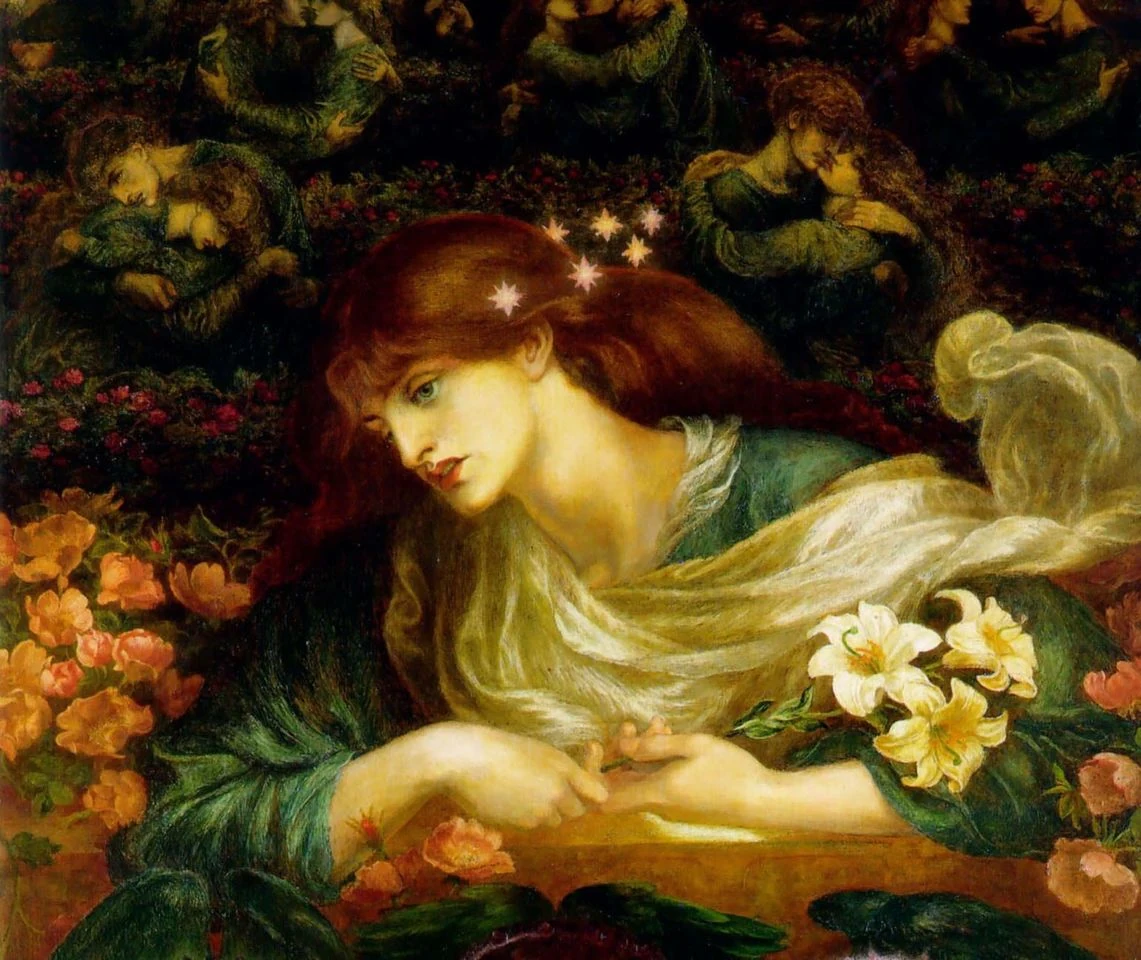
The Blessed Damozel shows how Rossetti’s two practices met. He began the poem in 1847, and it appeared in the Brotherhood’s journal, The Germ, in 1850. Its woman looks down from heaven towards her earthly lover. Rossetti returned to the subject in a painting made over a later period, from 1871 to 1878. The poem and picture share a medieval imagination, but they are distinct works, developed across decades rather than one being a simple illustration of the other.
Rossetti also worked as a translator and illustrator. His translations of Italian poetry appeared as The Early Italian Poets in 1861 and were republished as Dante and His Circle in 1874. He contributed illustrations to the 1857 edition of Alfred, Lord Tennyson’s poems and collaborated with his sister Christina Rossetti on the first edition of her Goblin Market in 1862. He was interested in the book as a complete visual object, including the relationship between its binding, illustrations and text. This approach extended the Pre-Raphaelite ambition beyond the painted canvas.
His medieval subjects and designs also drew the attention of William Morris and Edward Burne-Jones. In 1857, Rossetti joined a group of artists painting murals for the Oxford Union, taking stories from Thomas Malory’s Le Morte d’Arthur as their subject. The frescoes faded, but the project helped bring the young artists together. In 1861 Rossetti became a founding partner of the decorative arts firm Morris, Marshall, Faulkner & Co., contributing designs for stained glass and other objects.
Elizabeth Siddal and a change in style
Rossetti met Elizabeth Siddal around 1849 or 1850. She became his model and pupil, and they married in 1860. Siddal died in 1862, two years after their marriage. Rossetti later made her the subject of Beata Beatrix, a painting begun in the 1860s and dated 1864–70. The work draws on Dante’s image of Beatrice in La Vita Nuova, bringing personal bereavement into a literary and symbolic composition.
From around 1860, Rossetti’s painting changed. He moved away from the crowded medieval scenes of his early work towards close views of women set against dense colour and vegetation. The pictures frequently drew on a small group of models, including Siddal, Fanny Cornforth, Alexa Wilding and Jane Morris. Among the later works were Lady Lilith, Proserpine and Astarte Syriaca. Their sensual, dreamlike treatment of the figure became particularly influential for European Symbolists.
Rossetti’s personal and professional life became increasingly unsettled in his later years. His first collection, Poems, appeared in 1870 and prompted a fierce critical attack. He suffered a mental breakdown in 1872 and spent his final years largely withdrawn from public life. His second collection, Ballads and Sonnets, was published in 1881. He died at Birchington-on-Sea in Kent on 9 April 1882, aged 53, and was buried in the churchyard of All Saints.
Influence beyond the studio
Rossetti’s influence travelled through artistic partnerships, publications and the example of his work. His medieval imagery and decorative designs affected Morris and Burne-Jones, while his fusion of visual and literary ideas offered later artists a way to treat a painting as more than a straightforward illustration. His later portraits became important to the European Symbolist movement, and he is also regarded as a precursor of the Aesthetic movement.
His writing continued to reach audiences through other artists. Claude Debussy drew on The Blessed Damozel for his cantata La Damoiselle élue. In the twentieth century, Ralph Vaughan Williams made a song cycle from poems in The House of Life. Rossetti’s work is held in British collections including Tate Britain, Birmingham and Manchester. Its continued presence in galleries and performance gives later generations several ways to encounter a career that moved freely between words, images and design.
Why Dante Gabriel Rossetti deserves a place in British Legacy
Rossetti belongs in British Legacy not simply because he helped found an influential artistic group, but because his work changed what artists could do across different forms. The Pre-Raphaelite Brotherhood challenged established academic conventions with close attention to detail, vivid colour and complex compositions. Rossetti helped carry that experiment into poetry, book illustration and decorative design. His translations made Italian poetry available in English; his illustrations treated a book as a unified work of art; and his contributions to Morris, Marshall, Faulkner & Co. connected painting to the design of objects and interiors.
His influence is visible in the careers of artists such as Morris and Burne-Jones and in the later European Symbolist movement. It also endures through works that have continued to inspire composers, from Debussy to Vaughan Williams. The British connection lies in this specific artistic history: a London-born painter and poet helped form a movement that challenged the conventions of British art, shaped the development of decorative design and entered a wider European conversation. Rossetti’s achievement was not confined to one celebrated image. It was a sustained exchange between literature and visual art, carried into galleries, books, craft and music.
Sources
Dante Gabriel Rossetti (revision 1377861622)
Adapted in part from Dante Gabriel Rossetti by Wikipedia contributors, under CC BY-SA 4.0. Text has been edited and combined with the existing article; this adapted text is shared under the same licence. Contributor history.