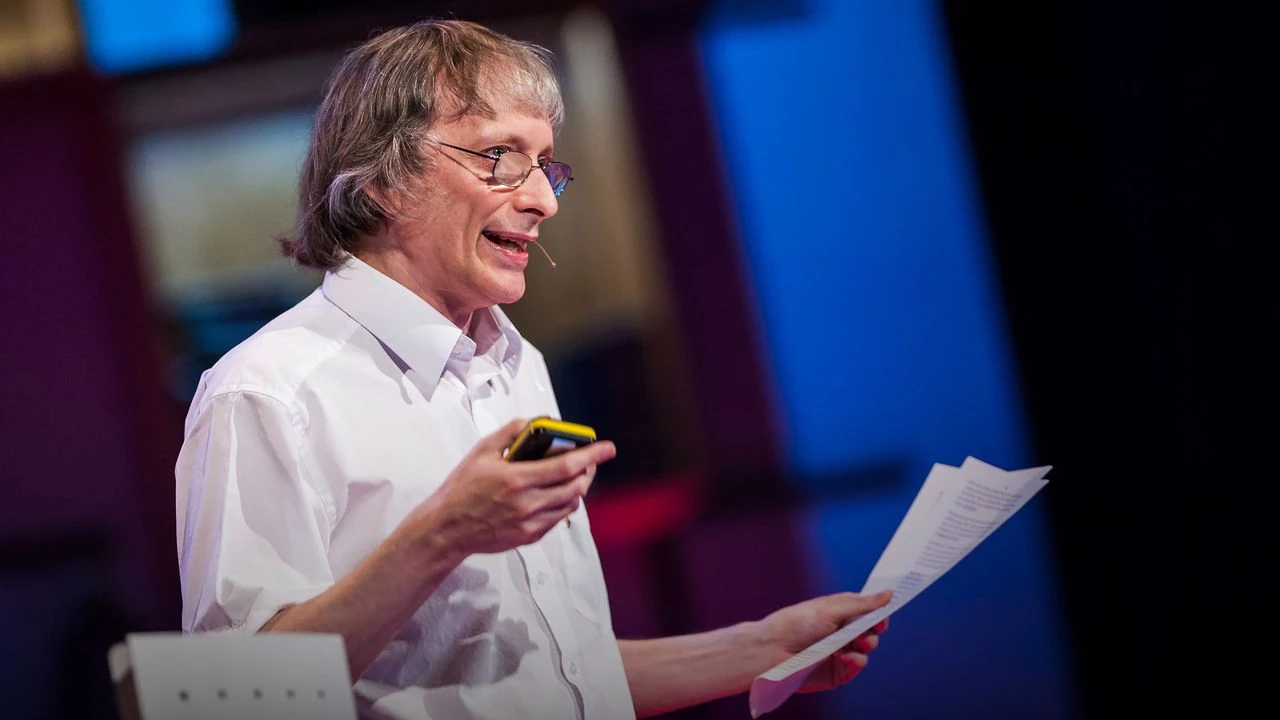
In 1985, David Deutsch set out a theoretical model of a computer governed by quantum mechanics. The idea was not a finished machine, but a way to ask what computation could be when the rules of classical physics no longer applied. His work helped lay the foundations of quantum computing, and subsequent research developed the field through algorithms, logic gates and error correction. Deutsch’s career has also crossed into questions about how science explains the world: his books connect physics and computation with knowledge, evolution and human progress.
From Haifa to Oxford
Deutsch was born in Haifa, Israel, on 18 May 1953. His family moved to the United Kingdom in 1956, when he was three. He attended Geneva House school in Cricklewood and later William Ellis School in Highgate. His early education in London preceded a scientific degree at Clare College, Cambridge, where he read Natural Sciences and took Part III of the Mathematical Tripos.
He went on to study theoretical physics at Wolfson College, Oxford. His doctorate, completed in 1978, concerned boundary effects in quantum field theory. Dennis Sciama and Philip Candelas supervised his research. Deutsch later worked at the University of Oxford, including in the Clarendon Laboratory’s Centre for Quantum Computation, where he is described as a visiting professor in the Department of Atomic and Laser Physics.
This route—from schools in London to research at Oxford—gives the British dimension of his career a concrete setting. Deutsch was born in Israel, but his education and academic work in Britain became the base for research that reached an international scientific community.
A computer governed by quantum theory
Deutsch’s 1985 work addressed a fundamental question: how should computation be described if the computer itself obeys quantum mechanics? He formulated a quantum Turing machine, a theoretical model that extended the familiar idea of a universal computer into the quantum domain. Its significance was conceptual as well as technical: it offered a framework for investigating computation as a physical process, rather than treating a computer as an abstract device detached from the laws of nature.
Quantum computers use quantum bits, or qubits, rather than classical bits. A classical bit is represented as either 0 or 1; a qubit is governed by quantum rules and can be prepared in combinations of these states. That distinction does not mean that a quantum computer simply tries every possible answer and returns the right one. What it can calculate, and how efficiently, depends on the design of the computation and the way quantum effects are used.
Deutsch also proposed an early quantum algorithm. In 1992 he and Richard Jozsa developed it into the Deutsch–Jozsa algorithm, one of the first examples of a quantum algorithm that is exponentially faster than any deterministic classical algorithm for the problem considered. It showed, in a carefully defined setting, that quantum computation could offer a provable advantage. The result helped make the subject more than a speculative possibility.
Building a research field
Deutsch’s work formed part of a wider theoretical programme. His contributions include research on quantum logic gates and computational networks, quantum error correction and the conditions under which a quantum computer can be universal. A universal quantum computer, in principle, can simulate any physical system. This possibility connects the theory of computing directly to physics: a computer built from quantum systems might model other quantum systems in ways that classical machines cannot efficiently reproduce.
His influence is reflected in the range of ideas associated with his name, among them the Church–Turing–Deutsch principle and the Deutsch–Jozsa algorithm. In 2008, he was elected a Fellow of the Royal Society. The Society’s account of his work highlighted the foundations he helped establish, his role in important advances and his contribution to making the field’s philosophical implications accessible to general readers.
Since 2012, Deutsch has also worked on constructor theory, a proposed way to formulate fundamental physics in terms of which transformations are possible and which are impossible. With Chiara Marletto, he published a paper on a constructor theory of information in 2014. The project extends his interest in how physical laws and information relate, while remaining distinct from the earlier work that established his reputation in quantum computation.
Physics, explanation and public writing
Deutsch’s books take his questions beyond the technical language of quantum algorithms. The Fabric of Reality, published in 1997, brings together quantum mechanics, computation, evolutionary theory and an account of knowledge. Its framework draws on the many-worlds interpretation of quantum physics, Karl Popper’s philosophy of science, Alan Turing’s theory of computation and Richard Dawkins’s account of evolution. Rather than reducing every subject to particle physics, the book presents these strands as mutually informative.
In The Beginning of Infinity: Explanations that Transform the World, published in 2011, Deutsch considers how knowledge grows, how creativity developed and how explanations can support progress. He treats the British Enlightenment of the seventeenth and eighteenth centuries as an important beginning in the history of purposeful knowledge creation, rather than as a completed achievement. These books made his concerns with explanation and scientific understanding available to readers outside specialist physics.
Why David Deutsch deserves a place in British Legacy
Deutsch merits a place in British Legacy for a specific reason: his British education and academic career helped produce work that changed how scientists think about the relationship between computation and physical law. His quantum Turing machine gave researchers a formal way to consider computation under quantum rules. The algorithm he developed with Richard Jozsa then supplied an early, rigorous example of a quantum computational advantage. Those are contributions to the foundations of a research field, not claims that current quantum computers can solve every difficult problem or that Deutsch alone created the technology.
His legacy also includes the range of people and disciplines his work has brought into conversation. Quantum information science joins physics, computing and mathematics; Deutsch’s work on algorithms, logic gates, error correction and universality helped define questions that researchers could pursue. His books extend that conversation to the public, examining how explanations, knowledge and creativity shape understanding. The British connection lies in the schools and universities where his education and research took place, and in the intellectual work he carried out at Oxford. Remembering him here recognises both that concrete British academic setting and the international reach of ideas developed within it.
Sources
David Deutsch — Wikipedia, revision 1378805637
Adapted in part from David Deutsch by Wikipedia contributors, under CC BY-SA 4.0. Text has been edited and combined with the existing article; this adapted text is shared under the same licence. Contributor history.