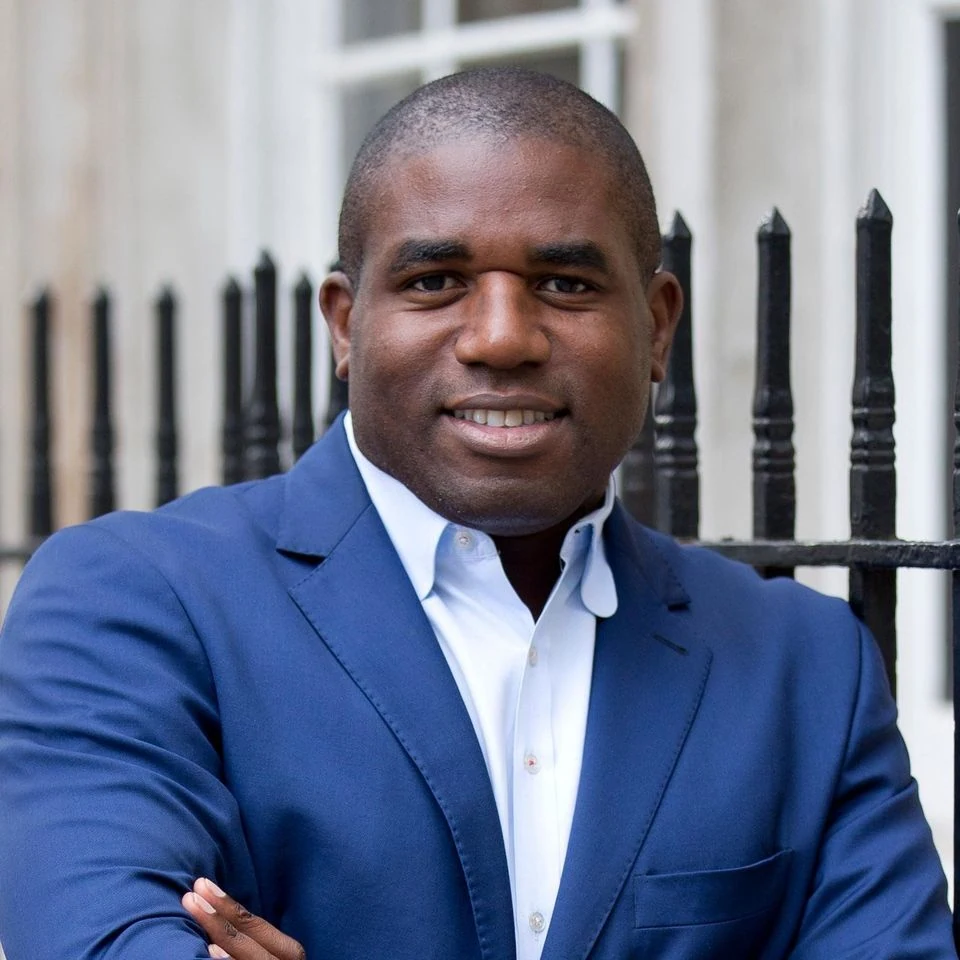
David Lammy’s public career has been shaped by a recurring challenge to Britain’s institutions: explain who is being treated unequally, whose account of citizenship is believed, and whose service is remembered. He has pursued those questions from Tottenham, the constituency he has represented since 2000, through ministerial office and into some of the highest roles in government. The Lammy Review of criminal justice disparities, his parliamentary interventions on Windrush and his part in bringing unequal commemoration of imperial war dead to public attention are distinct achievements. Together, they show a politician trying to turn arguments about fairness and belonging into inquiries, public accountability and change.[1]
From Tottenham to Westminster
David Lindon Lammy was born in north London on 19 July 1972 to Guyanese parents. He grew up in Tottenham and, after his father left the family when he was 12, was raised with his siblings by his mother. At ten, he won a choral scholarship to sing at Peterborough Cathedral and attended The King’s School, Peterborough. That educational route took him away from his home area, but his political life would remain closely connected to Tottenham and its representation.[1]
Lammy studied law at the School of Oriental and African Studies (SOAS), University of London, and graduated with a law degree. He was called to the Bar of England and Wales in 1994 at Lincoln’s Inn, then completed a Master of Laws at Harvard Law School, graduating in 1997. The supplied Wikipedia article describes him as the first black Briton to study at Harvard Law School. After Harvard, he worked in California and in Britain before moving into elected politics. His legal education and experience provide important context for a career in which he has repeatedly asked how public systems make decisions, and whom those decisions serve.[1]
In May 2000 Lammy was elected to the London Assembly on the Labour list. A month later, he won the Tottenham parliamentary by-election, taking his seat in the Commons on 22 June at the age of 27. He was the youngest MP in the House at the time. He has represented Tottenham ever since. The constituency link is central to his public profile: national arguments about law, race and citizenship have run alongside the work of representing a particular London community.[1]
Government, Parliament and public argument
Lammy entered government in 2002 as a parliamentary under-secretary in the Department of Health, with responsibility as a minister for public health. In 2003 he moved to the Department for Constitutional Affairs. He became Minister for Culture in 2005, then served in the Department for Innovation, Universities and Skills after Gordon Brown became prime minister. In 2008 he was promoted to Minister of State for Higher Education and Intellectual Property. He was appointed to the Privy Council that year. These posts placed him in several areas of public policy, from health and constitutional affairs to culture and universities.[1]
One decision from his early ministerial career remains part of its record: he voted in favour of authorising Britain’s participation in the 2003 invasion of Iraq. After Labour lost the 2010 general election, Lammy returned to the backbenches and did not take a post in Ed Miliband’s Shadow Cabinet. He continued to represent Tottenham and remained active in London politics. In 2014 he sought Labour’s nomination for Mayor of London in the 2016 election, but finished fourth in the selection process. In 2016 he was fined £5,000 after authorising automated calls to party members without their permission during that campaign; he apologised for breaching the rules on unsolicited communications.[1]
Lammy returned to the Labour front bench under Keir Starmer, first as Shadow Justice Secretary and, from 2021, as Shadow Foreign Secretary. After Labour’s victory in the 2024 general election, he became Foreign Secretary on 5 July. On 5 September 2025 he moved to the roles of Deputy Prime Minister, Justice Secretary and Lord Chancellor. He left those government offices on 20 July 2026 and returned to the backbenches. This sequence places a long period of constituency representation alongside senior executive responsibility; it also makes clear that his career has included both decisions made in government and criticism directed at the institutions he served.[1]
The Lammy Review: asking institutions to account for disparity
In 2016, the government commissioned Lammy to examine the treatment and outcomes of Black, Asian and minority ethnic people in the criminal justice system. Published in 2017, the resulting Lammy Review considered the journey through the system, including decisions about prosecution, sentencing, youth justice and prisons. Its contribution was not simply to assert that unfairness existed. It brought together questions about disparities, institutional practice and trust in a detailed inquiry intended to make government and justice agencies answer for the outcomes they produced.[1]
The review made 35 recommendations. Among its proposals was deferred prosecution for some young first-time offenders, intended to reduce the likelihood that a first encounter with the justice system would lead to deeper involvement. Lammy argued that comparisons needed to account for factors such as age and socioeconomic circumstances, while also addressing the unequal experiences that remained in areas including stop and search, conviction, imprisonment and support in prison. The report’s emphasis on examining how decisions were made gave public debate a framework for asking not only whether outcomes differed, but where within the system those differences arose and what might be done about them.[1]
The government published a response to the review. Its significance lies in the way it connected a public argument about racial inequality to recommendations addressed to the operation of justice institutions. A report cannot, by itself, ensure that its proposals are adopted or that disparities disappear. But the Lammy Review gave legislators, officials and campaigners a shared set of findings and proposals with which to scrutinise the system. It remains the most substantial piece of work associated with Lammy’s effort to make public institutions explain unequal outcomes rather than treat them as an unavoidable background condition.[1]
Windrush and the meaning of citizenship
During the Windrush scandal, Lammy used debates in the Commons to challenge the treatment of people from the Windrush generation. He argued that the scandal could not be understood only as a series of administrative mistakes: it had to be considered in relation to the immigration policies and practices that had made lawful residents prove their status. His interventions stressed that those affected had made their homes and lives in Britain. That insistence gave parliamentary force to a question the scandal exposed: how could people who had lived and worked in the country for decades be treated as though their right to belong were in doubt?[2]
Lammy’s place in that debate was not limited to a general statement about immigration. As the MP for Tottenham, he brought the issue into Parliament as a matter with immediate consequences for people and communities. The argument also connected with his broader concern about the effects of public policy on trust. When procedures designed to enforce immigration rules harm people who are entitled to live in Britain, the question is not only whether individual decisions were wrong. It is also whether the design of the system allowed those wrongs to happen and what remedy and accountability should follow. His speeches helped keep that wider question in view.[2]
Restoring people to the record of remembrance
In 2019 Lammy presented the Channel 4 documentary The Unremembered: Britain’s Forgotten War Heroes, about African servicemen who died while serving Britain in the First World War. The programme drew attention to the unequal commemoration of imperial war dead and helped prompt an investigation by the Commonwealth War Graves Commission. The issue was different from the criminal justice system or Windrush, but the underlying question was familiar: whether British institutions were applying their stated principles equally, and whose contribution had been excluded from the official account.[1]
The Commission’s review found that the treatment of service personnel had been affected by pervasive racism. It reported that up to 54,000 casualties of certain ethnic groups had not received the same commemoration as white soldiers, and that a further 350,000 personnel recruited from East Africa and Egypt had not been commemorated by name or at all. In April 2021, the Prime Minister offered an unreserved apology for the findings; the Defence Secretary also apologised in the Commons and promised action. Lammy described the apology as a watershed moment. The investigation and public response did not erase the original failure, but they made its scale part of the record and placed the question of repair before the country.[1]
Commemoration is often expressed through monuments and ceremony, but the work of remembering also depends on records: who is named, whose grave is marked and whose service is recognised. By bringing the subject to a wider audience, Lammy helped move a disparity in the history of war remembrance into formal review. That achievement connects his work on historical memory to his work on justice and citizenship. In each case, a public institution was asked to examine the gap between the principles it claimed and the people who experienced its decisions.
Writing about division and belonging
Lammy has also written about social division and the country’s response to disorder. His 2011 book, Out of the Ashes: Britain After the Riots, addressed the 2011 England riots. In 2020 he published Tribes, a book about social division and the human need to belong. These works sit alongside his parliamentary career rather than apart from it: together they reflect his continuing interest in how communities are represented, how people become isolated and what helps them feel recognised as part of society.[1]
His career has not been free of contested choices, as his vote on Iraq and the fine over campaign calls illustrate. Nor does holding senior office make a politician’s views or decisions immune from scrutiny. A balanced account of Lammy therefore has to include both his public interventions and the responsibilities he accepted within government. What distinguishes the principal work discussed here is the way it turns large themes—fairness, citizenship and remembrance—towards identifiable questions about evidence, institutional practice and remedy.
Why David Lammy deserves a place in British Legacy
David Lammy deserves a place in British Legacy because he has helped make several difficult questions part of Britain’s public record. The Lammy Review took concern about racial disparity in criminal justice and organised it into an inquiry with 35 recommendations. Its lasting value is not a claim that one report solved an entrenched problem; it is the practical framework it offered for examining where unequal outcomes occurred and what institutions should do in response. His work on Windrush likewise pressed Parliament to recognise that citizenship is more than a file or a status check: people who had made their lives in Britain were entitled to be treated as members of the society they had helped build.
His work on war commemoration extended that challenge into national memory. By presenting The Unremembered and bringing attention to the subsequent review, Lammy helped expose the unequal treatment of African, East African and Egyptian personnel who served Britain. The resulting findings, apology and promise of action made a neglected failure harder to overlook. These achievements have a specific British significance: they concern the conduct of British justice institutions, the treatment of Commonwealth citizens and the way Britain records its imperial and wartime history. Lammy’s career also shows a constituency politician moving into senior government while continuing to shape public debate. His legacy rests not on office alone, but on insisting that fairness and remembrance be tested against the experiences of people whom official accounts have too often left out.
Sources
David Lammy — Wikipedia revision 1374707377 · David Lammy — Wikipedia
Adapted in part from David Lammy by Wikipedia contributors, under CC BY-SA 4.0. Text has been edited and combined with the existing article; this adapted text is shared under the same licence. Contributor history.