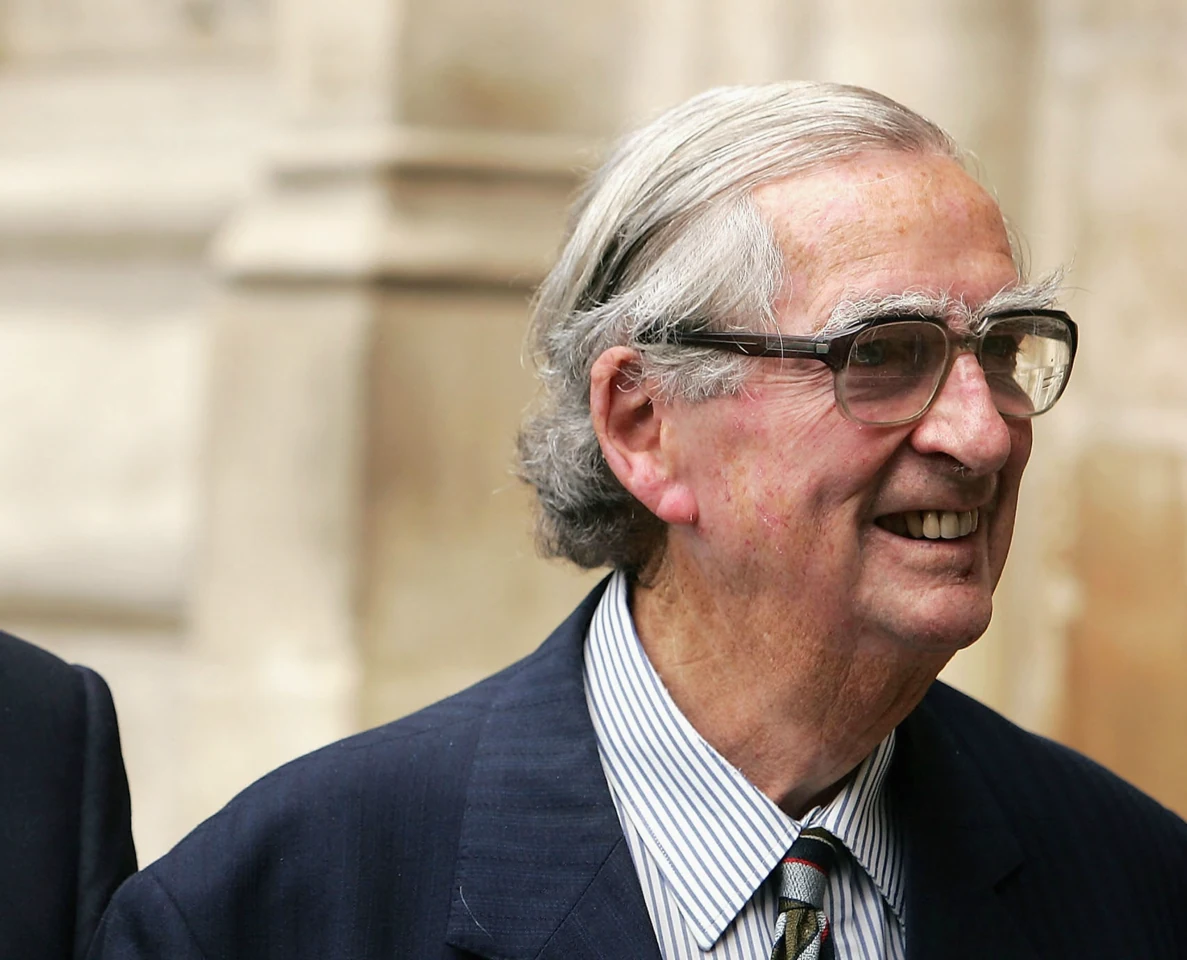
Denis Healey spent four decades in the House of Commons, held two of the most prominent offices in British government and became one of Labour’s best-known political figures. As Chancellor of the Exchequer, he faced sterling instability and the 1976 International Monetary Fund loan. As Defence Secretary, he oversaw a major reduction in Britain’s military commitments beyond Europe. His career also encompassed wartime service, fierce Labour leadership contests and an unusually long public life, from his first election in 1952 to his retirement from the Lords in 2015.
From Mottingham to the Army
Denis Winston Healey was born on 30 August 1917 in Mottingham, then in Kent. His family moved to Keighley in the West Riding of Yorkshire when he was five. His father, William, was an engineering mechanic who became head of Keighley Technical School. Healey attended Bradford Grammar School and won a scholarship to Balliol College, Oxford, in 1936. He read Greats and graduated with a double first in 1940.
After university, Healey served in the Second World War, first as a gunner in the Royal Artillery and then as an officer in the Royal Engineers. His service took him through the North African and Italian campaigns. At Anzio in 1944 he was the military landing officer for the British assault brigade; he was twice mentioned in dispatches and left the Army as a major. He was appointed an MBE in 1945.
Before the war ended, Healey had also entered Labour politics. He narrowly failed to win Pudsey and Otley in the 1945 general election. After the war he became secretary of the Labour Party’s international department, working on foreign policy and building contacts with socialist parties in Europe. He entered Parliament at a by-election in 1952 as MP for Leeds South East. After boundary changes, he represented Leeds East from 1955 until 1992.
Defence and the changing role of Britain
Healey became Secretary of State for Defence when Labour won the 1964 general election. He remained in the post until the party lost office in 1970, making him the longest-serving Defence Secretary, according to the biographical account. His time at the Ministry of Defence was marked by a deliberate attempt to reduce spending and scale back Britain’s military presence outside Europe, while maintaining a commitment to NATO.
The decisions involved cancelling or changing major programmes and withdrawing from commitments overseas. Among the projects abandoned were the proposed CVA-01 fleet-carrier replacement, the fifth planned Polaris submarine and several aircraft programmes, including the BAC TSR-2. In 1968, Healey and Prime Minister Harold Wilson announced plans to withdraw British forces from bases in South-East Asia, the Persian Gulf and elsewhere east of Suez. Those plans were not implemented all at once: Edward Heath’s government slowed their execution, and some forces remained in the region for years.
Healey’s record was not without controversy. He supported arms sales abroad, including to the apartheid government of South Africa, and later said that he had been wrong to approve that sale. He also authorised the removal of the Chagossian people from the Chagos Archipelago and the construction of the United States military base at Diego Garcia. These decisions belong in any account of his defence policies, alongside the reductions in Britain’s overseas role.
Chancellor in a time of economic strain
Labour returned to government in 1974, and Healey became Chancellor of the Exchequer in March. He held the office until the Conservatives took power in 1979. The period brought inflation and pressure on sterling. Healey’s early budgets included higher benefits and food subsidies, alongside proposals to redistribute income and wealth. His approach changed as the economic crisis deepened, and the shift divided opinion within his own party.
The defining episode came in 1976, when Healey and Prime Minister James Callaghan sought an IMF loan during the sterling crisis. The agreement brought external conditions on public spending. Healey’s chancellorship is sometimes divided into “Healey Mark I” and “Healey Mark II”: the labels capture the contrast between his earlier proposals, including a wealth tax, and the later period of spending restraint and government-backed pay controls. The loan and the measures attached to it were politically contentious; they should not be mistaken for a settled or uncontested route to lasting economic stability.
Healey also stood for the Labour leadership after Harold Wilson resigned in 1976, but finished third in the contest won by Callaghan. When Labour lost the 1979 general election, Healey became a leading figure in opposition. He lost the leadership election to Michael Foot in 1980, then served as deputy leader. In 1981, Tony Benn challenged him for that position under Labour’s new electoral system. Healey survived by a narrow margin, winning 50.4 per cent of the vote.
Parliamentary life, public image and later years
In opposition, Healey held shadow roles including Foreign Secretary. He stepped down as deputy leader after Labour’s defeat in 1983 and left the Shadow Cabinet in 1987. He remained an MP for Leeds East until 1992, when he retired from the Commons and entered the House of Lords as Baron Healey of Riddlesden. He was deputy leader of the Labour Party from 1980 to 1983, and was among the party’s most prominent voices through years of internal argument over its direction.
Healey was also familiar to audiences beyond Parliament. His bushy eyebrows and sharp, often caustic wit became part of his public image; the impressionist Mike Yarwood popularised the catchphrase “Silly Billy” as a supposed Healey line, which Healey later adopted. He appeared on television entertainment programmes, including Morecambe and Wise, and was satirised in Spitting Image. Away from politics, he took photographs, enjoyed music, painting and crime fiction, and sometimes played the piano at public events. His books included the photography collection Healey’s Eye and the autobiography The Time of My Life.
Healey married Edna Edmunds in 1945; they had three children and were married for almost 65 years. They lived in Alfriston, East Sussex. He died at home on 3 October 2015, aged 98, and was buried beside his wife at St Andrew’s Church. His personal archive was deposited at the Bodleian Library in 2017. Among his honours were the MBE, awarded in 1945, and appointment to the Order of the Companions of Honour in 1979.
Why Denis Healey deserves a place in British Legacy
Denis Healey’s place in British political history rests on decisions made at moments when the country’s priorities were under strain. As Defence Secretary, he directed a substantial retrenchment of Britain’s military role beyond Europe, cancelling costly programmes and changing the scale and location of the country’s commitments. Those choices were bound up with a stated desire to shift resources towards domestic priorities while retaining the NATO commitment. His record also included decisions with lasting human and political consequences, notably the removal of the Chagossians and the sale of arms to South Africa. Remembering both aspects makes his legacy more useful than a celebration that ignores the costs of government.
As Chancellor, Healey confronted the 1976 sterling crisis and negotiated an IMF loan whose spending conditions became a flashpoint within Labour. His career shows the pressures involved in reconciling economic management with a party’s social and political commitments. Outside office, his long parliamentary service, contested leadership campaigns and distinctive public manner helped make political argument visible to a broad audience. He served Britain in war and in government, represented Leeds for 40 years, and remained a prominent figure in national debate into old age. British Legacy can remember him not as an uncomplicated hero, but as a consequential politician whose decisions reveal how defence, public spending and party principle meet in the exercise of power.
Sources
Denis Healey (revision 1379198944) · Denis Healey
Adapted in part from Denis Healey by Wikipedia contributors, under CC BY-SA 4.0. Text has been edited and combined with the existing article; this adapted text is shared under the same licence. Contributor history.