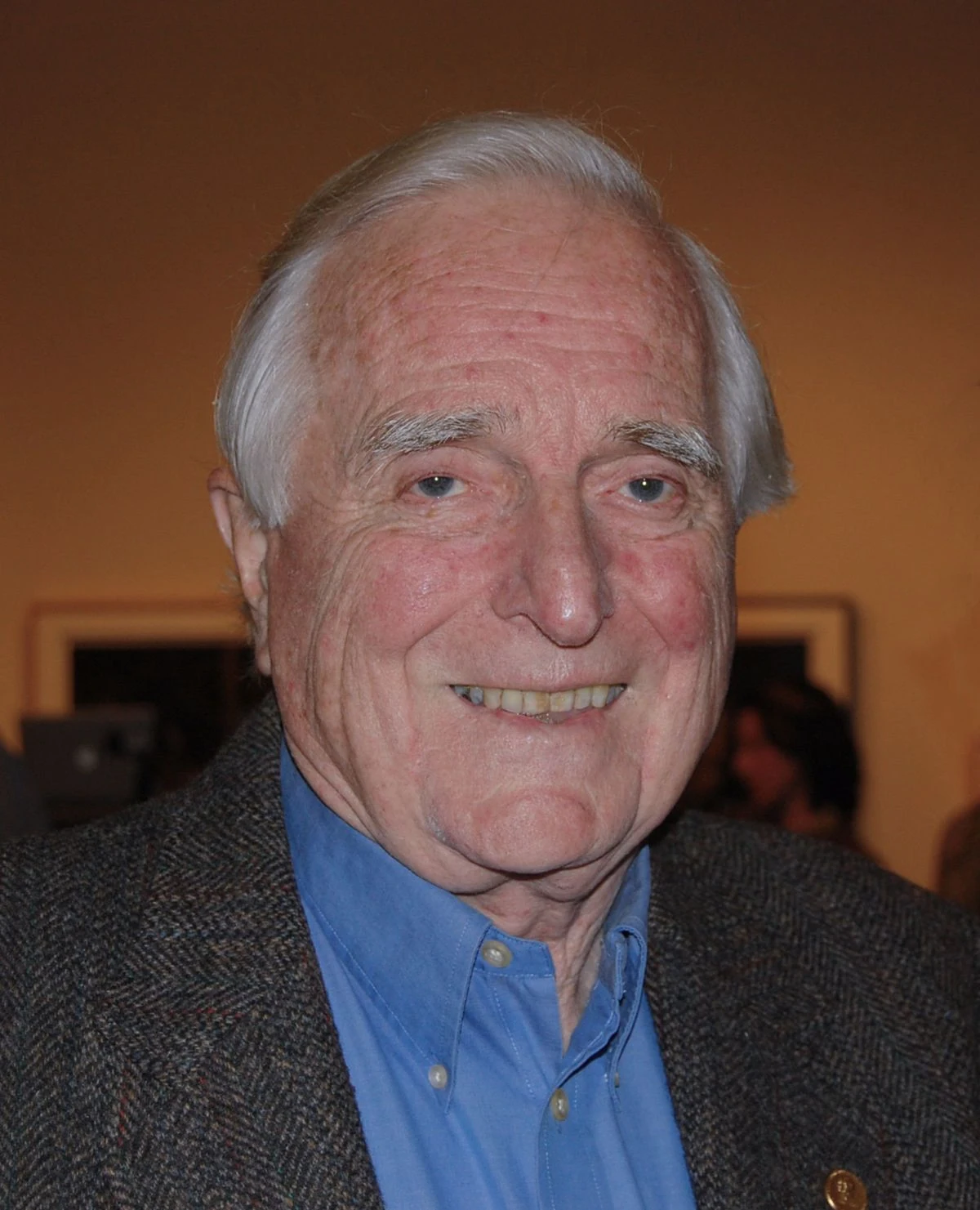
Douglas Engelbart did not set out merely to make computers easier to operate. He believed they could help people think and work together more effectively. At the Augmentation Research Center at Stanford Research Institute, he and his colleagues developed the computer mouse alongside a wider set of tools for interacting with information, including hypertext, bitmapped screens and collaborative computing. Their work came together in a landmark public demonstration in 1968.
Engelbart was an American engineer, not a British inventor. His connection to Britain is more specific than the broad claim that his ideas shaped the country’s entire digital culture: in 2001, he received the British Computer Society’s Lovelace Medal. His work also belongs to a history of computing whose influence crossed national boundaries, but the case for his place in British Legacy rests on identifiable achievements and this direct recognition by a British professional society.
A career shaped by a large ambition
Douglas Carl Engelbart was born in Portland, Oregon, on 30 January 1925. He served in the United States Navy as a radio and radar technician in the Philippines during the Second World War. There, he read Vannevar Bush’s 1945 essay “As We May Think”, which argued for making knowledge more widely accessible. Engelbart returned to Oregon State University and completed a degree in electrical engineering in 1948. He later studied at the University of California, Berkeley, earning a master’s degree in 1953 and a doctorate in 1955.
His ambitions had taken shape years earlier. Engelbart reasoned that serious efforts to improve the world depended on people combining their knowledge, and that computers might make such collective work more effective. At a time when computers were generally used for calculation and often accessed through intermediaries, he imagined workers using interactive displays to navigate information and collaborate. This was not simply a forecast about smaller machines. It was a proposal for changing how people could use technology to solve problems together.
After a year as an assistant professor at Berkeley, he decided that the university could not support the research he wanted to pursue. He briefly formed a company to commercialise work on storage devices, then took a position at Stanford Research Institute in Menlo Park in 1957. In 1962, he set out his research agenda in Augmenting Human Intellect: A Conceptual Framework. The resulting work gained support from the Advanced Research Projects Agency, and Engelbart formed the institute’s Augmentation Research Center.
The mouse and the 1968 demonstration
Engelbart’s team developed the oN-Line System, or NLS, as a working environment for handling information. Its tools included the mouse, bitmapped screens, word processing, hypertext and facilities for collaboration. The computer mouse was developed with lead engineer Bill English before 1965. The pair’s device used a wooden shell and two metal wheels; Engelbart’s 1967 patent application described it as an “X-Y position indicator for a display system”. He later explained that the name came from the cable, which looked like a tail.
The mouse was only one element of the team’s work. At the 1968 demonstration later known as “The Mother of All Demos”, Engelbart showed the NLS and a range of the centre’s ideas, including networked computing and a chorded keyboard. The demonstration made visible a way of working with a computer that joined screen, pointing device, text and shared information. It is more accurate to describe these as connected developments than to credit the mouse alone with creating the graphical interface or modern computing.
Engelbart received a patent for the mouse in 1970, but he did not receive royalties from the invention. He later said that the institute had licensed it to Apple Computer for about $40,000. The device became widely recognised, while Engelbart’s broader interest remained focused on how computer systems could support people and organisations.
Building—and sustaining—a research programme
The research centre’s work depended on institutional backing. Changes in funding during the early 1970s, disagreements over the direction of computing and the departure of researchers weakened the group. Some younger computer scientists favoured personal computers, while Engelbart continued to emphasise networked systems and shared work. In 1976, the laboratory and its software transferred to Tymshare, which renamed NLS as Augment. McDonnell Douglas acquired Tymshare in 1984.
At both companies, Engelbart found limited support for continuing the research programme he envisaged. He retired from McDonnell Douglas in 1986. This part of his career shows the distance that can open up between a technical idea and the sustained organisational commitment required to develop it. Although elements of the centre’s work became familiar features of later computing, the research itself had to pass through changes in ownership and purpose.
Engelbart continued to promote his approach. In 1988, he and his daughter Christina founded the Bootstrap Institute, later known as the Doug Engelbart Institute, to develop and share his ideas about improving collective problem-solving. From 1989 to 2000, the institute’s work included management seminars at Stanford University. A later collaboration also received funding to develop a modern user interface for Augment. In 2005, a National Science Foundation grant supported the open-source HyperScope project, which set out to reproduce some of Augment’s document-viewing and linking capabilities.
Recognition in the United States and Britain
Recognition for Engelbart’s work came through several scientific and technical institutions. He received the ACM Turing Award and the Lemelson–MIT Prize in 1997, and was inducted into the National Inventors Hall of Fame in 1998. In 2000, US President Bill Clinton awarded him the National Medal of Technology. The Computer History Museum made him a fellow in 2005, citing his contributions to human–computer interaction, the mouse and the use of computers to improve organisational efficiency.
The British Computer Society awarded Engelbart its Lovelace Medal in 2001. This provides a clear British connection without implying that his work originated in Britain or that particular British products or researchers were directly influenced by him. His career is also a useful reminder that the development of computing involved institutions, researchers and professional communities across borders. In this case, a British professional society formally recognised an American engineer whose work had helped establish important approaches to interacting with computers.
Engelbart died at his home in Atherton, California, on 2 July 2013, aged 88. He had founded and led a research centre, helped demonstrate an ambitious system for working with information, and spent much of his later career trying to keep his wider programme of collective problem-solving alive.
Why Douglas Engelbart deserves a place in British Legacy
Engelbart deserves a place in British Legacy not because he was British, but because his documented story connects a major international contribution to a British institution. The British Computer Society’s Lovelace Medal, awarded to him in 2001, is a concrete point of recognition. It gives the British connection substance while avoiding claims that the evidence does not establish about specific British companies, schools or individual researchers adopting his ideas.
His achievements also merit attention beyond the familiar shorthand of “inventor of the mouse”. Working with Bill English and the Augmentation Research Center, Engelbart helped develop a broader system of interactive computing, demonstrated in 1968. Its mouse, hypertext, bitmapped screens, word processing and collaborative tools formed parts of a research programme grounded in a social purpose: using computers to help people work with information and with one another. He continued to advocate that purpose after the original laboratory moved through new owners, founding the Bootstrap Institute with his daughter and supporting further work on Augment and HyperScope. Remembering Engelbart in a British collection therefore does not require making an unsupported claim about national influence. It recognises a British professional society’s response to work that changed how computing could be imagined, and honours a cross-border history of ideas, engineering and public recognition.
Sources
Douglas Engelbart — revision 1371987766
Adapted in part from Douglas Engelbart by Wikipedia contributors, under CC BY-SA 4.0. Text has been edited and combined with the existing article; this adapted text is shared under the same licence. Contributor history.