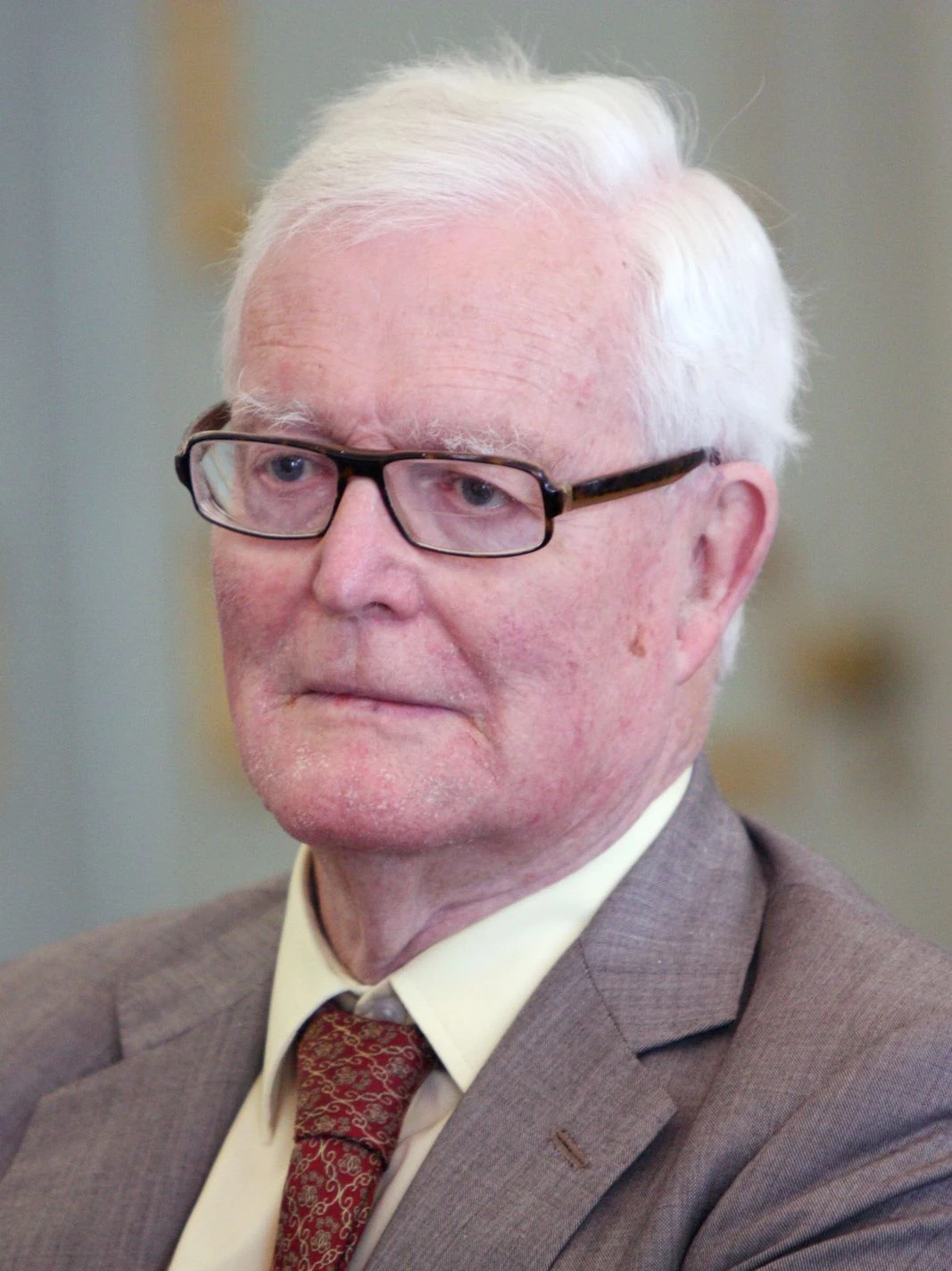
Douglas Hurd entered the Foreign Office in 1989 as Europe was being reshaped by the end of the Cold War. As Foreign Secretary under Margaret Thatcher and John Major, he welcomed a reunified Germany into the European political community, dealt with the collapse of the Soviet Union and helped determine Britain’s response to the wars in the former Yugoslavia. His record was not without controversy: his opposition to military aid for the Bosniaks drew criticism, and a court later ruled that his allocation of British aid to a Malaysian dam exceeded his legal powers.
From Marlborough to the Diplomatic Service
Douglas Richard Hurd was born in Marlborough, Wiltshire, on 8 March 1930. Public life was part of his family background: his father, Anthony, and grandfather, Sir Percy Hurd, were both Members of Parliament. Hurd attended Twyford School and Eton College, where he was a King’s Scholar, won the Newcastle Scholarship in 1947 and became captain of the school.
After leaving Eton, he completed National Service in the Royal Regiment of Artillery and was selected for officer training. He began at Trinity College, Cambridge, in 1949, served as president of the Cambridge Union Society and studied history, graduating with a first-class degree in 1952. He joined the Diplomatic Service that year. His postings took him to China, the United States and Italy; in 1966, he left the service to enter Conservative politics.
Hurd became a private secretary to Conservative prime minister Edward Heath, a political appointment that preceded his own election to the House of Commons. In February 1974, he won the Mid Oxfordshire seat, later renamed Witney, and represented the constituency until leaving the Commons in 1997. When the Conservatives returned to government in 1979, Margaret Thatcher appointed him Minister of State at the Foreign and Commonwealth Office. He was the first holder of that ministerial role focused on Europe.
Cabinet service before the Foreign Office
Hurd moved through several senior posts as Thatcher’s government changed. After the 1983 election, he went to the Home Office as a minister of state. In 1984, he became Secretary of State for Northern Ireland, succeeding Jim Prior. During that period, the Anglo-Irish Agreement marked a turning point in co-operation between the British and Irish governments over Northern Ireland. Hurd returned to the Home Office in 1985 as Home Secretary, a post he held until 1989.
His Home Office record included the Public Order Act 1986, which created an offence relating to public speech intended or likely to stir up racial hatred. He also argued for more rehabilitation of offenders and for alternatives to prison sentences, having concluded that the prison service did not work effectively. The range of these responsibilities—Northern Ireland, public order and criminal justice—formed the background to his later work in international affairs.
In 1990, Hurd stood in the Conservative leadership contest after Thatcher withdrew. He came third, behind Michael Heseltine and the eventual winner, John Major. Hurd and Heseltine then conceded, allowing Major to take over without a further ballot. Hurd remained Foreign Secretary in Major’s government, having taken up the post in October 1989 under Thatcher.
Foreign Secretary through a changing Europe
Hurd’s term as Foreign Secretary ran from 26 October 1989 to 5 July 1995. It encompassed the end of the Cold War, the Soviet Union’s collapse in 1991 and the first Gulf War, in which a coalition drove Iraqi forces from Kuwait. He cultivated relations with the United States under President George H. W. Bush and sought a more conciliatory approach towards other members of the European Community after tensions during Thatcher’s final years as prime minister.
Germany’s reunification in 1990 was one of the defining changes of the period. Hurd welcomed the reunited country into the European political community. In 1992, he signed the Maastricht Treaty, which established the European Union. These events placed British diplomacy within a debate about how a newly unified Germany and a changing Europe should relate to one another. Hurd’s place in that debate was as a serving British Foreign Secretary, responsible for representing his government as the political landscape shifted.
The wars following the break-up of Yugoslavia brought a different and more contested set of choices. During the Bosnian War, Hurd argued against sending military aid to the Bosniaks and supported keeping the arms embargo in place. He maintained that lifting it would create a “level killing field” and could prolong the conflict. He also opposed admitting Bosnian refugees to Britain, arguing that their presence might reduce pressure on Bosnia and Herzegovina to seek peace. The policy attracted criticism; in 2010, Hurd said he remained troubled by it, while still doubting that intervention would have ended the war sooner.
A legal challenge over aid
Hurd’s time at the Foreign Office also became associated with the Pergau River hydroelectric dam in Malaysia. Construction began in 1991 with money from Britain’s foreign aid budget, while the Malaysian government was buying British-made arms. The apparent connection between arms sales and aid led to a government inquiry in 1994. That year, the World Development Movement sought a judicial review of the decision to allocate £234 million towards the dam.
In November 1994, the High Court ruled that the allocation was outside Hurd’s legal powers. The legislation empowered him to fund economically sound projects, and the court held that the dam funding did not meet that requirement. The controversy became a significant test of the boundaries of a Foreign Secretary’s authority over aid expenditure. In 1997, responsibility for the aid budget was moved from the Foreign Secretary’s remit to the newly established Department for International Development.
Hurd left frontline politics in 1995, after 11 years in the Cabinet, and was succeeded as Foreign Secretary by Malcolm Rifkind. He stayed on as a political supporter of Major and took business appointments, including deputy chairman of NatWest Markets and a board position at NatWest Group. He left the Commons in 1997 and was made a life peer as Baron Hurd of Westwell, enabling him to sit in the House of Lords. He retired from the Lords in 2016.
Public service beyond government
After leaving ministerial office, Hurd continued to take part in public and institutional life. He chaired British Invisibles, later renamed International Financial Services London, and served on the Royal Commission on the Reform of the House of Lords. In 1999, he became High Steward of Westminster Abbey. He also chaired a commission reviewing the roles and functions of the Archbishop of Canterbury, and served as chairman of the German British Forum until 2005.
His public work included an interest in crime prevention. In 1988, he established Crime Concern, which worked with young people, families and adult offenders to address crime, anti-social behaviour and fear of crime, including through training and employment opportunities. The charity merged with Rainer in 2008 to form Catch22. Hurd also served as a patron of the Tory Reform Group and as an adviser to FIRST, an international affairs organisation.
Writing ran alongside his political career. His books include political thrillers, historical works and memoirs: among them The Arrow War, The Search for Peace, Memoirs, a biography of Robert Peel and Choose Your Weapons: The British Foreign Secretary. His fiction included The Shape of Ice and Image in the Water. This range reflects a continuing engagement with political history and the practice of diplomacy, rather than a career confined to ministerial office.
Why Douglas Hurd deserves a place in British Legacy
Douglas Hurd’s place in British Legacy rests on a record of public service across diplomacy, Parliament and government. As Foreign Secretary from 1989 to 1995, he represented Britain through the end of the Cold War, the dissolution of the Soviet Union and the reunification of Germany. He signed the Maastricht Treaty on behalf of the British government and worked to maintain relations with the United States while repairing ties with European Community partners. These were not abstract changes: they shaped the diplomatic setting in which Britain operated at a moment of profound political transition in Europe.
His legacy is also more complicated than a simple celebration of diplomatic skill. His Bosnia policy remains contested, and the Pergau dam ruling established a legal limit on his power to allocate aid. Those episodes make his record useful to remember as a case study in the choices and accountability of government. Beyond the Foreign Office, Hurd served as a constituency MP, helped establish Crime Concern and contributed to public institutions and debate after leaving the Cabinet. His career connects British diplomacy to domestic law, parliamentary representation and practical work on crime prevention. Taken together, those contributions—and the disputes surrounding them—give a fuller account of how a senior British politician exercised public responsibility during a period of change.
Sources
Douglas Hurd — Wikipedia revision 1378672959 · Douglas Hurd — Wikipedia
Adapted in part from Douglas Hurd by Wikipedia contributors, under CC BY-SA 4.0. Text has been edited and combined with the existing article; this adapted text is shared under the same licence. Contributor history.