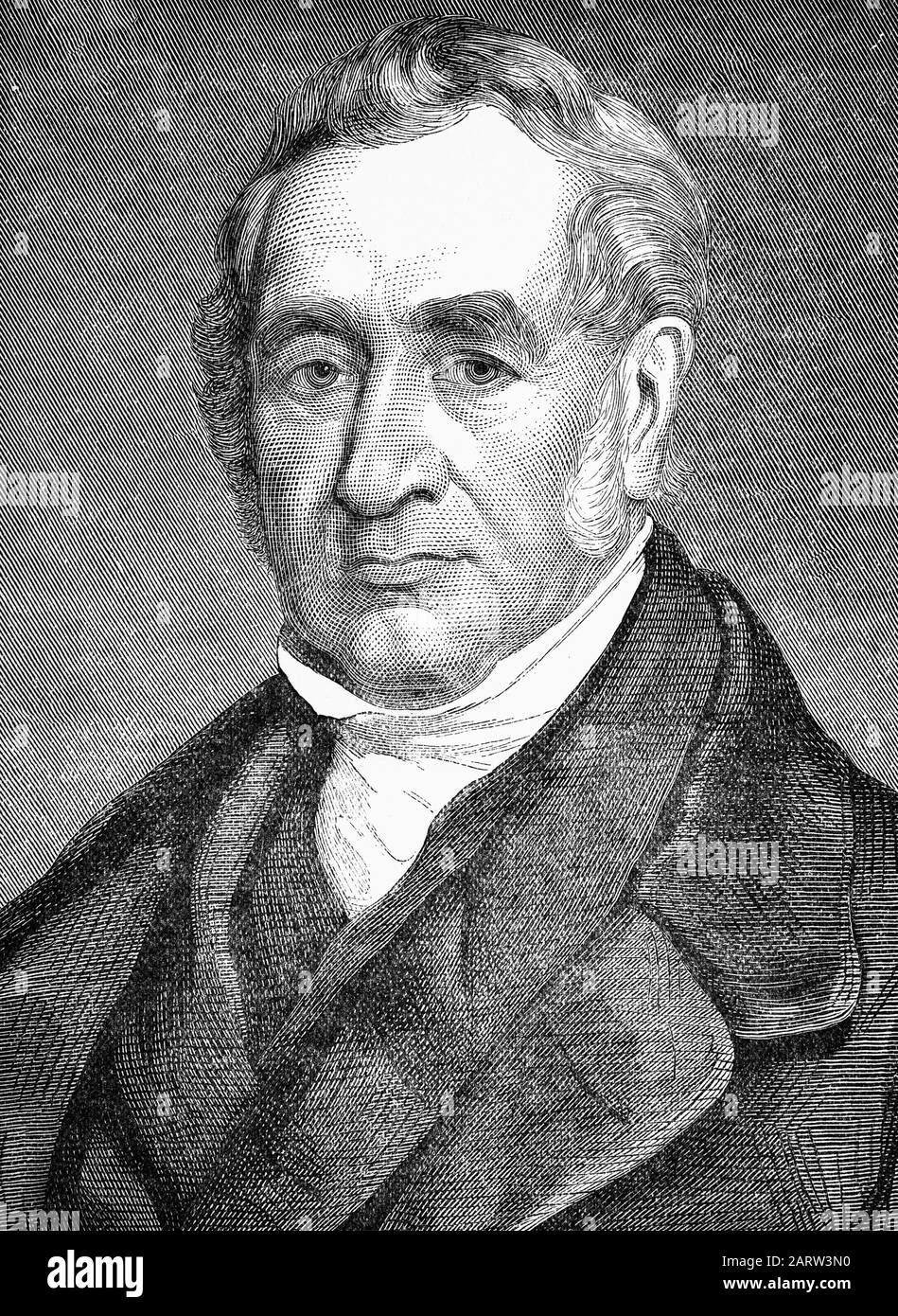
George Stephenson’s railway career began among the engines and wagonways of the Northumberland coalfield. Born at Wylam in 1781, the son of a colliery fireman, he had no formal schooling as a child. He learnt to read, write and reckon at night school as a young man, then built his expertise through practical work. His achievements included developing locomotives for coal transport, helping establish two landmark public railways and advancing a track gauge that became standard across much of the world.
A colliery education
Stephenson was born on 9 June 1781 at Wylam, about nine miles west of Newcastle upon Tyne. His father, Robert, worked as a fireman on a colliery pumping engine; neither parent could read or write, and the family could not afford to send George to school. At 17 he became an engineman at Water Row Pit, near Newburn. He paid to attend night classes, learning reading, writing and arithmetic, and later worked as a brakesman, controlling winding gear at different collieries.
In 1811, when a pumping engine at High Pit, Killingworth, was not working properly, Stephenson offered to repair it. His success brought promotion to enginewright for the Killingworth collieries, responsible for maintaining and repairing their engines. This work gave him a close understanding of steam-driven machinery. His engineering was grounded in the demands of mines: machinery had to work reliably, move heavy loads and operate in difficult conditions.
In 1815 he began experimenting with a safety lamp for use in mines where firedamp could ignite. The Cornish scientist Humphry Davy was working on the same danger, and their designs differed. Stephenson demonstrated his lamp underground before Davy presented his design to the Royal Society. The dispute over priority became contentious: a local inquiry supported Stephenson, and a House of Commons committee in 1833 found that he had an equal claim to the invention. The experience illustrates both his practical, experimental approach and the obstacles faced by a working engineer without the scientific standing of a celebrated academic.
Building locomotives for the coalfields
Stephenson designed his first locomotive in 1814 for the Killingworth wagonway. Named Blücher, it was intended to haul coal. Modelled on an earlier locomotive by Matthew Murray, it could draw 30 tons uphill at about four miles an hour. It was a successful flanged-wheel adhesion locomotive: its traction came from the contact between its wheels and the rails. The achievement was not an isolated leap. Stephenson and other engineers were adapting steam power to the practical limits of tracks, engines and heavy loads.
Those limits included fragile rails. Early cast-iron rails could break under the weight of locomotives, so Stephenson worked with William Losh to improve their design. He also experimented with distributing an engine’s weight over more wheels. For the Stockton and Darlington Railway, he used wrought-iron rails, which could be made longer and were less liable to crack under heavy loads.
In 1820 Stephenson was hired to build the eight-mile Hetton colliery railway. Opened in 1822, it was the first railway to operate without animal power, combining locomotives on level and uphill stretches with gravity on downhill inclines. The line was a practical demonstration of how different methods of traction could be used across a route, rather than relying on a single solution.
From Stockton and Darlington to Rainhill
The Stockton and Darlington Railway was initially planned for horse-drawn coal carts. After director Edward Pease met Stephenson, the company changed course and decided to use locomotives. Stephenson surveyed the route in 1821, with his 18-year-old son Robert assisting. George and Pease helped establish a Newcastle locomotive works, Robert Stephenson and Company, which supplied the engines.
The railway opened on 27 September 1825. Stephenson drove Locomotion, which hauled a load of coal and flour weighing about 80 tons for nine miles. The journey took two hours; on one stretch the train reached 15 miles an hour. A purpose-built passenger carriage, Experiment, carried dignitaries. This was the first time passenger traffic had been carried on a steam-locomotive railway. The line joined coal-producing areas to the River Tees and showed that locomotives could serve a public railway, not just a colliery wagonway.
Stephenson’s next major undertaking was the Liverpool and Manchester Railway, which opened in 1830 as the world’s first public inter-city railway to use locomotives. He sought to keep the route as level as possible, constructing cuttings, embankments and viaducts. A difficult section crossed Chat Moss, a peat bog. Stephenson’s solution was to float the track over a foundation of heather and branches, which was compressed beneath the railway.
To choose locomotives for the line, the railway’s directors held the Rainhill Trials in October 1829. Rocket, designed by Robert Stephenson with substantial input from his father, won the competition. Its fire-tube boiler improved heat exchange; the idea was suggested by Henry Booth, the railway’s treasurer. Credit for the locomotive’s development therefore belongs to more than one person, even as the Stephenson name became closely associated with it.
The Liverpool and Manchester Railway’s opening ceremony took place on 15 September 1830. George drove Northumbrian in a procession of eight trains. The day was marred when William Huskisson, the MP for Liverpool, was struck by Rocket and later died of his injuries. Despite the tragedy, the railway became a success, and Stephenson’s work brought him further engineering commissions. Its construction and operation demonstrated the potential of a railway to carry passengers and goods between major towns.
A network, not just a locomotive
Stephenson’s contribution extended beyond locomotive design. He understood that separately built railways would eventually need to connect, and that a common gauge would make that possible. The gauge he had used on the Stockton and Darlington Railway was 4 feet 8½ inches. It became the standard gauge used by most of the world’s railways.
He continued to work on railway projects across Britain, including the North Midland line and routes connecting towns in the Midlands and north of England. He also invested in the Leicester and Swannington Railway, whose first section opened in 1832 under Robert’s engineering leadership. At Snibston, near the proposed route, Stephenson bought an estate believed to contain coal. His mining venture supplied Leicester by rail and helped reduce the city’s coal costs.
Stephenson’s career was not without setbacks. His cautious views sometimes led him to favour longer, less direct routes, and his estimates and administrative work drew criticism. On the Grand Junction Railway he worked with Joseph Locke, but dissatisfaction with his estimates contributed to his resignation. The railway engineer was not infallible; his working life involved competing judgements about cost, route and what locomotives could achieve.
He became the first president of the Institution of Mechanical Engineers when it was formed in 1847. In later years he settled at Tapton House in Derbyshire and devoted time to his mining interests. He died there on 12 August 1848, aged 67, and was buried at Holy Trinity Church in Chesterfield.
Why George Stephenson deserves a place in British Legacy
George Stephenson deserves a place in British Legacy because his work helped turn the railway from an idea into an operating system for moving people and goods. He developed locomotives for the coalfields, tackled practical problems with engines and rails, and helped build the Stockton and Darlington Railway and the Liverpool and Manchester Railway. These were not achievements of a lone inventor working apart from others: Edward Pease, Robert Stephenson, Henry Booth and many other engineers and workers contributed to the projects. Stephenson’s significance lies in how he applied mechanical knowledge to the connected challenges of route-building, traction and public railway operation.
His influence also endured in the physical standard of the network. The gauge he used on the Stockton and Darlington Railway became the standard gauge adopted by most railways worldwide, making compatibility between lines a lasting part of his legacy. In Britain, the railways he helped establish formed part of the transport infrastructure that carried coal, other goods and passengers between communities. His story also links engineering achievement to education: born into a family unable to pay for schooling, he learnt at night while working in the collieries and went on to lead major engineering projects. That record—practical invention, infrastructure and hard-won technical learning—gives his British legacy substance beyond the familiar title of “Father of Railways”.
Sources
George Stephenson — Wikipedia, revision 1377781242
Adapted in part from George Stephenson by Wikipedia contributors, under CC BY-SA 4.0. Text has been edited and combined with the existing article; this adapted text is shared under the same licence. Contributor history.