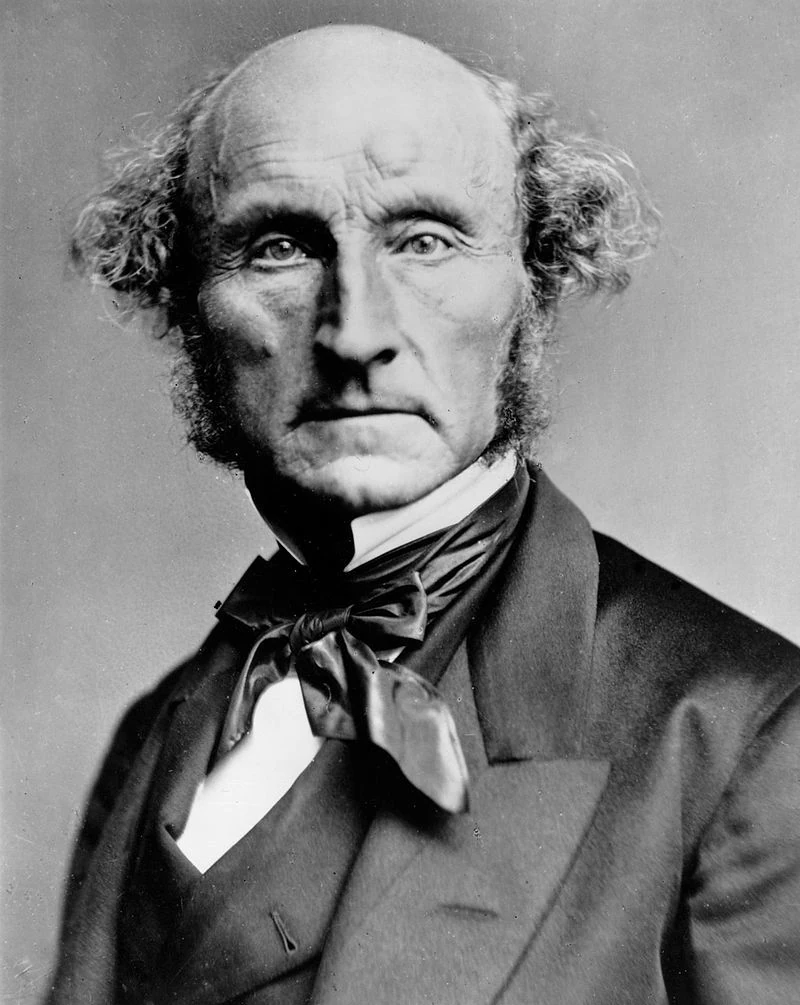
John Stuart Mill’s influence was built through argument: about how much power society may exercise over an individual, how evidence should be tested, and whether women should remain legally and politically subordinate to men. Born in Pentonville in 1806, he became a philosopher, political economist and Liberal MP for Westminster. His books addressed liberty, logic, political economy and equality; in Parliament he took up women’s suffrage. The range of that work—and the tensions within it, particularly his defence of colonial rule—makes him a revealing figure in Britain’s intellectual and political history.
A childhood designed for intellect
Mill was the eldest son of Harriet Barrow and James Mill, a Scottish philosopher, historian and economist. His father’s ambition was to prepare him to carry forward utilitarianism, the reforming philosophy associated with Jeremy Bentham. The education began early and was unusually intensive. Mill learned Greek at three and Latin at eight; his reading soon ranged across ancient literature, history, mathematics, logic and political economy. He was also set to teach younger children in the family.
This was not an ordinary childhood. James Mill deliberately limited his son’s contact with children outside the family, and directed his learning towards intellectual usefulness. John Stuart’s precocity is striking, but the method placed a heavy weight on reason and study. At fourteen he spent a year in France with the family of Samuel Bentham, Jeremy Bentham’s brother. The mountain scenery and French social life left lasting impressions, while courses in subjects including chemistry, zoology and mathematics extended his education beyond his father’s tutelage.
In his early twenties Mill experienced a period of deep sadness and contemplated suicide. In his autobiography he described asking himself whether the achievement of a just society, the goal towards which he had been working, would make him happy. Poetry, particularly the work of William Wordsworth, helped him recognise the importance of beauty and feeling. He did not abandon reform or reason; he came to see that a worthwhile life required more than either. Individuality, imagination and emotional development became more prominent in his thinking.
That change helps explain the breadth of his mature work. Mill remained concerned with institutions and public welfare, but he also asked what kinds of people those institutions allowed to develop. His education had trained him to reason; his crisis gave him reason to question whether intellectual discipline alone could sustain a full human life.
Work, administration and empire
Mill joined the East India Company in 1823, aged seventeen, and remained there until the company’s territories in India came under direct Crown control in 1858. He rose through its administrative ranks, eventually becoming Examiner of Indian Correspondence. His career brought sustained contact with the practice of government as well as the study of political institutions.
It also complicates any simple account of him as an unqualified champion of freedom. Mill defended British colonial government in terms that reflected the assumptions of his age and his own belief that societies he considered less developed could be ruled despotically for the purpose of improvement. He supported Company rule in India, even while criticising particular policies, and wrote in defence of the company when Crown control was proposed. His arguments for liberty did not extend equally to peoples under British rule. Recognising that contradiction is part of understanding both the reach and the limits of his political thought.
Mill’s public career later brought him directly into British parliamentary life. He represented the City of Westminster as a Liberal MP from 1865 to 1868. He advocated a wider franchise and parliamentary changes, including proportional representation, and took up social questions such as labour organisations and co-operatives. His political activity did not simply reproduce his philosophical writing: it required him to argue within institutions, address immediate proposals and contend with opposition.
Liberty against state and social pressure
Published in 1859, On Liberty remains Mill’s best-known book. Its concern is not simply freedom from a powerful monarch. Mill also feared the pressure that a majority, public opinion or social custom could exert on a person who departed from accepted ways. A society could hold elections and still restrict thought through convention, exclusion or censorship. Power over individuals could come from neighbours and public opinion as well as from government.
Mill’s proposed limit is often called the harm principle. In his account, the only proper reason to exercise power against an adult’s will is to prevent harm to others; a person’s own supposed good, physical or moral, is not by itself enough. That principle is not a claim that all actions are beyond regulation. Mill distinguished between a person’s own conduct and conduct that affects others, and accepted that harmful acts could justify interference. His central challenge was to those who would use coercion merely because they disliked an action or believed they knew what was best for the person concerned.
Freedom of discussion is essential to this argument. Mill insisted that no individual or majority can assume infallibility. A view that is suppressed might be true; even a false view can make the truth clearer when people have to answer it. And many opinions contain only part of the truth, which open disagreement can test and develop. Beliefs repeated without challenge risk becoming dead formulas rather than ideas their holders understand. For Mill, discussion was therefore not a concession to disorder but a means of correcting error and keeping knowledge alive.
Liberty also had a positive purpose. It gave people room to form judgements, try different ways of living and develop their capacities. Uniformity might make a society appear orderly, but it could also prevent the growth of distinctive character. Mill’s defence of individual freedom joined a concern about coercion to a wider account of human development: people should have space to become more than compliant subjects.
Evidence, education and political judgement
A System of Logic, published in 1843, addressed how reasoning and scientific inquiry work. Mill examined how people move from observations to general claims and why those claims need to be tested against evidence. He argued for a role for induction and empirical verification, including in the study of human society. The project reflected a larger Victorian question: whether subjects such as politics and economics could be approached with disciplined inquiry rather than resting on authority, custom or assertion.
His interest in reason also shaped his writing on utilitarianism. Mill inherited the tradition associated with Bentham and his father, which judged actions by their consequences for happiness. But he resisted a narrow account of happiness as a matter of counting pleasures. He argued that pleasures differ in quality as well as quantity, giving greater importance to intellectual and moral fulfilment than to merely physical satisfaction. That qualification helped him connect welfare to education, character and human dignity.
In Considerations on Representative Government, Mill treated participation as more than a way to choose rulers: it could educate citizens in the responsibilities of public life. He supported widening political participation, while also worrying about how knowledge and judgement would be cultivated. Some of his proposed remedies, including plural voting for those he considered better educated, reflect an elitism that sits uneasily with his advocacy of wider participation. The tension is worth retaining. Mill’s political thought was not a simple blueprint for modern democracy; it was an attempt to confront the competing claims of inclusion, competence and civic education.
His interest in education also found a public expression at the University of St Andrews, where he served as Lord Rector from 1865 to 1868. His inaugural address, delivered in 1867, defended a broad liberal education rather than one restricted to narrowly practical training. The case was consistent with his wider conviction that learning should develop judgement and individuality, not merely prepare people for a fixed role.
Political economy and the uses of prosperity
Principles of Political Economy, first published in 1848, became one of the most widely read economics books of its period. Mill brought together ideas associated with Adam Smith, David Ricardo and his father, but political economy for him was not a detached calculation of wealth. Questions about production, wages, taxation, inheritance and the organisation of work were also questions about how people lived and what opportunities a society made available.
Mill did not simply advocate leaving every economic arrangement untouched. He accepted intervention where he thought there were sufficient grounds and considered co-operatives, trade unions and the distribution of wealth. Over time, his views moved towards a greater interest in socialist ideas and worker ownership. He envisaged forms of association in which workers could own capital collectively and manage their enterprises through elected representatives. His writing combined support for markets in many circumstances with an insistence that economic arrangements should be judged by their human consequences.
He also questioned whether continual economic expansion should be society’s overriding aim. In discussing a stationary state, Mill considered whether growth that damaged the environment and reduced quality of life could be worse than a more stable level of wealth. The point was not that material conditions did not matter, but that prosperity should be assessed by what it allowed people to enjoy and become. That argument gives his economic writing a wider scope than a defence of accumulation for its own sake.
Women’s equality and Westminster
Mill’s case for women’s equality drew on both intellectual partnership and public campaigning. Harriet Taylor, whom he married in 1851 after a long friendship, had a significant influence on his thought. Mill described her contribution in generous terms. The exact extent of her role in particular works is not settled by the supplied evidence, so it is more accurate to recognise her influence than to assign sole authorship of any specific argument to either partner.
The Subjection of Women, published in 1869, attacked the legal subordination of women as unjust and harmful to human improvement. Mill challenged the claim that women’s subordinate position revealed their natural capacities. Since law, education and social arrangements had restricted their opportunities, he argued, it was impossible to treat their resulting position as fair evidence of what women could do. The argument turned a familiar defence of inequality back on itself: a society could not confidently declare women naturally suited to subordination after preventing them from testing their abilities on equal terms.
Mill carried that argument into Parliament. In 1866 he became the second person in Parliament, after Henry Hunt, to call for women to have the vote. The following year, during debates on the Reform Bill, he proposed replacing the word “man” with “person”. The amendment was defeated, but it placed women’s political equality before the Commons as a question of parliamentary reform. His efforts were part of a broader campaign, not its beginning or its entirety. Women activists and campaigners had their own essential role in organising and pressing for change.
Mill’s importance lies partly in the connection he made between principle and legislative action. He argued in print that women’s subordination was indefensible, then used the position of an MP to contest their exclusion from the franchise. His parliamentary interventions did not secure the change he sought, but they made the case in a national political forum and gave it an explicit place in debates about representation.
Why John Stuart Mill deserves a place in British Legacy
John Stuart Mill deserves a place in British Legacy because he helped give British public life a rigorous vocabulary for discussing freedom and its limits. On Liberty confronted not only the power of the state but the quieter coercion of convention and majority opinion. Its defence of open discussion rested on a practical argument: people and institutions make mistakes, and silencing dissent deprives society of opportunities to identify and correct them. Mill also connected liberty to the development of character. Freedom mattered not as an excuse for indifference to others, but as space in which people could form judgements and develop their capacities.
His work on political economy and representative government extended that concern into questions of social organisation. He asked how wealth, education and participation might serve human lives rather than become ends in themselves. His opposition to women’s legal subordination was both an argument about justice and a challenge to the assumptions that kept women from education, independence and political representation. As an MP, he brought that challenge into Westminster, even though his proposed amendment failed. These are specific contributions to British debate, made through books, administration, university life and Parliament.
A useful account of Mill must also include his limits. He defended liberty while supporting forms of colonial rule that denied self-government to people under British power, and some of his ideas about political competence sit uneasily with universal participation. Those contradictions do not erase his achievements; they help explain the historical conditions in which they were formed. Mill’s legacy is not a collection of finished answers. It is a body of arguments that continues to invite scrutiny: about when power is justified, who is permitted to speak, and whether institutions help people lead freer and fuller lives.
Sources
John Stuart Mill — Wikipedia revision 1375478147
Adapted in part from John Stuart Mill by Wikipedia contributors, under CC BY-SA 4.0. Text has been edited and combined with the existing article; this adapted text is shared under the same licence. Contributor history.