
Stanley Spencer painted Cookham as a place where the familiar and the sacred could occupy the same ground. In his biblical scenes, neighbours became Gospel figures and the village churchyard became a site of resurrection. His work also returned to the First World War, not chiefly through images of battle but through hospital routines, wounded men and the companionship of service life. Spencer’s art joined an intensely local vision to questions of faith, death and human connection.
A village carried to the Slade
Spencer was born in Cookham, Berkshire, on 30 June 1891, the eighth surviving child of William and Anna Caroline Spencer. His father, known as Par, was a music teacher and church organist. Spencer was educated at home by his sisters Annie and Florence, and learned to draw with his younger brother Gilbert under the guidance of local artist Dorothy Bailey. In 1907, with the help of local landowner Lady Boston, he began studying at Maidenhead Technical Institute.
From 1908 to 1912, he attended the Slade School of Fine Art in London, where Henry Tonks was among his teachers. His fellow students included Dora Carrington, Mark Gertler and Paul Nash. Spencer was so attached to home that he often travelled back to Cookham after classes; another student, C. R. W. Nevinson, nicknamed him “Cookham”. The name captured an artistic fact as well as a personal habit: the village would remain the imaginative centre of much of his painting.
His early work already combined close observation with biblical subject matter. In 1912 he exhibited at the Second Post-Impressionist Exhibition in London. The following year, Apple Gatherers appeared in the Contemporary Art Society’s first exhibition. In other paintings, familiar people and objects from Cookham entered scenes drawn from scripture. Rather than setting biblical events in a distant, idealised world, Spencer placed them among the houses, lanes and faces he knew.
War, memory and the Sandham Chapel
Spencer first served in the First World War as an orderly with the Royal Army Medical Corps. In 1916 he was sent to Macedonia, where he worked with a field ambulance unit; in 1917 he volunteered for infantry service with the 7th Battalion, the Berkshire Regiment. He spent two and a half years at the front, experienced persistent bouts of malaria and was invalided out of the Army. His elder brother Sydney was killed in action in 1918.
After the war, Spencer’s military experience became the subject of works that looked beyond combat to suffering and care. In Travoys Arriving with Wounded at a Dressing Station at Smol, Macedonia, September 1916, he drew on his experience of the continuous flow of casualties through a dressing station. He described his intention not as horror but as redemption: the wounded and the medical work around them carried spiritual meaning. In 1918 he returned to Cookham and completed Swan Upping, a painting he had left unfinished when he enlisted.
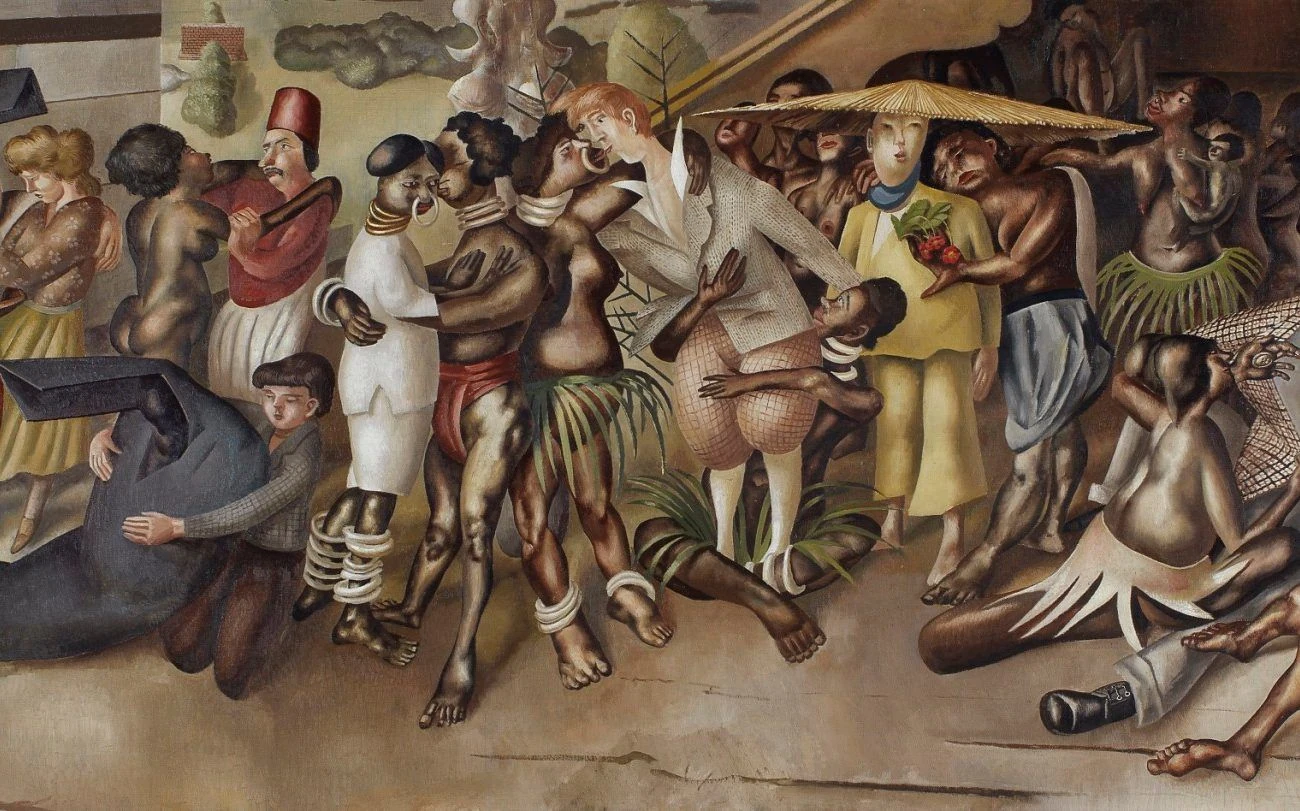
Patrons Louis and Mary Behrend commissioned a group of paintings as a memorial to Mary’s brother, Lieutenant Henry Willoughby Sandham, who had died in the war. They arranged for a chapel to be built at Burghclere to house them. Spencer worked there from 1927 to 1932, creating a cycle of sixteen paintings informed by his service at Beaufort War Hospital, in Hampshire training camps and in Macedonia.
The paintings give space to the ordinary work of military life: scrubbing floors, making beds, filling tea urns and moving kit bags. Their subject is not conventional heroism but the shared routines and human companionship Spencer remembered. At the end of the sequence, soldiers rise from their graves in a vision of resurrection. The chapel’s large-scale cycle thus connects daily labour and wartime loss with Spencer’s persistent belief that death could not be the end of everything.
Resurrection in Cookham
Spencer began The Resurrection, Cookham in 1923, while renting Henry Lamb’s studio in Hampstead. He had married the artist Hilda Carline in 1925; their daughters, Shirin and Unity, were born in 1925 and 1930. The painting was the centrepiece of his first solo exhibition, at the Goupil Gallery in 1927. It shows people emerging from graves in the grounds of Holy Trinity Church, with figures from Spencer’s life among them. Some climb over a stile; others head towards the Thames or inspect their headstones. The scene turns the resurrection into an event within the lived geography of Cookham.
The exhibition received strong attention, and the painting was bought by Lord Duveen, who presented it to the Tate. Spencer’s combination of precise detail and unconventional composition unsettled familiar boundaries between religious painting and scenes of everyday life. His village was neither simply a backdrop nor an idealised rural setting: it was the place through which he could picture spiritual life as immediate and shared.
Spencer continued to develop this fusion in works made for a proposed “Church-House”, an unrealised scheme for a building that would bring together sacred and domestic spaces. He returned repeatedly to its ideas, including in later Cookham paintings. The project remained unbuilt, but it helps explain why ordinary rooms, streets and relationships recur in his religious imagination.
Shipyards and later work
During the Second World War, the War Artists’ Advisory Committee sent Spencer to Lithgows shipyard at Port Glasgow. There he began Shipbuilding on the Clyde, a group of paintings of civilian workers and industrial processes. Spencer proposed a much larger cycle than the committee could fund. Among the completed works were scenes of burners, caulkers, welders, riggers and plumbers, as well as portraits of people working in the yards. The series brought his attentiveness to routine and collective effort into an industrial setting far from Cookham.
After the war he returned to Cookham and again made resurrection a central subject. His later projects included large paintings based on a vision of the dead rising across a plain towards a hill, as well as Christ Preaching at Cookham Regatta, left unfinished at his death. He painted The Crucifixion in 1958, setting it in Cookham High Street. His work was not confined to village and religious subjects: landscapes, portraits and the shipyard paintings formed part of a varied career.
Spencer was elected an Associate of the Royal Academy in 1932, resigned after the Academy rejected two paintings in 1935, and later rejoined. He was appointed a CBE in 1950 and knighted in 1959. A major retrospective at the Tate followed in 1955. Diagnosed with cancer in 1958, he painted a final self-portrait in July 1959. He died that December, aged 68, at the Canadian Red Cross Memorial Hospital on the Cliveden estate. His ashes were buried in Cookham churchyard.
Why Stanley Spencer deserves a place in British Legacy
Spencer’s place in British art rests on more than the distinctiveness of his style. He made Cookham a setting for questions that reach beyond one village: how people recognise one another, what it means to live with loss, and whether the sacred might be present in everyday experience. In The Resurrection, Cookham, local people and landmarks are not decorative details added to a religious scene. They make the vision specific, and allow the idea of resurrection to unfold among familiar graves, paths and river traffic. That approach gave religious painting a particular English sense of place without reducing it to picturesque countryside.
His war paintings extend that achievement. The Sandham Memorial Chapel gives sustained attention to the routines of hospital and camp life, while the Port Glasgow series records civilian work in a shipyard during the Second World War. Together, these works preserve forms of experience often overshadowed by battle scenes: nursing, cleaning, building, carrying and working alongside others. The chapel’s memorial purpose and the shipyard paintings’ focus on labour make art a means of attending to people whose efforts could otherwise pass without notice. Spencer’s British legacy lies in that combination of place, faith and close observation: he found expansive human meaning in local lives and ordinary work, and made those lives central to ambitious public art.
Sources
Stanley Spencer — revision 1377264892
Adapted in part from Stanley Spencer by Wikipedia contributors, under CC BY-SA 4.0. Text has been edited and combined with the existing article; this adapted text is shared under the same licence. Contributor history.
.jpg)