Howard Hodgkin’s paintings are abstract, yet they remain closely connected to lived experience. Colour, shape and the physical edge of a panel could suggest a remembered encounter without describing it literally. Across painting and printmaking, he built a visual language that brought personal feeling into public view, and represented Britain on some of the international art world’s most prominent stages.
From Hammersmith to art school
Gordon Howard Eliot Hodgkin was born in Hammersmith, London, on 6 August 1932. His father, Eliot Hodgkin, managed for the chemical company ICI and was an amateur horticulturist; his mother, Katherine, was a botanical illustrator. During the Second World War, Hodgkin was evacuated with his mother and sister to Long Island, New York. Back in England, he attended Eton College and Bryanston School in Dorset. He had decided on an artistic career in childhood and ran away from school to pursue it.
Hodgkin studied at Camberwell Art School and later at the Bath Academy of Art in Corsham. One of his earliest recorded paintings, Memoirs, dates from 1949, when he was 17. Its angular forms and black outlines precede the abstract style with which he became associated. His first solo exhibition was held in London in 1962.
His early education was not straightforward: Hodgkin was dyslexic, and the existing biographical account describes conventional schooling as difficult for him. He found a direction in art, while his later work drew on memories, people and places rather than aiming to reproduce a scene as it appeared. An early interest in Indian art is associated with a visit to India in the early 1960s. The painting In the Studio of Jamini Roy connects that interest with the Indian painter Jamini Roy.
When the frame becomes part of the work
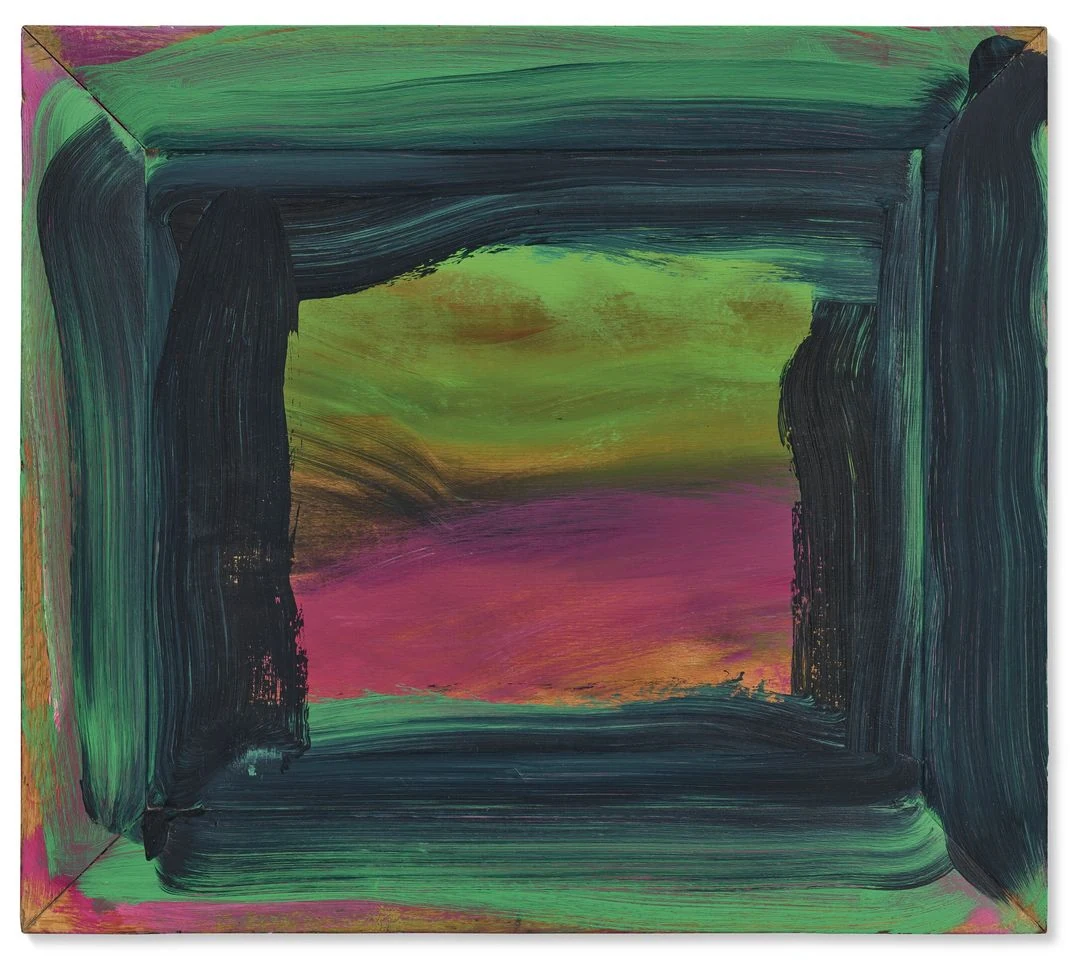
Hodgkin’s paintings make colour do more than describe an object or setting. The hues and shapes carry the weight of an experience, while leaving viewers room to form their own associations. Works including Dinner at Smith Square and Mr and Mrs E.J.P. are linked in the existing account to personally significant moments. Their abstraction does not close down interpretation: a viewer can respond to the arrangement, texture and emotional charge without needing to settle on one definitive story.
The edge of a painting was part of that visual language. Hodgkin worked on wood as well as canvas and made the frame integral to the finished work, either incorporating it physically into the painting or creating an illusion that helped define its subject. The boundary was not simply a neutral surround. It could shape the image’s space and become one of the means by which the work held a memory in view.
He also developed a substantial practice in printmaking. His prints were hand-painted etchings, made with master printer Jack Shirreff at 107 Workshop. In 1995, Hodgkin produced the Venetian Views series: four prints showing the same view of Venice at different times of day. Venice, Afternoon was made through a complex process using 16 sheets, or fragments, to create a colourful, painterly effect. The series carried his interest in colour and changing perception into a medium with its own technical demands.
Public commissions and international exhibitions
Hodgkin represented Britain at the Venice Biennale in 1984. In 1985 he won the Turner Prize, and in 1992 he was knighted. The following year brought a commission that linked his work to a major British cultural institution overseas: he was invited to design a mural for the British Council’s headquarters in India, designed by Charles Correa. The mural depicts a banyan tree spreading its branches across the walls, a symbol of the Council’s work rooted in Indian cultural life.
Hodgkin’s exchanges with India were not confined to the mural. His interest in Indian art and his association with Jamini Roy offer another point of contact between his practice and that artistic context. These connections belong alongside his international exhibitions, rather than replacing the British setting of a career that included major shows and honours at home.
His exhibitions in Britain included a major presentation at Tate Britain in 2006. In 2010, his work appeared at the Yale Center for British Art in The Independent Eye: Contemporary British Art From the Collection of Samuel and Gabrielle Lurie, alongside work by five other British artists. Before his death, Hodgkin was working on exhibitions planned for the Hepworth Wakefield and the National Portrait Gallery.
Honours and a continuing record
The Turner Prize and knighthood were part of a longer record of recognition. Hodgkin was appointed a CBE in 1977 and received the Alfred Toepfer Foundation’s Shakespeare Prize in 1997. The University of Oxford awarded him an honorary DLitt in 2000. In 2003, he was made a Member of the Order of the Companions of Honour for services to art; in 2014, Whitechapel Gallery named him its Art Icon.
Hodgkin died in a London hospital on 9 March 2017, aged 84. By then, his career had extended across painting and printmaking, from an early figurative work to the abstract paintings and intricate etchings for which he became known. The combination of a recognisable personal approach and an openness to different places and media gives his work a history that is both particular and outward-looking.
Why Howard Hodgkin deserves a place in British Legacy
Hodgkin deserves a place in British Legacy for a specific artistic achievement: he made abstraction a way of recording experience without reducing it to illustration. In his work, colour, shape and texture can hold the force of a memory or encounter, while allowing viewers to bring their own perceptions to what they see. His treatment of the frame strengthened that approach. Rather than leaving the edge outside the image, he could make it part of the painting’s structure and meaning. His hand-painted etchings show that this visual language was not limited to one surface or medium; the Venetian Views series, with its layered process and shifting times of day, demonstrates how he pursued colour through printmaking as well as painting.
His British significance is visible in both recognition and cultural contribution. Hodgkin represented Britain at the Venice Biennale, won the Turner Prize, received the CBE and was made a Companion of Honour for services to art. The mural for the British Council’s headquarters in India extended his practice into an institutional setting where British and Indian cultural life met. That commission, together with his interest in Indian art, makes his story more than a record of honours at home: it shows how a British artist could engage with another cultural context while retaining a distinctive artistic voice. Remembering Hodgkin preserves the achievement of an individual painter and printmaker, and a wider example of British art working across borders.
Sources
Adapted in part from Howard Hodgkin by Wikipedia contributors, under CC BY-SA 4.0. Text has been edited and combined with the existing article; this adapted text is shared under the same licence. Contributor history.