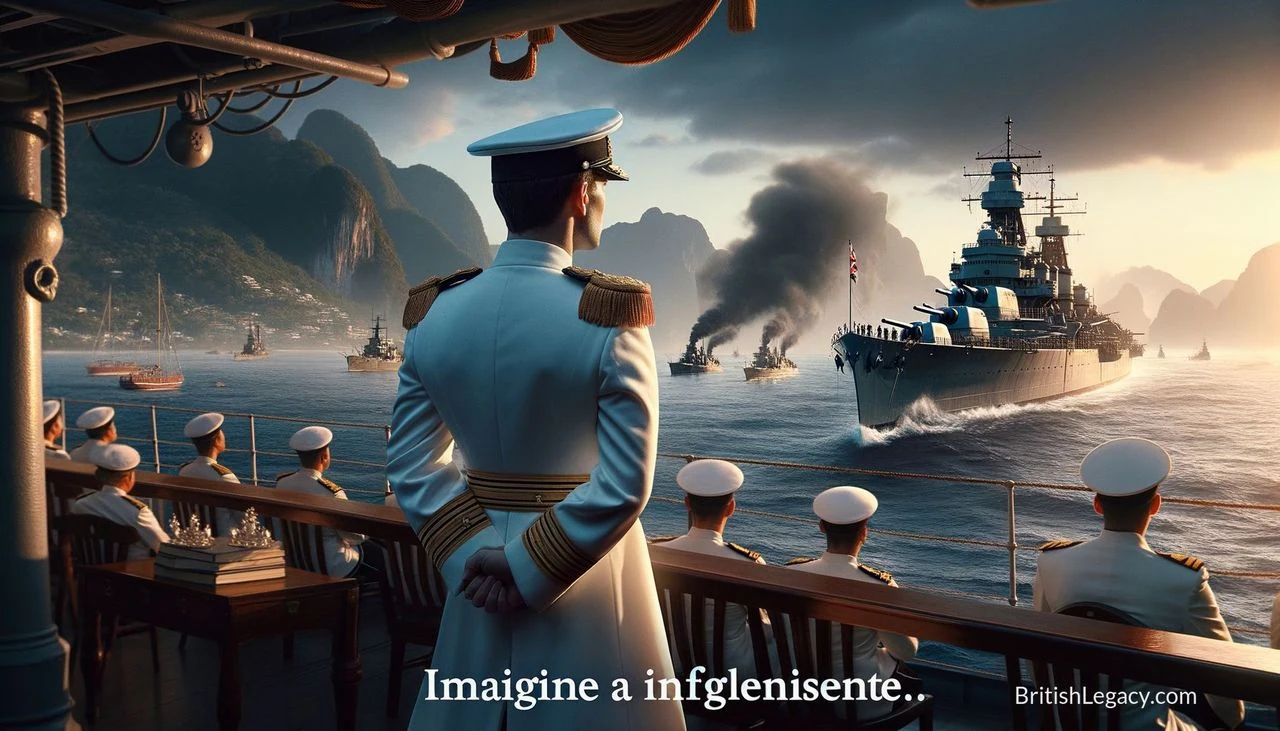
Louis Mountbatten’s career carried him from the Royal Navy’s signals rooms to the command of Allied forces in South-East Asia, and then to the last viceroyalty of British India. He helped plan raids against German-occupied Europe, oversaw the campaign that returned Burma to Allied control and became the public face of a transfer of power that created India and Pakistan amid mass displacement and violence. His later senior defence appointments extended his influence at home. So did the arguments about his judgement, his role in partition and the way he presented his own achievements.
A young officer drawn to naval technology
Born Prince Louis of Battenberg on 25 June 1900 at Frogmore House, Windsor, Mountbatten was the youngest child of Prince Louis of Battenberg and Princess Victoria of Hesse and by Rhine. In 1917, as the British royal family abandoned German names and titles during the First World War, his father adopted the surname Mountbatten. Louis became known as Lord Louis Mountbatten after his father was made Marquess of Milford Haven.
He entered the Royal Naval College, Osborne, in 1913. During the First World War he served as a midshipman aboard HMS Lion and HMS Queen Elizabeth. In 1918, still a teenager, he became first lieutenant of the sloop HMS P.31. After the war he studied at Christ’s College, Cambridge, for two terms before returning to naval service.
In the interwar years Mountbatten developed a particular interest in communications and electronics. He attended the Portsmouth Signals School and studied electronics at the Royal Naval College, Greenwich. He served in the Mediterranean Fleet as an assistant and later fleet wireless officer, then held destroyer commands. In 1939 he took command of HMS Kelly, serving as commander of the 5th Destroyer Flotilla when war began. Kelly was torpedoed in 1940 and sunk by German aircraft during the Battle of Crete in 1941; Mountbatten survived both incidents.
Wartime command, from raids to South-East Asia
In October 1941, Mountbatten became Chief of Combined Operations. The role involved planning raids and developing equipment for operations that required forces to land on defended coasts. His staff’s work included the Bruneval raid of February 1942, which captured part of a German radar installation, and the St Nazaire raid the following month, which put a major dock out of action. Mountbatten also promoted technical projects including the Mulberry harbours, assembled for the invasion of Normandy, and the PLUTO pipeline. His proposed ice-based aircraft carrier, Project Habakkuk, was not built.
The Dieppe Raid, launched on 19 August 1942, was a costly failure. Mountbatten was central to its planning and promotion, and the assault caused heavy casualties, most of them Canadian. Mountbatten argued that the operation yielded lessons for the Normandy landings; historians have disputed whether those lessons justified the losses. The raid’s consequences and the arguments about responsibility complicate any simple account of his wartime record.
In August 1943, Mountbatten became Supreme Allied Commander of South East Asia Command, with responsibility for a coalition operating across a vast theatre. Under the command, Allied forces recaptured Burma from Japan; General William Slim led the land campaign. On 12 September 1945, Mountbatten received the Japanese surrender in Singapore. The command was disbanded the following year. For his wartime service he was made a Knight of the Garter and, in 1946, created Viscount Mountbatten of Burma; he became Earl Mountbatten of Burma in 1947.
India: a rapid transfer and a lasting dispute
Mountbatten arrived in India in March 1947 as viceroy, charged with overseeing the transfer of power. The British government had initially set a deadline of June 1948. Facing escalating communal violence and a breakdown in order, he brought the date forward: British rule ended in August 1947, when India and Pakistan became independent. He had originally been instructed to seek a united India, but concluded that partition was unavoidable.
The boundary between the new states was drawn by a commission chaired by Cyril Radcliffe. Its announcement left millions of people on the side of the new borders where they were not part of the majority community. Large-scale flight, mass displacement and violence accompanied partition. Mountbatten’s accelerated timetable remains a central point of criticism: critics argue that the haste contributed to the human catastrophe, while other accounts emphasise the British government’s desire to withdraw quickly and its limited resources. His role should not be reduced either to a claim that he secured a peaceful transition or to a single uncontested explanation of the violence.
Mountbatten stayed on as the first governor-general of independent India, serving until June 1948. He worked to persuade princely states to join the new Indian union. His relationship with Indian leaders, including Jawaharlal Nehru, was close, while his dealings with Muhammad Ali Jinnah took place amid the breakdown of efforts to preserve a united country. India and Pakistan emerged as sovereign states, but partition left mass suffering and disputes whose consequences were not settled by the transfer of power.
Senior posts at home and a violent death
After leaving India, Mountbatten returned to the Royal Navy. He held senior commands in the Mediterranean, became First Sea Lord in 1955 and was promoted to Admiral of the Fleet the following year. In 1959 he became Chief of the Defence Staff, serving until 1965. In that office he oversaw the consolidation of the service departments into a single Ministry of Defence. During the Suez Crisis of 1956, he advised Prime Minister Anthony Eden against military intervention, warning of its consequences for Britain’s standing and relations with other countries.
Beyond military office, Mountbatten supported international education. He was president of the United World Colleges organisation from 1967 to 1978. During that period the United World College of South East Asia was established in Singapore, followed by the United World College of the Pacific in Canada. He also helped launch the International Baccalaureate. These activities added an international and educational strand to a public life otherwise most closely associated with naval service and the end of British rule in India.
On 27 August 1979, Mountbatten was killed when a bomb planted by the Provisional Irish Republican Army exploded aboard his boat off Mullaghmore in the Republic of Ireland. His grandson Nicholas Knatchbull and crew member Paul Maxwell also died in the blast; other members of the party were injured, and Doreen, Lady Brabourne, died the next day. Mountbatten’s ceremonial funeral took place at Westminster Abbey on 5 September, and he was buried at Romsey Abbey.
Why Lord Mountbatten deserves a place in British Legacy
Mountbatten belongs in British Legacy because his life illuminates Britain’s changing role in the twentieth century, rather than offering a simple story of military success or public service. As Chief of Combined Operations, he was involved in the development of raids and landing technology used in the war against Nazi Germany. As Supreme Allied Commander in South-East Asia, he led a multinational command during the campaign that returned Burma to Allied control and received Japan’s surrender in Singapore. Later, as First Sea Lord and Chief of the Defence Staff, he occupied the most senior levels of the British naval and defence establishments. Those roles show how command, technology and institutional change intersected in his career.
His place in the record also depends on confronting the costs and limits of power. The Dieppe Raid brought severe losses, and the accelerated end of British rule in India coincided with partition, mass displacement and communal violence. Mountbatten’s part in these events remains debated; describing partition as a peaceful handover would obscure what people experienced. At the same time, his work to bring princely states into the Indian union and his later support for international education form part of the documented story. British Legacy can remember him most usefully by holding these elements together: achievement, influence and responsibility, without turning either his admirers’ praise or his critics’ judgements into a substitute for historical detail.
Sources
Lord Mountbatten — supplied revision
Adapted in part from Lord Mountbatten by Wikipedia contributors, under CC BY-SA 4.0. Text has been edited and combined with the existing article; this adapted text is shared under the same licence. Contributor history.