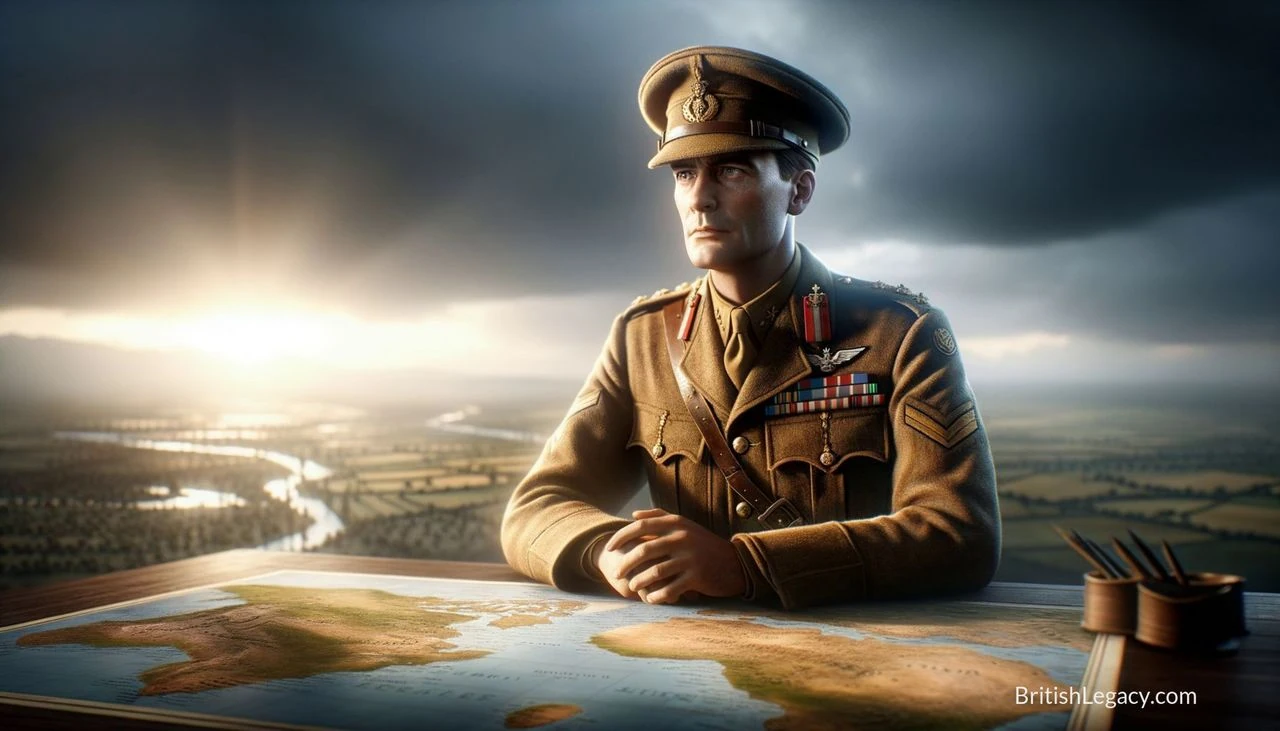
Claude Auchinleck’s wartime record is often compressed into two episodes: command in North Africa, where his forces stopped the Axis advance at El Alamein, and leadership of the Indian Army, whose supply and training work supported the Allied campaign in Burma. Neither story is simple. He was removed after the reverses of 1942, yet his defensive preparations mattered; later, he made the support of General William Slim’s Fourteenth Army a priority. His career also spanned the partition of India, when he was charged with overseeing the division and withdrawal of British forces.
A soldier shaped by India
Auchinleck was born in Aldershot, Hampshire, on 21 June 1884, the son of a British Army officer. His father was posted to Bangalore while Claude was young, and the family went with him. After his father died in 1892, Auchinleck returned to England and attended Eagle House School and Wellington College on scholarships. He then studied at the Royal Military College, Sandhurst.
He was commissioned as an unattached second lieutenant in the Indian Army in January 1903 and joined the 62nd Punjabis in April 1904. He spent much of his career in India, learned several Indian languages and became familiar with local customs. In the First World War, his regiment served in the defence of the Suez Canal, Aden and Mesopotamia. At the Battle of Hanna in January 1916, he was among the few British officers in his regiment to survive the action. He later led the regiment at the Second Battle of Kut and the capture of Baghdad, and received the Distinguished Service Order for his service in Mesopotamia.
Between the wars, Auchinleck attended the Staff College at Quetta and the Imperial Defence College. His experience made him attentive to the practical demands of military organisation, including supply and administration. In 1933 he took command of the Peshawar Brigade, which operated in the adjoining tribal areas. He was mentioned in despatches for campaigns there. In 1938 he chaired a committee on the modernisation, composition and re-equipment of the British Indian Army; its recommendations formed the basis of a 1939 report on the army’s transformation.
From Norway to the Middle East
At the outbreak of the Second World War, Auchinleck was appointed to command the Indian 3rd Infantry Division. In 1940 he was recalled to Britain to lead IV Corps, then took command of Anglo-French ground forces during the failed Norwegian campaign. He subsequently commanded V Corps and Southern Command, responsible for the defence of southern England. In January 1941 he returned to India as commander-in-chief, succeeding Sir Robert Cassels.
That spring, a pro-Axis coup in Iraq threatened the Royal Air Force base at Habbaniya. Although the Middle East commander, Archibald Wavell, was reluctant to divert forces, Auchinleck sent the 1st Battalion of the King’s Own Royal Regiment by air to Habbaniya and the 10th Indian Infantry Division by sea to Basra. The arrival of British relief forces helped bring the Anglo-Iraqi conflict to a close.
In July 1941, Auchinleck and Wavell exchanged commands: Auchinleck became commander-in-chief of Middle East Command, with responsibility for a region extending beyond North Africa to Persia and the wider Middle East. His November 1941 offensive, Operation Crusader, relieved the besieged garrison at Tobruk and forced Erwin Rommel’s forces to withdraw to El Agheila. But the Axis army recovered, and in 1942 its attack at Gazala defeated the British-led Eighth Army. Tobruk fell in June, and the Eighth Army retreated into Egypt.
El Alamein: defence and dismissal
On 24 June 1942, Auchinleck took direct command of the Eighth Army, replacing Neil Ritchie. He chose to delay the Axis advance at Mersa Matruh before falling back to El Alamein, where terrain and fresh troops offered a stronger defensive position. In the First Battle of El Alamein, his forces stopped the exhausted German and Italian advance. A series of counter-attacks followed, but poor planning and coordination meant they achieved little.
Auchinleck’s command was under strain. Senior officers disagreed, and he lost the confidence of British and Dominion commanders. Prime Minister Winston Churchill wanted an offensive and pressed him for a decisive victory. After Churchill and the Chief of the Imperial General Staff, Alan Brooke, met him in Cairo in August 1942, Auchinleck was replaced as commander-in-chief of Middle East Command by Harold Alexander. He was therefore not in command at the Second Battle of El Alamein, the later offensive led by Bernard Montgomery.
His part in the earlier defence should not be mistaken for sole responsibility for the eventual victory. The account of his command includes serious defeats and ineffective counter-attacks as well as the stand at El Alamein. It also records later historians’ more favourable assessments of his contribution to the successful defence, alongside criticism of Churchill’s decision to remove him. The record supports a measured conclusion: Auchinleck established a position that halted the Axis advance, but did not lead the final offensive that drove it back.
Building the base for Burma
After declining a new command in Persia and Iraq, Auchinleck spent almost a year without an appointment. In June 1943 he returned as commander-in-chief of the Indian Army. Responsibility for operations against Japan was passing to the newly formed South East Asia Command, but India remained essential as a base, recruiting area and training ground. Auchinleck oversaw the army’s reorganisation, internal security and the defence of the North-West Frontier. He also prioritised the supply, maintenance and training that enabled Slim’s Fourteenth Army to operate in Burma.
Slim later credited Auchinleck and the Indian Army with providing indispensable support to the Fourteenth Army, from its formation through to victory. The scale of the wider transformation was substantial: the Indian Army grew from 183,000 personnel in 1939 to more than 2,250,000 by the end of the war. That expansion was not Auchinleck’s achievement alone, but his role as commander-in-chief placed him at the centre of the organisation, training and logistical work on which Allied operations depended.
Partition and a final command
Auchinleck remained commander-in-chief of the Indian Army after the war. He was promoted to field marshal in June 1946. As partition approached, he was responsible for helping prepare the future Indian and Pakistani armies, a task he undertook despite strong personal reservations about partition. In August 1947 he became supreme commander of the British forces remaining in India and Pakistan. He held the post until the Supreme Headquarters closed at the end of November, then left India.
After a period in Italy connected with an unsuccessful business venture, he returned to London and pursued charitable and business interests. He settled in Beccles, Suffolk, in 1960, then moved to Marrakesh in 1967. He died there on 23 March 1981, aged 96, and was buried in Casablanca. Memorials to him include a plaque in the crypt of St Paul’s Cathedral and a bronze statue in Birmingham.
Why Claude Auchinleck deserves a place in British Legacy
Auchinleck’s place in British history rests not on an uncomplicated tale of victory, but on the breadth and consequence of his responsibilities. In North Africa, he took charge of an exhausted army after the defeat at Gazala, organised its withdrawal and established the El Alamein position that stopped the Axis advance in the First Battle of El Alamein. He was removed before Montgomery’s later offensive, and his earlier command included costly setbacks. Keeping those facts together gives a more useful account of military leadership than a simple claim that one commander won the campaign.
His contribution in India was different but no less significant. He directed the expansion and reorganisation of the Indian Army and gave priority to the supply, maintenance and training that sustained the Fourteenth Army in Burma. After the war, he faced the difficult responsibility of preparing armed forces for partition and overseeing the final British military presence in India and Pakistan. These episodes connect his British military career to a wider history involving Indian soldiers and the end of British rule. Remembering Auchinleck means recognising both the operational choices made in wartime and the institutional work that supported other forces in the field. It also means treating his record with care: his influence is clearest when described through specific commands, decisions and responsibilities, rather than unqualified praise.
Sources
Adapted in part from Claude Auchinleck by Wikipedia contributors, under CC BY-SA 4.0. Text has been edited and combined with the existing article; this adapted text is shared under the same licence. Contributor history.