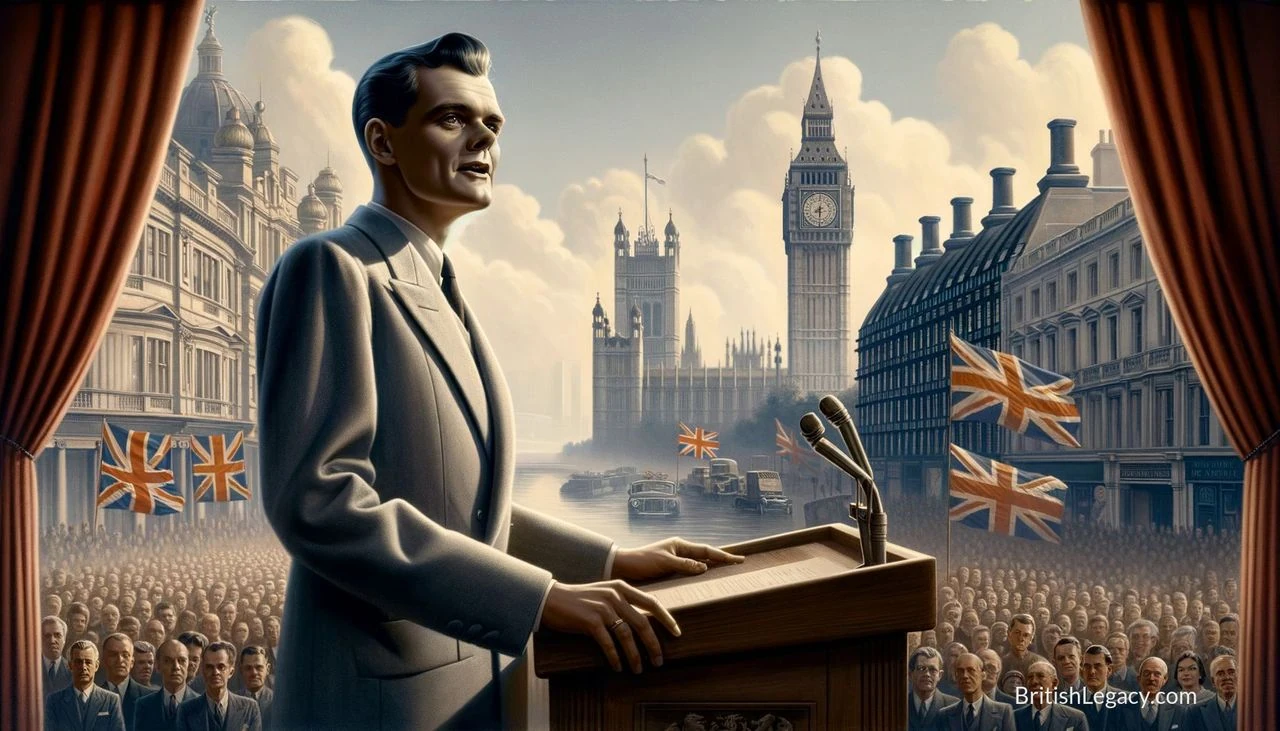
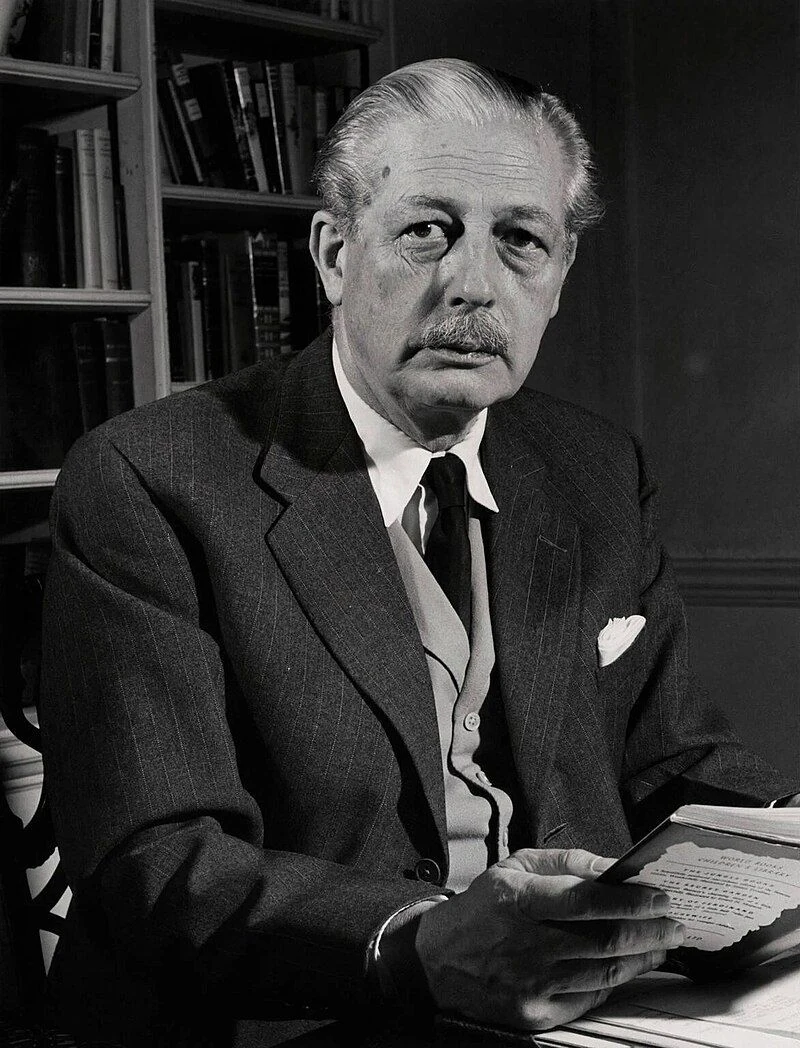
Harold Macmillan’s premiership brought together two large shifts in Britain’s post-war story: the spread of affluence at home and the retreat from imperial rule abroad. His “Wind of Change” speech in Cape Town became a landmark statement about African national consciousness, but it was not the whole of his record. Macmillan also presided over rising living standards, pursued a closer relationship with the United States, and left office amid political scandal and questions about his government’s judgement.
A publishing family, Oxford and the First World War
Maurice Harold Macmillan was born in London on 10 February 1894. His father, Maurice Crawford Macmillan, was a publisher; his mother, Helen, was an American artist and socialite. His grandfather Daniel had founded Macmillan Publishers, the family business Harold would later help run. He attended Eton and Balliol College, Oxford, where he studied classics. The First World War interrupted his studies before he completed his degree.
Macmillan served as an infantry officer, first with the King’s Royal Rifle Corps and then the Grenadier Guards. Wounded at the Battle of Loos in 1915 and severely injured at the Somme in 1916, he spent much of the last two years of the war in hospital. His wounds left him with a limp and lasting difficulties with his right hand. After the war he joined the family publishing firm and married Lady Dorothy Cavendish in 1920.
He entered Parliament in 1924 as Conservative MP for Stockton-on-Tees. He lost the seat in 1929, returned in 1931, and spoke against unemployment in the constituency and appeasement of Nazi Germany. His pre-war writing and political activity included arguments for state direction of investment and a centrist approach to economic policy. During the Second World War he held several government posts, including Minister Resident in the Mediterranean. In that role he worked with Allied leaders and officials in North Africa and Italy. After losing Stockton in 1945, he returned to the Commons as MP for Bromley later that year.
Housing, Suez and the route to Downing Street
When the Conservatives returned to office in 1951, Macmillan became Minister of Housing and Local Government. Churchill gave him the task of increasing housebuilding to 300,000 homes a year; Macmillan reached the target by the end of 1953, a year ahead of schedule. He later served as Minister of Defence, Foreign Secretary and Chancellor of the Exchequer under Anthony Eden.
As Chancellor, Macmillan was involved in the government’s planning for the 1956 Suez invasion. He initially supported using force against Egypt after Gamal Abdel Nasser nationalised the canal. When American opposition and the resulting financial pressure made Britain’s position untenable, Macmillan backed withdrawal. Suez damaged Britain’s standing and the relationship with the United States. Eden resigned in January 1957, and Macmillan succeeded him as prime minister.
Macmillan sought to restore that relationship, working with President Dwight D. Eisenhower, while also managing a difficult domestic economic balance. His government favoured high employment and a mixed economy, but its choices contributed to the stop-go pattern of economic management. In January 1958, three senior Treasury ministers resigned over economic policy. Macmillan’s government nevertheless benefited from rising living standards and low unemployment. In a speech in 1957 he said that most people had “never had it so good”, while warning about inflation. The Conservatives won the 1959 general election with an increased majority. His government also passed measures on housing, air pollution, working conditions and noise, and introduced a graduated pension scheme.
Decolonisation and the “Wind of Change”
Macmillan’s approach to the remaining colonies changed as the costs and consequences of holding them became harder to ignore. In January 1960 he began a tour of Africa. On 3 February, addressing the South African Parliament in Cape Town, he spoke of “the wind of change” blowing through the continent and described the growth of African national consciousness as a political fact. The speech recognised a movement that was already reshaping the continent; it did not, by itself, bring about independence.
Under Macmillan, a succession of African territories became independent: Nigeria in 1960, Sierra Leone and Tanganyika in 1961, Uganda in 1962, and Kenya in 1963. The Gold Coast had already become Ghana in 1957. Malaya also gained independence in 1957, and in 1963 Malaya, Singapore, Sarawak and British North Borneo formed Malaysia. The pace and terms of the transfers were debated, and the process was not free of conflict. In Kenya, the Hola massacre of 1959 had drawn attention to the abuse of detainees during the colonial emergency. In Southeast Asia, the formation of Malaysia led to confrontation with Indonesia, which began in 1963 and continued after Macmillan left office.
Decolonisation was therefore neither a single speech nor a smooth act of British generosity. Macmillan and his ministers made choices amid nationalist movements, international pressure and resistance to the end of empire. His government also accepted the dissolution of the Central African Federation by the end of 1963. These changes contributed to a Commonwealth increasingly made up of independent states, while Britain’s role in the world was being renegotiated.
Cold War, Europe and a troubled departure
Macmillan worked to improve relations with the United States after Suez, but the alliance had limits. His dealings with Eisenhower and, later, President John F. Kennedy included disagreements over foreign policy and the sharing of power. During the Cuban Missile Crisis in 1962, Kennedy consulted Macmillan by telephone; the evidence supports a close exchange between the leaders, rather than the claim that Macmillan was pivotal in defusing the crisis.
He also pursued negotiations on nuclear weapons. Britain, the United States and the Soviet Union signed the Partial Test Ban Treaty in 1963, following talks in which Macmillan’s government played a part. At the same time, Britain sought to join the European Economic Community. President Charles de Gaulle vetoed the application in January 1963, leaving Macmillan’s European policy without its intended result.
At home, controversy and political damage mounted. The Vassall spy case weakened confidence in the government, and the Profumo affair in 1963 further undermined its credibility. Macmillan’s 1962 “Night of the Long Knives”, in which he dismissed several ministers in a major reshuffle, was widely seen as a sign of political anxiety. He resigned in October 1963 after prostate surgery; the condition was benign, and his illness gave him a way to leave office. He remained active in public life, later serving as Chancellor of the University of Oxford and returning to the House of Lords as Earl of Stockton. He died at his home in West Sussex on 29 December 1986, aged 92.
Why Harold Macmillan deserves a place in British Legacy
Macmillan deserves a place in British Legacy because his career helps explain how Britain changed its position in the world after the Second World War. The “Wind of Change” speech is remembered not as a switch that instantly ended empire, but as a public recognition of African national consciousness at a moment when the government was transferring power across the continent. Independence came through a series of political decisions, negotiations and struggles, and the results varied. Remembering Macmillan’s part in that process makes the story more specific than a general claim that Britain simply moved from empire to partnership.
His domestic record gives that history another dimension. As housing minister he met a major housebuilding target ahead of schedule; as prime minister he governed during rising living standards, passed social and environmental measures, and faced the weaknesses of stop-go economic policy. His efforts to repair relations with the United States, negotiate nuclear limits and bring Britain into the European Economic Community show a government trying to adapt its international role, with mixed results. The Suez crisis, the conflicts surrounding decolonisation, and the scandals that damaged his final years prevent an uncomplicated portrait. Together, these achievements and failures make Macmillan a useful subject for British Legacy: a politician whose choices illuminate both the possibilities and the costs of managing Britain’s post-war transition.
Sources
Harold Macmillan — Wikipedia, revision 1378024418
Adapted in part from Harold Macmillan by Wikipedia contributors, under CC BY-SA 4.0. Text has been edited and combined with the existing article; this adapted text is shared under the same licence. Contributor history.