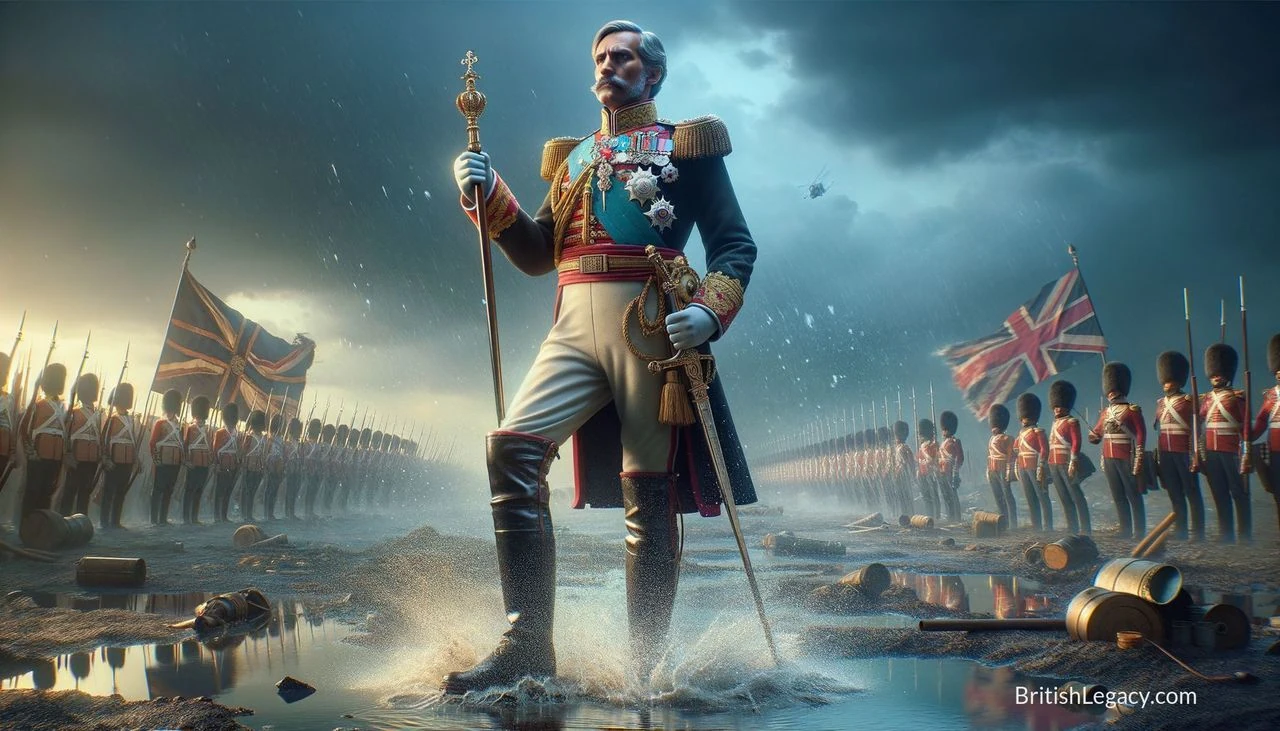
Arthur Wellesley’s reputation rests above all on Waterloo, where, on 18 June 1815, he commanded an Allied army that defeated Napoleon’s forces alongside the Prussian army. But the victory was the culmination of a much longer career: service in Ireland and India, campaigns across the Iberian Peninsula, and decades in British politics. Wellington’s story also reaches beyond battlefield success. As prime minister he helped secure Catholic emancipation, while his opposition to parliamentary reform made him a divisive political figure.
An Irish upbringing and an uncertain birthplace
Wellesley was born on 1 May 1769 into the Anglo-Irish Wellesley family. The date is widely accepted, but his exact birthplace remains uncertain: Dublin is commonly given, while Dangan Castle in County Meath has also been proposed. He was the son of Anne, Countess of Mornington, and Garret Wesley, later the 1st Earl of Mornington. The family had homes in both Dublin and County Meath.
His early education took him to schools in Trim, Dublin, Chelsea and Eton. He disliked Eton and, after his father’s death in 1781, the family faced financial difficulty. A period at a French riding academy in Angers improved his horsemanship and French. In 1787 he entered the British Army as an ensign, beginning a career that would take him from Ireland to the European battlefields.
His first years included military appointments and a short political career in the Irish House of Commons, where he represented Trim. He served in the Flanders campaign of 1794–95, a difficult experience that, by his later account, taught him what not to do. In 1796 he sailed for India with his regiment. He changed the spelling of his surname from Wesley to Wellesley in 1798.
India: command, campaigning and Assaye
In India, Wellesley served in the Fourth Anglo-Mysore War, which ended with the British capture of Seringapatam in 1799 and the death of Tipu Sultan. A failed night attack near the fortress exposed him to the hazards of fighting in darkness and unfamiliar terrain. After the city fell, Wellesley remained to command the area and was appointed governor of Seringapatam and Mysore. His responsibilities included restoring order after the fighting.
In 1800 he was given command against the insurgent Dhondia Wagh. The campaign ended with Wagh’s death at the Battle of Conagul in September. Wellesley’s most celebrated Indian battle followed in 1803, during the Second Anglo-Maratha War. At Assaye, he attacked a larger Maratha force before a second British force could join him. The victory came at a heavy cost to his troops. Wellesley later described Assaye as the best battle he had ever fought, rather than Waterloo.
His Indian service developed skills that would matter in later campaigns: preparation and supply, disciplined movement, intelligence-gathering and the use of diplomacy to secure allies. In 1805 he returned to Britain. His reputation at home was not yet comparable to that of established public figures such as Admiral Horatio Nelson, whom he met briefly after arriving back.
Portugal, Spain and the route to Waterloo
In 1808 Wellesley took command of an expedition to Portugal. He defeated French forces at Roliça and Vimeiro, but was soon superseded by other commanders. The controversial Convention of Sintra, which arranged the French evacuation from Portugal, led to an inquiry in Britain. Wellesley had agreed to a preliminary armistice but had not signed the convention, and was cleared.
He returned to the peninsula as the senior British commander in Portugal. In 1809 he crossed the Douro and drove French forces from Porto, then fought alongside Spanish forces at Talavera. After the battle, he was made Viscount Wellington. When French forces invaded Portugal in 1810, he slowed their advance at Buçaco and relied on the Lines of Torres Vedras, a system of defensive earthworks protecting the approaches to Lisbon. The French withdrew after their invasion stalled.
Wellington’s later campaigns combined sieges, manoeuvre and battle. He captured Ciudad Rodrigo and Badajoz in 1812, then defeated the French at Salamanca and helped liberate Madrid. In 1813, he outflanked French communications and won at Vitoria, a victory that brought his promotion to field marshal. The Allied advance continued into France, with battles in the Pyrenees and at Nivelle, Nive and Orthez. Wellington was made Duke of Wellington in 1814.
When Napoleon returned from exile in 1815, Wellington took command of a British-led Allied army in the Netherlands. At Waterloo, his army held its position through a day of French attacks. Prussian forces under Gebhard Leberecht von Blücher joined the fighting, and the combined Allied and Prussian forces defeated Napoleon. The victory ended Napoleon’s return to power and secured Wellington’s place among Britain’s most prominent military commanders. The outcome depended on allied forces working together, rather than on Wellington’s army alone.
Government, emancipation and opposition
Wellington entered government after his military career had made him a national figure. He became prime minister in January 1828, leading a government that passed the Roman Catholic Relief Act in 1829. The measure allowed Roman Catholics to sit in Parliament and hold many public offices. Wellington supported it despite strong opposition, judging that the political crisis in Ireland made the existing restrictions unsustainable. The Act came with a sharp increase in the property qualification for the Irish county vote, which disfranchised many voters.
His ministry also brought the political costs of his position into sharp relief. He opposed the Reform Bill of 1832, and his resistance to reform became associated with public hostility. Protesters attacked Apsley House, his London home, and iron shutters were installed. The nickname “Iron Duke” is associated with this period of political unpopularity and resolve, not simply with his military campaigns.
Wellington’s first premiership ended in 1830. In late 1834, he served briefly as caretaker prime minister while Robert Peel was in Italy, before Peel took office. These were not two full premierships: Wellington’s main government ran from 1828 to 1830, followed by a short interim ministry in 1834. He remained a leading figure in the House of Lords and returned to high office under Peel, including as commander-in-chief of the British Army from 1842. He retired from political life in 1846 but remained commander-in-chief until his death.
Final years and public remembrance
Wellington died at Walmer Castle in Kent on 14 September 1852, aged 83. His state funeral took place in London in November, and he was buried in St Paul’s Cathedral. The scale of public mourning reflected his status as a national figure as well as the fame of his military victories.
His public memory was not confined to Waterloo. The 33rd Regiment of Foot, which he had commanded, became the 33rd (The Duke of Wellington’s) Regiment in 1853. His career also became a subject of continuing debate: accounts of his achievement include the role of allied armies, the human cost of campaigning and the controversies of his political life. In 2002, he was placed 15th in the BBC’s poll of the 100 Greatest Britons.
Why Arthur Wellesley, Duke of Wellington, deserves a place in British Legacy
Wellington’s place in British history is grounded in a career that connected military command to public office. His campaigns in India and the Iberian Peninsula preceded Waterloo, and the experience he acquired in logistics, discipline and military planning helped shape his reputation as a commander. At Waterloo, however, the victory was shared: Wellington’s British-led Allied army fought alongside the Prussians under Blücher. Keeping that coalition in view gives a more accurate account of the achievement and of the international forces involved in ending Napoleon’s return.
His political legacy is just as important to a British feature. As prime minister, Wellington backed the Catholic Relief Act of 1829, a major change to the civil and political position of Roman Catholics. He also opposed the Reform Bill, and the hostility that followed shows the tension between his commitment to established institutions and demands for political change. Those contrasting decisions resist a simple portrait of an uncomplicated national hero. They make his story useful for understanding how military distinction, political judgement and public reputation intersected in nineteenth-century Britain. His life deserves remembrance not through general claims about national character, but through specific achievements, contested choices and the lasting place his career holds in British public history.
Sources
Arthur Wellesley, 1st Duke of Wellington
Adapted in part from Arthur Wellesley, 1st Duke of Wellington by Wikipedia contributors, under CC BY-SA 4.0. Text has been edited and combined with the existing article; this adapted text is shared under the same licence. Contributor history.