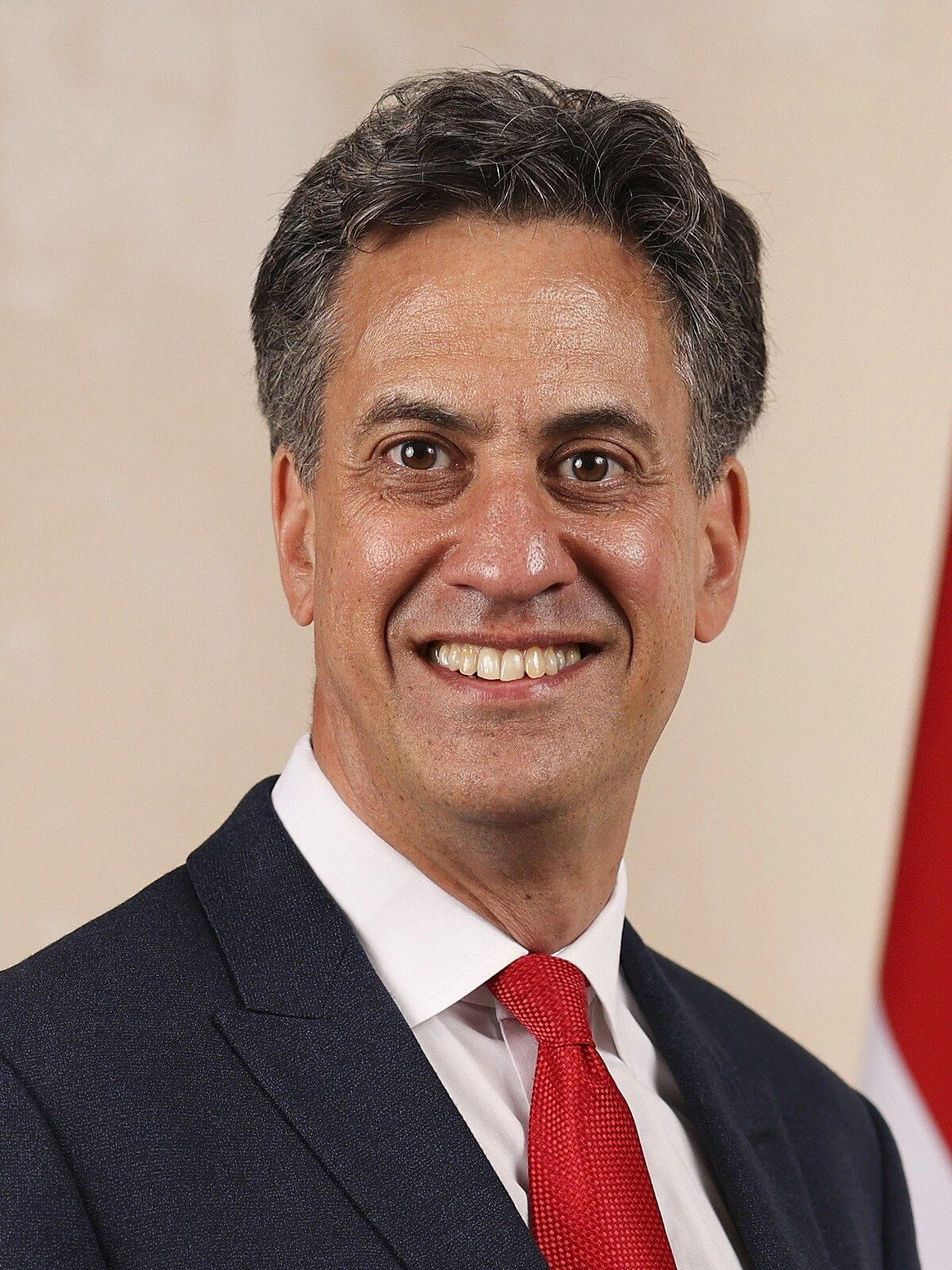
Ed Miliband’s political career has taken him from economic policy work in Whitehall to the leadership of the Labour Party, a return to government as energy secretary and, in July 2026, the office of Foreign Secretary. Climate policy has been a recurring thread: he led the department responsible for energy and climate change from 2008, later returned to that brief in opposition and government, and now holds a senior role in a government whose account of his career includes both energy security and international affairs.
From London and Leeds to Westminster
Edward Samuel Miliband was born in Fitzrovia, London, on 24 December 1969, to Marion Kozak and Ralph Miliband. His parents came from Polish Jewish families. Ralph was a Marxist academic; Marion was a human-rights campaigner and an early member of the Campaign for Nuclear Disarmament. Ed grew up with his elder brother, David, who would also enter politics.
The family moved to Leeds in 1973, when Ralph took up a post at the University of Leeds. Ed attended Featherbank Infant School in Horsforth and later Primrose Hill Primary School and Haverstock Comprehensive School in London. He learned the violin and, as a teenager, reviewed films and plays for LBC Radio’s Young London programme. After his O-levels, he worked as an intern for Tony Benn, then the MP for Chesterfield.
In 1989, Miliband went to Corpus Christi College, Oxford, to study philosophy, politics and economics. He dropped philosophy and graduated with an upper-second-class degree. At the London School of Economics he completed a master’s degree in economics. His first work after Oxford was in television: in 1992 he joined Channel 4’s A Week in Politics as a researcher. The following year Harriet Harman recruited him as a policy researcher and speechwriter in Labour’s Treasury team. He later worked for shadow chancellor Gordon Brown and, after Labour’s 1997 election victory, became one of Brown’s special advisers.
Miliband spent 2002–03 as a visiting scholar at Harvard University, where he taught economics and a course on the politics of social justice. On returning to Britain, he became chair of HM Treasury’s Council of Economic Advisers, with responsibility for long-term economic planning. He left the advisory role in 2005 to seek election to Parliament.
From MP to Cabinet minister
Miliband was elected MP for Doncaster North on 5 May 2005. He joined the government in 2006 as Minister for the Third Sector, with responsibility for voluntary and charitable organisations. When Brown became Prime Minister in 2007, Miliband entered the Cabinet as Minister for the Cabinet Office and Chancellor of the Duchy of Lancaster. His brother David was also in the Cabinet, then serving as Foreign Secretary.
In October 2008, Miliband became the first Secretary of State for the newly created Department of Energy and Climate Change. The role placed climate policy alongside the practical questions of energy supply and government responsibility for reducing emissions. He announced a proposed increase in the government’s emissions-reduction commitment: an 80 per cent cut by 2050, replacing the previously announced 60 per cent target for carbon dioxide.
As the department’s minister, he also addressed the future of coal-fired power. In 2009 he said that any proposed new coal power station would have to demonstrate that it could capture and store 25 per cent of its emissions from the outset, with the ambition of reaching 100 per cent by 2025. He represented the United Kingdom at the Copenhagen climate summit that year. The conference produced a commitment to additional international climate finance but did not secure a legally binding agreement. The episode illustrates the limits as well as the reach of ministerial climate diplomacy: national policy could be changed, but a global settlement depended on negotiations among governments.
Miliband’s account of public service also includes work outside the energy brief. In 2007 he and David became the first brothers to serve in the same British Cabinet since Edward and Oliver Stanley in 1938. The relationship between the two was soon made a matter of public political attention when they both stood in Labour’s 2010 leadership election.
Labour leadership and the 2015 defeat
After Labour lost the 2010 general election, Miliband announced that he would seek to replace Brown as party leader. His brother David was among the candidates. Ed won the contest, with the result announced on 25 September 2010 after preferences were redistributed. He became both Labour leader and Leader of the Opposition.
Under his leadership, Labour adopted the “One Nation Labour” branding and moved its policy emphasis to the left of the New Labour years. Miliband opposed the Conservative–Liberal Democrat coalition’s public-sector cuts and argued for a politics concerned with fairness and the pressures on living standards. He also changed the party’s leadership-election rules, replacing the electoral college with a one-member, one-vote system in 2014.
The leadership was tested in elections at several levels. Labour made gains in English local elections in 2012 and 2013, and came second in the 2014 European Parliament election, increasing its number of MEPs from 13 to 20. Those results did not translate into a general-election victory. In May 2015 Labour lost to the Conservatives, lost almost all its Scottish MPs and recorded a net loss of 26 seats. Miliband retained Doncaster North but resigned as party leader the next day. Jeremy Corbyn succeeded him.
After leaving the leadership, Miliband returned to the backbenches. He backed the Remain campaign in the 2016 European Union referendum and continued to speak about inequality and climate policy. In 2020, Keir Starmer appointed him Shadow Secretary of State for Business, Energy and Industrial Strategy. A year later he took on the newly created shadow climate-change and net-zero brief, later titled Shadow Secretary of State for Energy Security and Net Zero.
Back in government: energy security and climate
Labour’s victory in the 2024 general election brought Miliband back to government as Secretary of State for Energy Security and Net Zero. He was re-elected for Doncaster North, and two days after his appointment lifted the ban on onshore wind development. His stated energy programme included an ambition for clean power to meet 95 per cent of electricity demand by 2030 and a pledge to reduce average bills by £300 by that year.
In July 2024, Miliband announced Great British Energy, a publicly owned company intended to invest in and develop clean-energy infrastructure. The government allocated it £8.3 billion, funded through a windfall tax on major oil and gas companies. The original funding arrangement later changed: £2.6 billion was diverted to Great British Nuclear. The programme connected the climate agenda to a claim about domestic energy capacity, but its scale and delivery remained matters for political debate.
His position on fossil fuels also faced scrutiny. Labour’s manifesto commitment was to prohibit new oil and gas licences in the North Sea. After the 2026 Iran war raised concerns about an energy shock, Miliband rejected the argument that more North Sea drilling would bring down prices, calling it “totally false”. He argued instead for accelerated clean-energy measures, including solar panels, electric vehicles and solar installations on public land, as well as changes intended to separate gas and electricity prices. The proposed Energy Independence Bill in the 2026 King’s Speech included a legal prohibition on new drilling and plans to ban onshore fracking.
In 2026 Miliband approved several large solar projects, including the proposed One Earth Solar Farm in Nottinghamshire and Lincolnshire, after overriding objections from inspectors. He defended the decisions as necessary to build clean power and improve energy security. These choices placed growth in renewable generation alongside environmental concerns raised during the planning process, a balance that has been part of the political argument around the projects.
Foreign Secretary and continuing public role
Following Keir Starmer’s resignation and Andy Burnham’s appointment as Prime Minister, Miliband became Foreign Secretary on 20 July 2026, succeeding Yvette Cooper. The appointment returned him to a field associated with his brother David, who held the same office from 2007 to 2010. The brothers had previously served together in Cabinet; the later appointments made them the first pair of brothers in modern British history to have both held the Foreign Secretary’s office.
Miliband’s first overseas engagement in the post was a meeting of ASEAN foreign ministers in Manila. He called for de-escalation of the Iran war and said that a diplomatic settlement should reopen the Strait of Hormuz and uphold freedom of navigation. He also welcomed the Islamabad Memorandum’s proposal for 60 days of toll-free passage through the strait, though its implementation stalled after attacks on tankers.
He has also presented international development and climate change as linked priorities. On 27 July 2026, he announced that he would take a seat on the World Bank, a role usually held by a junior minister, and said the decision signalled that development and the climate crisis were central to government policy. In September, the UK announced sanctions on goods from illegal settlements in the West Bank, coordinated with 11 other countries. Miliband described the measure as a new approach intended to protect the prospects of a two-state solution.
His political work has extended beyond ministerial office. From 2017 to 2024, he co-hosted the podcast Reasons to be Cheerful with Geoff Lloyd. He has written about policy and political ideas, including Go Big: 20 Bold Solutions to Fix Our World, published in 2021. These activities sit alongside a career shaped by elected office, party leadership and the work of making policy in government and opposition.
Why Ed Miliband deserves a place in British Legacy
Ed Miliband’s place in British political history rests on a career that has repeatedly brought climate policy into the centre of government. As the first Secretary of State for Energy and Climate Change, he oversaw a department created to bring those responsibilities together. His work included a proposed 80 per cent emissions cut by 2050, a framework for requiring new coal stations to capture emissions, and representation of the UK at the Copenhagen climate summit. Those measures and negotiations were not the work of one minister alone, but his offices gave him a direct role in shaping and arguing for them.
His return to the energy brief in 2024 gave that record a further practical dimension. Great British Energy, the onshore wind decision, clean-power ambitions and new solar projects all concern how the country produces electricity and how quickly it can move away from fossil fuels. The policies involve difficult trade-offs over funding, planning, energy prices and the landscape; a legacy is not a claim that those debates are settled. It is the record of making them consequential questions of public policy.
Miliband’s wider contribution is also institutional. He served as Labour leader and Leader of the Opposition, changed the party’s leadership-election system, and has represented Doncaster North in Parliament since 2005. His later move to the Foreign Office has taken the climate and development themes into international diplomacy. Together, these roles offer a specific British connection: a politician whose influence has been exercised through Parliament, Cabinet, party organisation and negotiations with other governments. His career shows how long-term questions such as emissions, energy security and social fairness recur across different political offices, and why their place in public debate matters.
Sources
Ed Miliband (revision 1379430448) · Ed Miliband
Adapted in part from Ed Miliband by Wikipedia contributors, under CC BY-SA 4.0. Text has been edited and combined with the existing article; this adapted text is shared under the same licence. Contributor history.