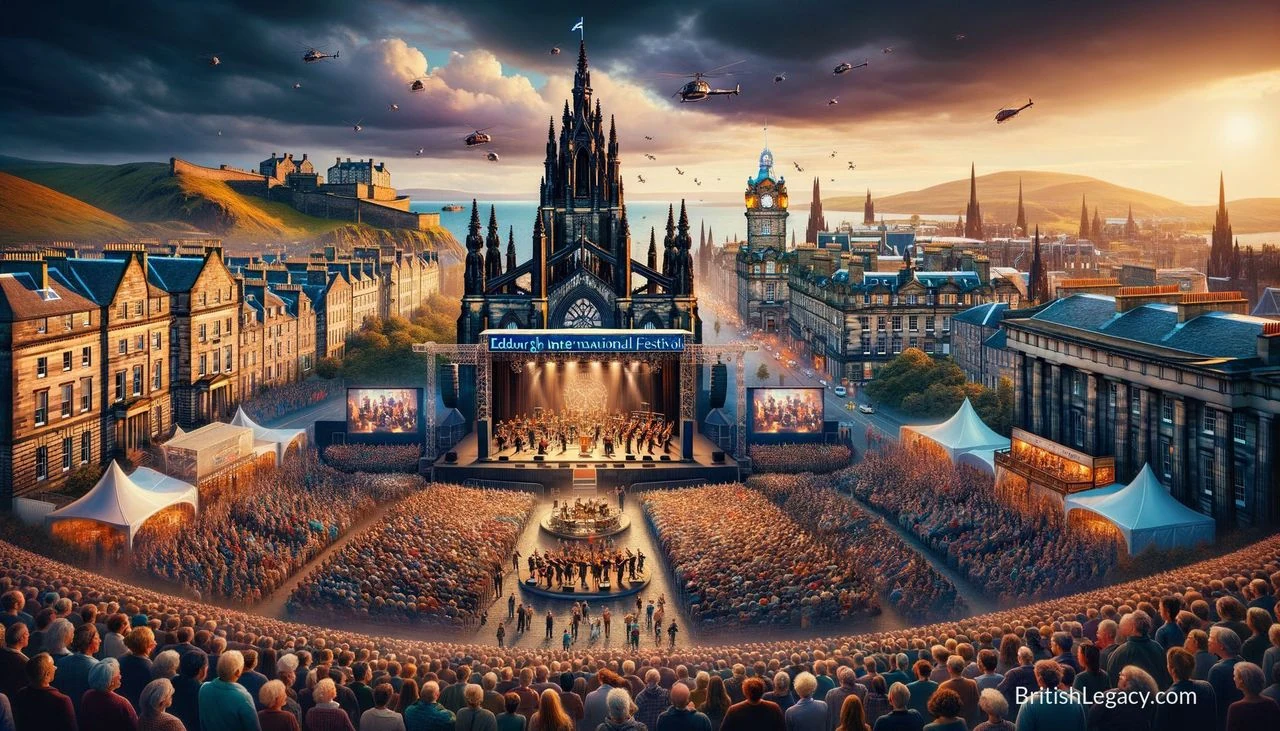
In August 1947, Edinburgh welcomed an international festival of music and drama conceived in the shadow of war. Its purpose was not simply to revive cultural life, but to create a meeting place where artists and audiences could gather across national boundaries. The festival has returned almost every year since, developing into a major annual programme of classical music, opera, theatre, dance and other arts. Its history is also a story of civic commitment: an ambitious international event built around the venues and cultural life of Scotland’s capital.
An idea formed during wartime
The idea took shape during the Second World War. Rudolf Bing, then general manager of Glyndebourne Opera, had discussed the possibility of an international festival with arts patron Lady Rosebery, theatre director Tyrone Guthrie and Audrey Mildmay, whose husband, John Christie, founded Glyndebourne. Bing wanted the arts to help heal the wounds of war. In 1944, he and his colleagues considered whether a substantial festival could be staged somewhere in the United Kingdom while European cultural centres remained damaged and impoverished.
Edinburgh offered a city of considerable beauty, a strong civic identity and venues that could support a varied programme. Harry Harvey Wood, head of the British Council in Scotland, took the proposal to Lord Provost Sir John Falconer, who welcomed it on the city’s behalf. The festival was co-founded by Bing, Wood, Sidney Newman, Reid Professor of Music at Edinburgh University, and Edinburgh civic leaders including Falconer. Its early financing brought together private and public support: Lord Rosebery contributed £10,000 in winnings from his horse Ocean Swell, Edinburgh Town Council matched that sum, and the Arts Council of Great Britain provided further money.
The first International Festival of Music and Drama ran from 22 August to 11 September 1947. Its programme ranged beyond music to opera, ballet, drama, film, song and Scottish piping and dancing. This breadth was part of the original design: the event was intended to give international artists a platform while enriching cultural life in Scotland, Britain and Europe. It has been held annually since then, apart from its cancellation in 2020 during the COVID-19 pandemic; a scaled-back festival followed in 2021.
Music, opera and theatre on Edinburgh stages
Classical music was prominent from the beginning. Among the first season’s highlights were concerts by the Vienna Philharmonic with Bruno Walter, who had left Europe after Germany’s annexation of Austria in 1938. The festival brought together established performers and artists at earlier stages of their careers. Its early concert and recital programmes included conductors such as Thomas Beecham and Herbert von Karajan, violinist Yehudi Menuhin, pianist Artur Schnabel and singer Lotte Lehmann. In later decades, artists including Jacqueline du Pré, Martha Argerich, Daniel Barenboim and Mstislav Rostropovich appeared in Edinburgh.
Opera, too, was central to the programme. With no ideal facilities in the city for creating large-scale staged opera, the festival invited companies from elsewhere. Glyndebourne supplied productions in its first years, followed by companies including Hamburg, La Scala, the Stuttgart State Opera and the Royal Opera. From 1965, Edinburgh Festival Opera also offered locally created performances. These visiting companies brought singers, conductors and directors from across Europe and beyond, establishing opera as a recurring part of the festival rather than an occasional addition.
Drama was present from the outset. The Old Vic supported the early festival, later joined by British companies including the Royal Shakespeare Company, the Traverse Theatre and the National Theatre of Great Britain. A notable early success came in 1948 with a performance of David Lyndsay’s The Thrie Estaites, staged in the Assembly Hall on the Mound; the work returned in later festival years. International companies also came to Edinburgh, among them the Comédie-Française, Dublin’s Abbey Theatre and Japanese Noh and Bunraku companies. The festival’s programme thus connected established British institutions with theatre made in other countries.
More than a concert season
The festival’s programme expanded beyond performance. Visual art joined the event in 1949, with exhibitions at the National Gallery of Scotland and the Royal Scottish Academy. Early exhibitions included works by Rembrandt, Degas, Renoir and Gauguin; later years brought displays ranging from German Expressionist painting to Scottish artist Charles Rennie Mackintosh. The festival has also presented world premieres, including T. S. Eliot’s The Cocktail Party in 1949 and The Confidential Clerk in 1953, and works by Scottish composer James MacMillan in 2018 and 2019.
Its activity is rooted in Edinburgh’s existing buildings. Usher Hall has been used since the first festival in 1947, as have the King’s Theatre and the Royal Lyceum Theatre. The Festival Theatre, whose history reaches back to the Empire Theatre, has also served the event since 1947, initially for ballet and later for opera and ballet. Other venues have joined the programme over time, including the Queen’s Hall and the Hub, which serves as a festival office, information centre and performance venue.
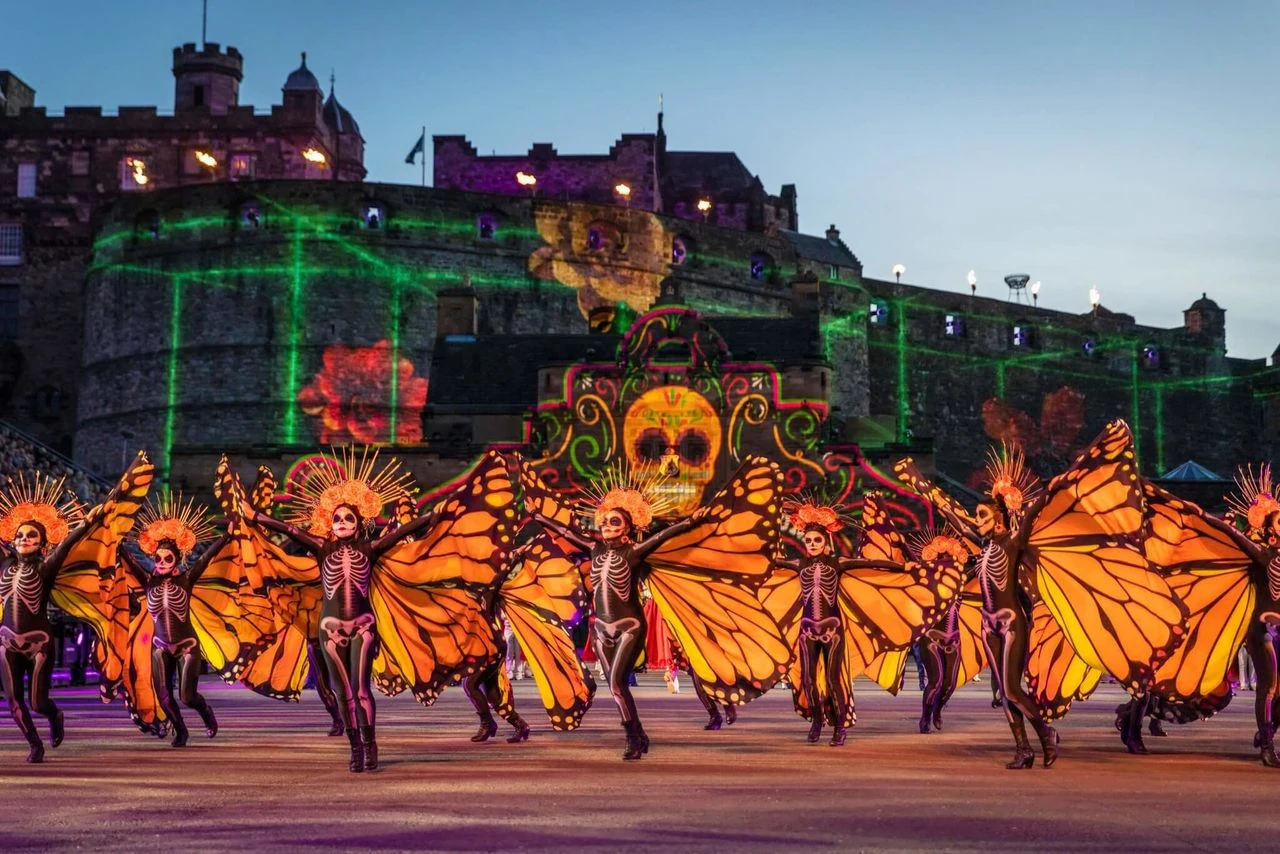
The International Festival takes place alongside a wider August calendar, but it is distinct from the Edinburgh Festival Fringe. The Fringe began in 1947 when eight theatre companies performed outside the official programme. It has since developed into a major arts festival in its own right. Other events also contribute to Edinburgh’s festival season: the Edinburgh International Film Festival began in August 1947, while the Edinburgh International Book Festival grew out of a writers’ festival established in 1966. The Royal Edinburgh Military Tattoo, first staged separately in 1950, became another regular event during the festival period.
A changing festival, sustained by the city
The International Festival’s dates changed in 2015, when its programme was brought forward to begin and end in August, bringing it back into alignment with the Fringe. Its directors have included Bing, who led the first three festivals, and a succession of arts administrators and artists. Nicola Benedetti, the Scottish-Italian violinist, became director in 2022. Under successive leadership, the festival has retained its international outlook while presenting a programme that extends beyond its original emphasis on music and drama.
The festival’s relationship with the Fringe is often described through contrast: a curated International Festival alongside the Fringe’s open-access, unjuried approach. That distinction is useful, but it does not make the two events rivals or substitutes. They have separate histories and identities, and together with the other August events they contribute to the scale and variety of Edinburgh’s cultural season. The International Festival’s own defining features are its invited international programme, its use of the city’s stages and galleries, and a founding ambition to bring people together through the arts.
Why Edinburgh International Festival deserves a place in British Legacy
The Edinburgh International Festival deserves a place in British Legacy because it is a specific example of cultural rebuilding through sustained civic and international collaboration. Its founders imagined an event that could reconnect audiences with ambitious music, theatre and opera after the disruption of war. That intention was backed by practical arrangements: private funding, support from Edinburgh Town Council and the Arts Council of Great Britain, and the use of the city’s theatres and concert halls. The festival’s first season in 1947 turned that proposal into a continuing public event, rather than leaving it as a statement of aspiration.
Its contribution is visible in the range of work it has brought to Edinburgh. International orchestras and performers shared programmes with British theatre companies; opera companies travelled to the city; visual-art exhibitions extended the event beyond the stage; and new works received premieres. The festival has also become part of a wider cultural calendar that includes independent events such as the Fringe, the Film Festival and the Book Festival. These are distinct organisations, not achievements to be credited to the International Festival alone. The festival’s own legacy lies in the platform it has maintained for international performance, the civic cooperation required to sustain it and the durable connection it has created between Edinburgh’s venues and artists from elsewhere. Its British significance is grounded in that history: an Edinburgh institution with an international purpose and a continuing role in Scotland’s cultural life.
Sources
Edinburgh International Festival
Adapted in part from Edinburgh International Festival by Wikipedia contributors, under CC BY-SA 4.0. Text has been edited and combined with the existing article; this adapted text is shared under the same licence. Contributor history.