Edward Burne-Jones made images of a world apart: enchanted gardens, figures absorbed in myth and processions moving through dreamlike space. Yet his work did not stay within the frame. As a painter and designer, he helped shape the decorative arts of Victorian Britain, working with William Morris on stained glass, tapestries and other crafts. His career connected the medieval subjects that fascinated him with the workshops, churches, galleries and publishing ventures of his own time.
Birmingham, Oxford and a change of direction
Burne-Jones was born Edward Coley Burne Jones in Birmingham on 28 August 1833. His mother, Elizabeth, died within days of his birth. His father, Edward Richard Jones, was a frame-maker, and Burne-Jones grew up in the care of his father and the family housekeeper. He attended King Edward VI grammar school and then the Birmingham School of Art, before going to Exeter College, Oxford, to study theology.
At Oxford he became friends with William Morris. Their shared interest in poetry and the Middle Ages drew them into a circle of students who called themselves the Brotherhood. They read John Ruskin and Alfred Tennyson, visited churches and looked to medieval art and society for inspiration. Burne-Jones became absorbed in Thomas Malory’s Le Morte d’Arthur, a source of stories that would remain important to him.
He had intended to enter the Church, but friendship with Morris and the influence of the artist Dante Gabriel Rossetti turned both young men towards art. Burne-Jones left Oxford without taking a degree. He had not received extensive formal training as a draughtsman, and described himself as having found himself at 25 what he ought to have been at 15. His early work, including detailed drawings in pen and ink, shows the effort with which he developed his skills, as well as the imaginative detail that became a hallmark of his work.
Burne-Jones was not a founder of the Pre-Raphaelite Brotherhood, formed in 1848 by artists including Rossetti and John Everett Millais. He became closely associated with the movement’s approach and subject matter. Rossetti’s work influenced him, while his friendship with Morris connected him to a wider circle of artists and makers seeking alternatives to conventional academic practice.
From drawings to public recognition
Burne-Jones worked across several forms from early in his career. In 1857 he began a series of designs for stained glass, and he also made illustrations and decorative work. A visit to Italy in 1859 took him to Florence, Pisa, Siena and Venice. He was particularly drawn to the work of Siena, while medieval literature and classical stories continued to supply subjects for his own images.
For much of the 1860s he worked in watercolour. In 1864 he became an associate of the Society of Painters in Water-Colours, exhibiting works that included The Merciful Knight. He later turned increasingly to oil painting. His exhibition career, however, was interrupted after a controversy in 1870 over Phyllis and Demophoön. Rather than make the alteration requested by the Society, he withdrew the painting and resigned his membership. For several years he exhibited little, though he continued to work.
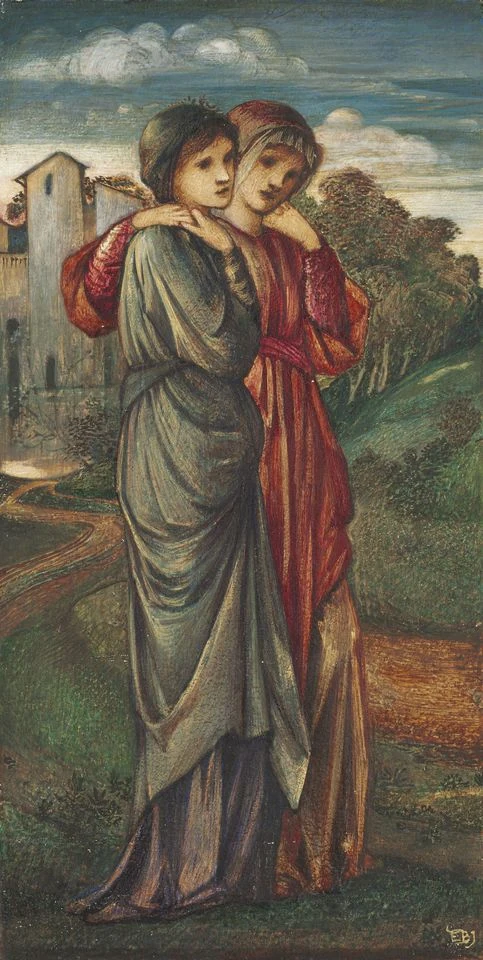
His wider recognition came in 1877, when the new Grosvenor Gallery opened with eight of his oil paintings on show, including The Beguiling of Merlin and The Mirror of Venus. The exhibition made him a leading figure in the Aesthetic Movement, which valued art for its beauty and the experience it offered rather than requiring a moral or practical purpose. His pictures often drew on Arthurian legend, Greek myth and medieval romance, with carefully worked detail and figures set in imagined worlds.
The Beguiling of Merlin draws on the Arthurian story of the enchanter’s entrapment by Nimue, also known as Vivien. Rather than treating the legend as a simple episode of action, Burne-Jones gives it an atmosphere of stillness and enchantment. In The Golden Stairs, first exhibited in 1880, a line of sixteen women descends a staircase. The ordered procession and controlled palette make the painting’s beauty feel measured and deliberate. These works show how his subjects and compositions could evoke narrative without turning the image into a straightforward illustration.
A painter at work across the decorative arts
In 1861 Morris established Morris, Marshall, Faulkner & Co. with Burne-Jones, Rossetti, Ford Madox Brown, Philip Webb and others. The firm undertook work in stained glass, carving, metalwork, printed fabrics, carpets and other forms of decoration. Burne-Jones’s contribution was especially important to its designs for stained glass, and he continued to produce designs after the company was reorganised as Morris & Co. in 1875.
These designs were made for buildings as well as for private or domestic settings. A commission for the South Kensington Museum, now the Victoria and Albert Museum, included stained-glass windows and figures by Burne-Jones. His designs can also be found in churches across Britain, among them Birmingham’s St Philip’s Cathedral and St Martin in the Bull Ring, Salisbury Cathedral, and churches in Frome, Tamworth and Oxford. Other examples were made for buildings in the United States and Australia. The work joined his interest in medieval forms to the practical collaboration of a Victorian design firm.
Burne-Jones also designed illustrations for books, including volumes produced by Morris’s Kelmscott Press. Among these was the Kelmscott edition of Chaucer’s works, published in 1896. He designed sets and costumes for Henry Irving’s 1894 Lyceum Theatre production of King Arthur, which starred Irving and Ellen Terry and later toured America. He was disappointed by aspects of the finished stage production, but the commission brought his Arthurian imagery into a different public setting.
Although often associated with the beauty and reverie of Aestheticism, Burne-Jones’s pictures were part of a broader artistic debate about what art was for. He described a picture as a “beautiful, romantic dream” of something that never was and never would be. That formulation helps explain the distance between his imaginary worlds and everyday life, but the work itself was made through sustained collaboration: with artists, craftspeople, printers and the company established by Morris.
Honours, final years and changing reputations
Burne-Jones was elected an associate of the Royal Academy in 1885, though he formally resigned in 1893. He became president of the Birmingham Society of Artists in 1885 and was made a baronet in 1894. The title was not uncomplicated: his socialist friend Morris and his wife Georgiana were among those who disapproved of the honour. He continued to develop large decorative projects, including work on The Last Sleep of Arthur in Avalon, which remained unfinished at his death.
He died in London on 17 June 1898, aged 64. A memorial service was held at Westminster Abbey six days later, and his ashes were buried at St Margaret’s Church, Rottingdean, where his family had spent summer holidays. In the decades after his death, his standing shifted. A centenary exhibition at the Tate Gallery in 1933 drew a poor audience, as modern art had eclipsed much Victorian painting. From the 1970s onwards, new books and exhibitions helped bring renewed attention to his work. A major exhibition marking the centenary of his death travelled from New York to Birmingham and Paris in 1998.
Why Edward Burne-Jones deserves a place in British Legacy
Burne-Jones belongs in British Legacy not simply because he painted memorable scenes from myth, but because he made those imaginative worlds part of a wider culture of design. His work with Morris & Co. carried his ideas into stained-glass windows, tapestries and other decorative arts. Designs made for churches and public buildings remain in places across Britain, connecting his art to the buildings and communities for which it was commissioned. His illustrations for Kelmscott Press books and his theatre designs further show how his visual language travelled beyond easel painting.
His British connection is especially clear in the links between Birmingham, Oxford and the Victorian arts. Birmingham shaped his early education and later held a major collection of his work; Oxford brought him into lasting partnership with Morris; and their firm helped sustain a renewed practice of decorative craftsmanship. Burne-Jones’s path from theology student to painter and designer also illustrates how Victorian artistic movements grew through friendships, shared reading and practical collaboration. His work was admired abroad and influenced artists beyond Britain, but its lasting significance at home lies in the range of forms it touched: pictures, books, theatre and glass. That breadth makes his legacy more than a gallery of dreamlike paintings; it is also a record of how art could enter everyday spaces.
Sources
Edward Burne-Jones (revision 1377407645) · Edward Burne-Jones
Adapted in part from Edward Burne-Jones by Wikipedia contributors, under CC BY-SA 4.0. Text has been edited and combined with the existing article; this adapted text is shared under the same licence. Contributor history.