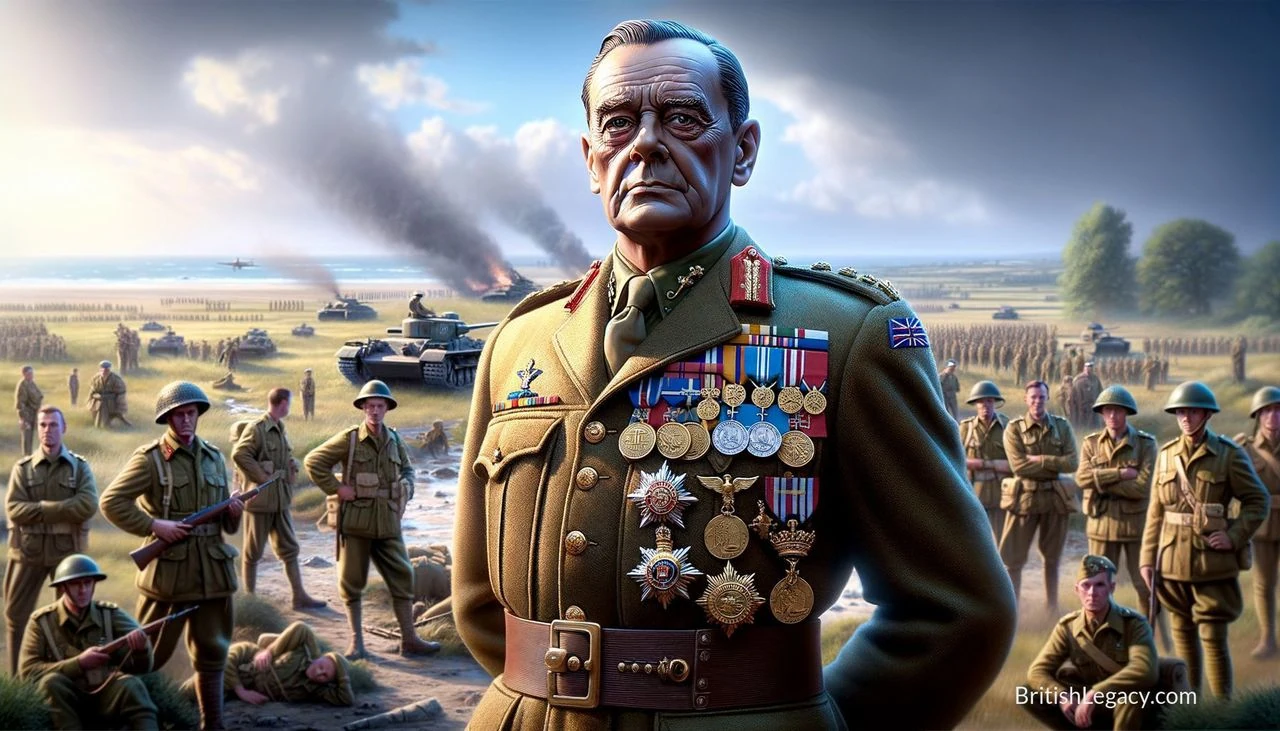
Bernard Law Montgomery’s wartime reputation was built on victories, but not on an uncomplicated record. He commanded the Eighth Army at El Alamein, led Allied ground forces in Normandy and later oversaw the 21st Army Group’s advance across north-west Europe. His methods could be deliberate and his manner abrasive; his campaigns also exposed the challenges of coordinating Allied armies and their supplies. After the war, he held senior British and NATO posts, while his memoirs and public conduct continued to attract criticism.
From Kennington to the Western Front
Montgomery was born on 17 November 1887 in Kennington, then described in the biographical record as part of Surrey, England. He was the fourth of nine children of Henry Montgomery, an Irish Anglican clergyman, and Maud Farrar. His father became Bishop of Tasmania in 1889, and Montgomery spent part of his childhood there. The family later returned to England. He attended The King’s School, Canterbury, then St Paul’s School in London and the Royal Military College, Sandhurst. In 1908 he received a commission in the Royal Warwickshire Regiment.
He went to France with his battalion in 1914. During the First Battle of Ypres, at Méteren in October, a sniper shot him through the right lung; he was also wounded in the knee. He survived, received the Distinguished Service Order for gallant leadership, and spent more than a year recovering in England. He returned to the Western Front and served as a staff officer at the Somme, Arras and Passchendaele, finishing the war as chief of staff of the 47th (2nd London) Division.
After the war, Montgomery served in Ireland during the final stages of the Irish War of Independence and held a succession of regimental, staff and training appointments. He married Elizabeth Carver in 1927; their son, David, was born the following year. His wife died of septicaemia in 1937, after an infected insect bite. In the years before the Second World War, Montgomery commanded infantry formations in Britain, India and Palestine, where British forces were suppressing an Arab revolt.
Building an army in Britain
At the outbreak of war in 1939, Montgomery took command of the 3rd Infantry Division in France as part of the British Expeditionary Force. During the German invasion of the Low Countries in May 1940, the division moved into Belgium and then withdrew towards Dunkirk. Montgomery briefly took command of II Corps during the final stages of the evacuation. The division returned to Britain with relatively few casualties, though the retreat left Allied forces short of equipment.
Back in Britain, Montgomery was given responsibility for training and defence. He insisted on physical fitness and continual exercises, and developed methods for preparing formations to move and fight under pressure. In 1941 he commanded XII Corps and then South-Eastern Command, which he renamed South-Eastern Army to encourage an offensive outlook. A large combined-forces exercise in 1942 tested the approach. That period of preparation preceded his appointment to a much larger and more urgent task in North Africa.
El Alamein and the Mediterranean campaigns
In August 1942, Montgomery took command of the Eighth Army in Egypt. German and Italian forces under Erwin Rommel had recently been checked at the First Battle of El Alamein. Montgomery strengthened the front, organised supplies and trained his troops before launching a major offensive. At Alam el Halfa in August, he repelled Rommel’s attack but did not immediately pursue the withdrawing force. Instead, he continued preparing for a larger operation.
The Second Battle of El Alamein began on 23 October 1942 and lasted 12 days. The Eighth Army broke through Axis positions and took more than 30,000 prisoners. The victory helped Allied forces regain the initiative in North Africa. Montgomery continued to command the Eighth Army in the campaigns in Tunisia, Sicily and Italy. At the Mareth Line in Tunisia, he changed the plan when a direct assault met stronger resistance than expected, shifting the main effort inland to outflank the position.
His command style was closely associated with preparation, visible contact with troops and concentration of resources. It did not prevent disputes with fellow Allied commanders. In Sicily, Montgomery’s views on the invasion plan and his relations with American generals George Patton and Omar Bradley contributed to tensions. In Italy, he complained about what he saw as poor coordination and a lack of opportunity, while the Eighth Army’s advance through difficult terrain and German defensive lines was slow and costly.
Normandy, the Rhine and the limits of command
In 1944, Montgomery returned to Britain to lead the 21st Army Group for Operation Overlord. From D-Day on 6 June until 1 September, he commanded all Allied ground forces in Normandy under Supreme Allied Commander Dwight D. Eisenhower. The fighting did not follow a neat, prearranged timetable. Allied forces encountered determined German resistance, and the struggle for Caen and the eventual breakout became the subject of enduring argument about Montgomery’s plans and the purpose of the operations around the city. British and Canadian forces held substantial German strength in the east while American forces broke out in the west, but accounts differ over how far this outcome had been intended from the outset.
Montgomery continued to command the 21st Army Group after Eisenhower took over direct command of Allied ground forces. His campaign in north-west Europe included the failed airborne and ground offensive at Arnhem, Operation Market Garden. He later acknowledged that he had underestimated the difficulty of opening the approaches to Antwerp and that his assessment was wrong. The port’s access through the Scheldt estuary remained in German hands after Antwerp itself was captured. Montgomery eventually made clearing the Scheldt a priority, and the port opened to Allied shipping in November 1944.
During the Battle of the Bulge, Eisenhower temporarily placed the American First and Ninth Armies on the northern flank under Montgomery’s command. The arrangement caused resentment among some American officers. In the final months of the war, Montgomery’s forces crossed the Rhine in March 1945 and took part in the encirclement of German forces in the Ruhr. On 4 May, at Lüneburg Heath, he accepted the surrender of German forces in north-west Germany, Denmark and the Netherlands.
Senior appointments and a contested reputation
After the war, Montgomery became commander-in-chief of the British Army of the Rhine and then Chief of the Imperial General Staff, serving from 1946 to 1948. He chaired the Western Union commanders-in-chief committee from 1948 to 1951. When NATO established Supreme Headquarters Allied Powers Europe in 1951, he became Deputy Supreme Allied Commander Europe, serving until his retirement in 1958.
Montgomery was made Viscount Montgomery of Alamein in 1946 and received senior British and Allied honours. His memoirs, published in 1958, attacked or criticised a number of former colleagues, including Eisenhower. His claims about the first Battle of El Alamein prompted Field Marshal Claude Auchinleck to threaten legal action; Montgomery later made a radio broadcast expressing gratitude for Auchinleck’s role in stabilising the front. His forceful opinions and lack of tact had already caused friction during the war, and the post-war memoirs kept those disagreements in public view.
Montgomery died at his home in Isington, Hampshire, on 24 March 1976, aged 88. After a funeral at St George’s Chapel, Windsor, he was buried at Holy Cross churchyard in Binsted, Hampshire. His association with the war remains visible in Britain: the Imperial War Museum holds his papers and command vehicles, and a statue stands outside the Ministry of Defence in Whitehall. His name also appears in memorials and collections beyond the United Kingdom, reflecting the international reach of the Allied campaigns he commanded.
Why Bernard Montgomery deserves a place in British Legacy
Montgomery belongs in a British account of the Second World War because he held responsibility at several decisive points in the Allied campaign. At El Alamein, he took command of an army facing an immediate threat, strengthened its position and prepared a major offensive that broke the Axis line. Later, as commander of the 21st Army Group, he directed British, Canadian, Polish and American formations in north-west Europe, from Normandy to the Rhine. These operations were multinational, and their outcomes cannot be credited to one commander alone. Yet Montgomery’s appointments and decisions placed him at the centre of the British contribution to the Allied land campaign.
His legacy is more useful when it includes both achievement and limitation. The capture of Antwerp did not immediately make its port usable: the Scheldt had to be cleared, and the delay strained Allied logistics. Market Garden failed to achieve its central objective, and Montgomery later admitted a serious error in his assumptions about Antwerp. The arguments over Normandy, his working relationships with Allied commanders and his sharp criticism of colleagues in his memoirs all complicate the image of an untroubled strategist. For British Legacy, that complexity matters. Montgomery’s career shows the reach of British military command in a coalition war, but also the costs of misjudgement, the importance of cooperation and the difficulty of turning battlefield success into sustained operational advantage.
Sources
Bernard Montgomery — revision 1379805763
Adapted in part from Bernard Montgomery by Wikipedia contributors, under CC BY-SA 4.0. Text has been edited and combined with the existing article; this adapted text is shared under the same licence. Contributor history.