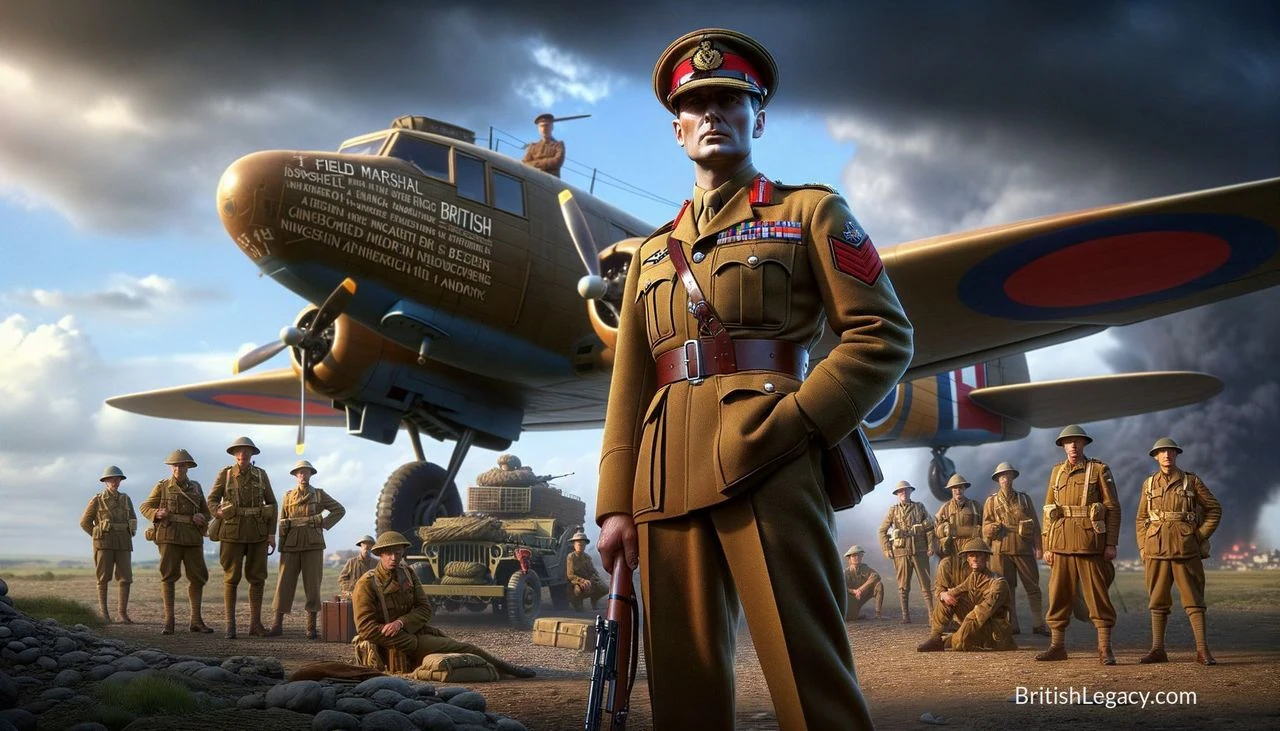
Claude Auchinleck’s wartime career crossed several theatres and placed him at the centre of difficult decisions about command, supply and the future of the Indian Army. He led forces in Norway, commanded the Middle East theatre during the North African campaign and later supported the Fourteenth Army’s operations from India. His record includes both defeats and consequential contributions, notably the defence at El Alamein and the organisation that sustained Allied forces in Burma.
From Aldershot to the Indian Army
Auchinleck was born in Aldershot, Hampshire, on 21 June 1884. His father, John Claud Alexander Auchinleck, was a Royal Horse Artillery colonel posted to Bangalore; the family accompanied him to India while Claude was young. After his father died in 1892, Auchinleck returned to England. He attended Eagle House School and Wellington College on scholarships before entering the Royal Military College, Sandhurst.
Commissioned into the Indian Army in January 1903, he joined the 62nd Punjabis the following year. He served in Tibet and Sikkim, and later became adjutant of his regiment. His knowledge of Indian languages and local customs helped him communicate directly with soldiers. During the First World War, the regiment served in the defence of the Suez Canal and in Mesopotamia. Auchinleck took part in the costly Battle of Hanna, the Second Battle of Kut and the capture of Baghdad. He was awarded the Distinguished Service Order for service in Mesopotamia.
Between the wars, he attended the Staff College at Quetta and the Imperial Defence College. He commanded the Peshawar Brigade during operations on the North-West Frontier, including the Mohmand campaigns, and later held staff and district commands. In 1938 he chaired a committee examining the Indian Army’s modernisation, composition and equipment. Its recommendations formed the basis of the Chatfield Report, a programme associated with the army’s expansion from 183,000 personnel in 1939 to more than 2.25 million by the end of the war.
Norway and the Middle East
At the outbreak of the Second World War, Auchinleck was appointed to command the 3rd Indian Infantry Division. In 1940 he was brought to Britain to lead IV Corps, and in May took command of the Anglo-French ground forces in Norway. After that campaign failed, he returned to Britain and became general officer commanding Southern Command, responsible for the defence of southern England. In December 1940 he was appointed Commander-in-Chief, India.
In April 1941, when a pro-Axis government in Iraq threatened RAF Habbaniya, Auchinleck sent the 1st Battalion of the King’s Own Royal Regiment by air and the 10th Indian Infantry Division by sea to Basra. The relief column from Palestine arrived as the Anglo-Iraqi conflict was nearing its end. In July, he exchanged posts with General Archibald Wavell, taking command of Middle East Command, which covered North Africa as well as Persia and the Middle East.
Auchinleck launched Operation Crusader in November 1941. After hard fighting and the relief of Tobruk, Axis forces withdrew to El Agheila. The British position then deteriorated: Rommel’s forces regrouped and drove the Eighth Army back towards Egypt, and Tobruk fell in June 1942. Auchinleck took direct command of the Eighth Army on 24 June. He chose to delay the Axis advance at Mersa Matruh before withdrawing to El Alamein, where the terrain and available reinforcements helped him establish a defensive line.
In the First Battle of El Alamein, that line halted the exhausted German and Italian advance. Auchinleck’s subsequent counter-attacks achieved little, and disputes over command and the handling of the army damaged confidence among senior officers. Churchill and the Chief of the Imperial General Staff, Alan Brooke, visited Cairo in August 1942. Auchinleck was replaced as Commander-in-Chief, Middle East, by Harold Alexander. His North African command was not an uninterrupted success, but the defence at El Alamein prevented the Axis advance from continuing into Egypt.
Building the base for the Burma campaign
Auchinleck declined an offer to command the newly created Persia and Iraq Command, arguing that separating it from Middle East Command would not work. After a period without a command, he returned to the post of Commander-in-Chief, India, in June 1943. Responsibility for operations against Japan was transferred to the new South East Asia Command, but India remained essential as a base, recruiting area and training ground.
As Commander-in-Chief, India, Auchinleck oversaw internal security, the defence of the North-West Frontier, the reorganisation and training of the Indian Army, and the lines of communication that carried personnel and supplies towards Burma and China. He made the supply of General William Slim’s Fourteenth Army a priority. Slim later credited Auchinleck and the Army of India with providing support without which the Fourteenth Army could not have operated. This logistical work was a less visible part of the campaign than battlefield command, but it helped sustain the force through to its eventual victories.
Auchinleck remained in office through the end of the war and the approach to Partition. He helped prepare the future Indian and Pakistani armies, despite disagreeing with Partition. In 1945, as unease grew over the trials of officers of the Indian National Army, he commuted the more serious judicial sentences. He was promoted to field marshal on 1 June 1946. After Partition in August 1947, he became Supreme Commander of the British forces remaining in India and Pakistan, serving until the headquarters closed at the end of November.
Retirement, honours and remembrance
Auchinleck left India on 1 December 1947. After a brief period in Italy connected with an unsuccessful business project, he returned to Britain and pursued charitable and business interests. He also became a skilled watercolour painter. He lived in Beccles, Suffolk, from 1960 to 1967, then moved to Marrakesh, where he died on 23 March 1981, aged 96. He is buried in the Commonwealth War Graves Commission plot at Ben M’Sik European Cemetery in Casablanca.
Known in the army as “the Auk”, Auchinleck received British and foreign decorations, including the Knight Grand Cross of the Order of the Bath, the Knight Grand Cross of the Order of the Indian Empire, the Companion of the Order of the Star of India and the Distinguished Service Order. His British memorials include a plaque in the crypt of St Paul’s Cathedral and a bronze statue on Broad Street in Birmingham.
Why Claude Auchinleck deserves a place in British Legacy
Auchinleck’s place in British history rests not on a simple story of victory, but on the responsibilities he carried across a changing wartime landscape. His command in North Africa included the loss of Tobruk and his replacement in 1942. It also included the decision to establish a defensible position at El Alamein, where the Axis advance into Egypt was stopped. Setting those events alongside one another gives a more useful account of command than a portrait built solely from praise: decisions made under pressure had lasting consequences, and Auchinleck’s record was contested even by those directing the war.
His service in India offers another measure of his contribution. As Commander-in-Chief, he organised training, supply and communications for forces operating in Burma, while the Indian Army expanded and the prospect of Partition transformed its future. Slim’s assessment of the support from Auchinleck and the Army of India points to the practical value of this work. It helped sustain the Fourteenth Army, rather than merely adding another name to a list of senior commanders. His role in preparing the future Indian and Pakistani armies also places his career within the transition away from British rule, a significant part of the history of Britain’s relationship with India. Remembering Auchinleck means recognising both his military achievements and the imperial context in which he served.
Sources
Claude Auchinleck — Wikipedia revision 1379805909 · Claude Auchinleck
Adapted in part from Claude Auchinleck by Wikipedia contributors, under CC BY-SA 4.0. Text has been edited and combined with the existing article; this adapted text is shared under the same licence. Contributor history.