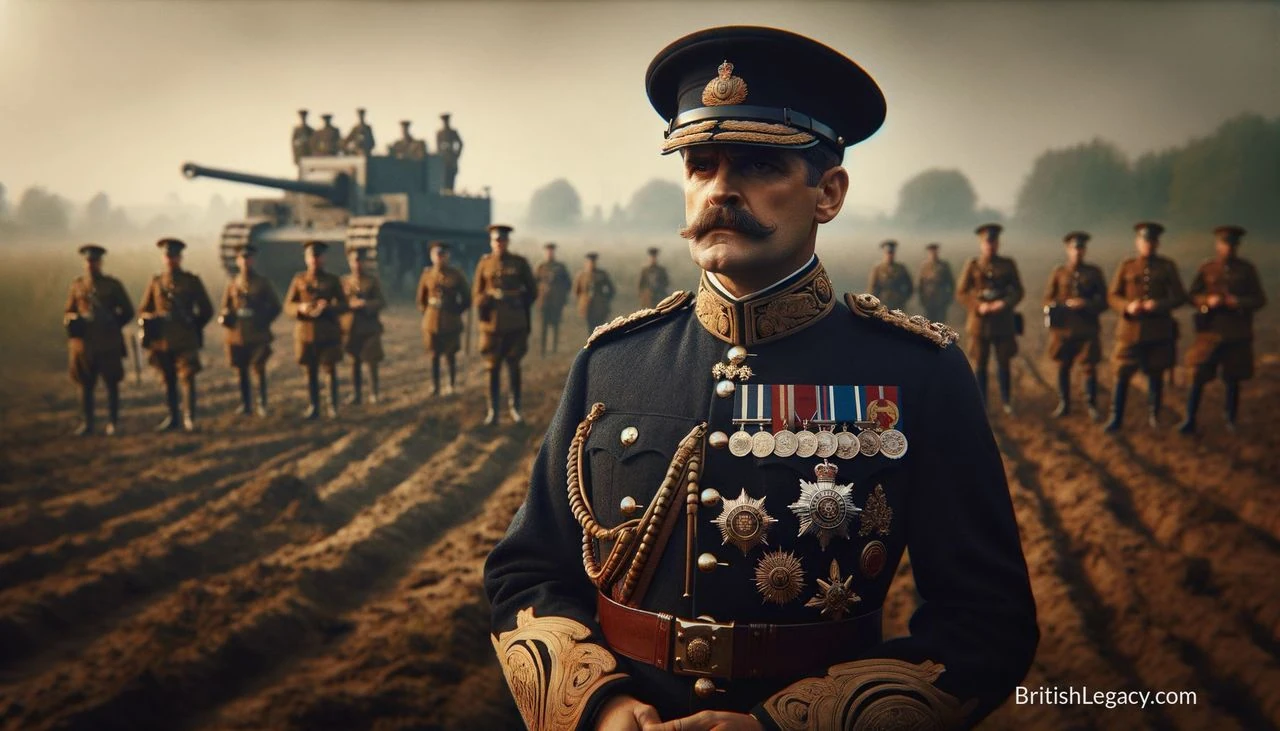
John Denton Pinkstone French commanded the British Expeditionary Force (BEF) during the opening phase of the First World War. In August 1914, British forces under his command fought at Mons and then withdrew as the German advance continued. Their retreat formed part of the wider Allied effort before the First Battle of the Marne. French remained in command through 1915, a period marked by fighting at Ypres, criticism of his approach and disagreements with military and political leaders. He resigned in December that year.
From naval service to the cavalry
French was born in Kent on 28 September 1852. He began his military career in the Royal Navy before transferring to the British Army. His cavalry leadership during the Second Boer War of 1899–1902 brought him recognition. By the early twentieth century he had been knighted and had established himself as an experienced officer.
These early stages of his career preceded the responsibility for which he is chiefly remembered: command of the BEF in the first years of a European war. His route from naval service to the Army, and his work in cavalry campaigns, provide the available outline of the career that led to that appointment.
Command in 1914 and 1915
When Britain declared war on Germany in August 1914, French was appointed commander-in-chief of the BEF and led British forces on the Western Front. The army’s first major engagement was the Battle of Mons in late August. French’s forces withdrew in the face of the German advance. Their movement was part of the broader Allied retreat and subsequent effort that culminated in the First Battle of the Marne, where the German advance was halted.
The fighting at Mons and the Marne belongs to the opening sequence of French’s command; it should not be mistaken for a claim that he alone determined the Allied outcome. The war then settled into the prolonged trench warfare associated with the Western Front. French remained in command through 1914 and 1915, including during the fighting at Ypres. His leadership drew criticism, including over caution, and he disagreed with French allies as well as British political leaders, among them Prime Minister H. H. Asquith and War Minister Lord Kitchener.
Leaving the BEF
French resigned as commander of the BEF in December 1915 amid mounting pressure and the difficulties of coalition warfare. Sir Douglas Haig succeeded him and led the force for the remaining years of the conflict. French’s subsequent service included the office of Lord Lieutenant of Ireland, held during a period of political volatility. His career therefore continued beyond the Western Front, although the account of that later role is brief.
Why John French deserves a place in British Legacy
French’s place in British military history is grounded in his command of the BEF at the start of the First World War. The force he led fought at Mons, withdrew during the German advance and took part in the wider Allied campaign that preceded the Marne. These events connect his career to a consequential opening phase of Britain’s participation in the war. They also make clear the limits of any simple heroic account: the retreat and the subsequent Allied effort involved a wider campaign, not one commander acting alone.
His record also shows the strains attached to coalition command. French faced criticism of his leadership and disagreements with allied and British leaders before resigning in 1915. Those details matter alongside his battlefield role: they place military decisions within the relationships and pressures that shaped his command. His later appointment as Lord Lieutenant of Ireland extended his public service beyond the Western Front. Remembering French means recognising both the responsibilities he held at a defining moment in British military history and the contested judgements that accompanied them.