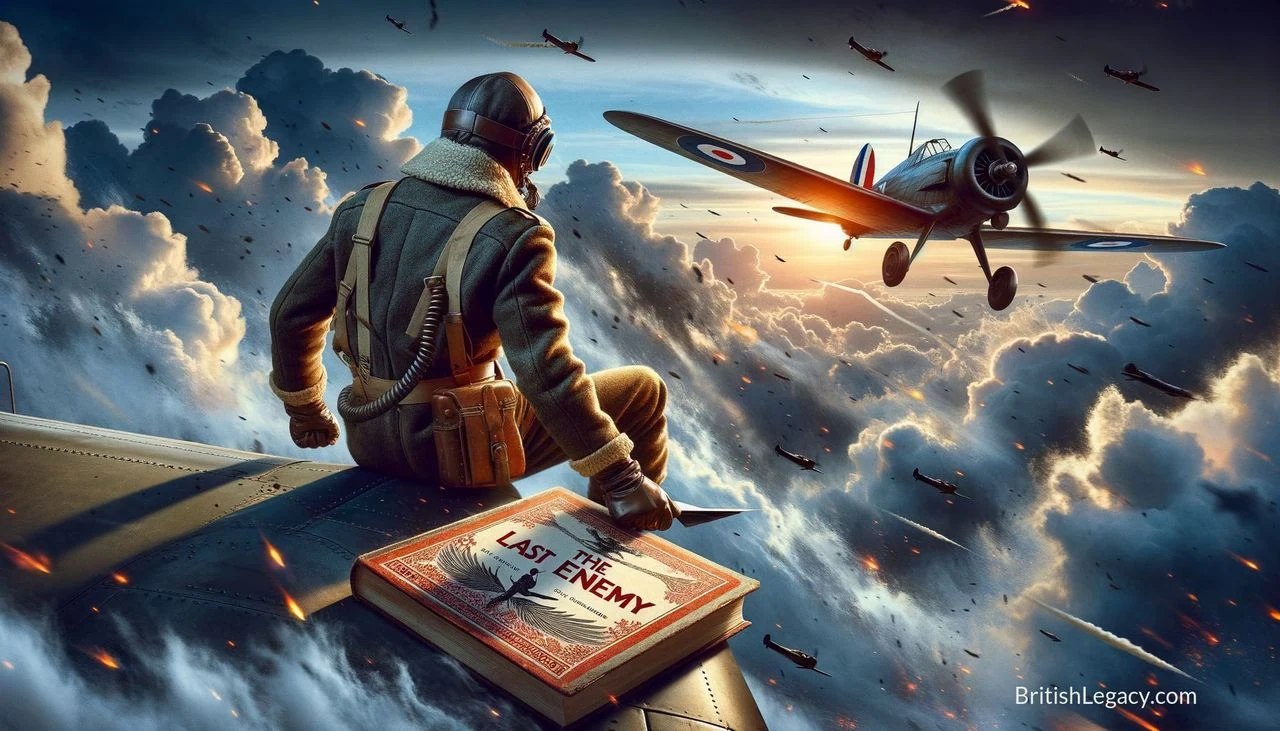
Richard Hope Hillary’s account of the Battle of Britain begins in the cockpit of a Spitfire and continues through a crash, severe burns and months of reconstructive surgery. Published in 1942, The Last Enemy made him a writer as well as a fighter pilot. He returned to the Royal Air Force after his injuries, but was killed on a night-training flight in Scotland in January 1943, aged 23.
An Australian-born student in Britain
Hillary was born in Sydney, Australia, on 20 April 1919. His parents, Michael and Edwyna Hillary, were Australian, and he was sent to England for his education. He attended Shrewsbury School and Trinity College, Oxford. At Oxford he joined the university’s Air Squadron and the Royal Air Force Volunteer Reserve in 1939. He also rowed in Trinity College’s successful eight in 1938.
Hillary was called up to the RAF in October 1939. After completing his flying training, he joined B Flight of No. 603 Squadron in July 1940. The squadron was based at RAF Montrose and flew Spitfires. It moved south to RAF Hornchurch on 27 August, entering combat soon afterwards as the Battle of Britain intensified.
Combat, a crash and a long recovery
In a week of combat, Hillary was credited with five enemy aircraft shot down, two probably destroyed and one damaged. On 3 September 1940, during an engagement with German fighters, his Spitfire caught fire. Hillary was unable to leave the aircraft immediately. He eventually fell from it unconscious, came round while falling and opened his parachute, landing in the North Sea. A lifeboat from Margate rescued him.
Hillary suffered extensive burns to his face and hands. He was treated first at the Royal Masonic Hospital in Hammersmith and then at Queen Victoria Hospital in East Grinstead, where the surgeon Archibald McIndoe directed his care. Hillary underwent repeated operations over three months. He became one of the best-known members of McIndoe’s Guinea Pig Club, an association of airmen treated for burns and other serious injuries.
The injury ended his combat flying for the time being, but not his connection to the RAF. During his recovery, Hillary began writing about the air war and the bodily consequences of his crash. His experience of surgery and convalescence became part of the story, rather than a short postscript to his time in the air.
Writing The Last Enemy
In 1941, Hillary persuaded the British authorities to send him to the United States to rally support for Britain’s war effort. He spoke on American radio and drafted much of his book while there. The work appeared in Britain in 1942 as The Last Enemy; its American title was Falling Through Space.
The book moves between the anticipation of flying a Spitfire, the confusion of aerial combat and the realities of severe injury and treatment. Hillary wrote about his own experience, giving the account its force as a personal record of the Battle of Britain rather than a general history of the campaign. Its title places combat within a larger meditation on death, while the narrative also describes the practical, often painful process of recovery.
Hillary’s writing is one reason his story reaches beyond a squadron record. It preserves the perspective of a young pilot who had experienced both the exhilaration of flying and the consequences of being shot down. His book’s publication during the war placed that testimony before readers while the conflict was still under way.
Return to flying and a final training flight
After recovering, Hillary persuaded the RAF to let him return to flying. He joined No. 54 Operational Training Unit at RAF Charterhall, near Berwick-upon-Tweed, for a conversion course in night-fighter aircraft. This was a return to training, not a second tour on the Battle of Britain front line.
On 8 January 1943, Hillary and Sergeant Wilfred Fison, a navigator and radio operator, were killed when their Bristol Blenheim night fighter crashed during a training flight in adverse weather. The aircraft came down on farmland in Berwickshire. Hillary was in his 24th year.
A funeral service took place at St Martin-in-the-Fields in London on 25 January, followed by cremation at Golders Green. His former squadron commander, Wing Commander George Denholm, scattered his ashes over the English Channel from a Douglas Boston. Hillary is commemorated on the Commonwealth War Graves Commission memorial.
Remembering a pilot and author
Hillary is commemorated at RAF Charterhall, where a memorial was unveiled in 2001 at the site of the former airfield. Trinity College, Oxford, also remembers him through an annual literature prize, a portrait outside the college library and an annual lecture established in his honour in 1992. Those traditions connect his wartime service with his work as a writer and former student.
His life joined several experiences that are often remembered separately: an Australian childhood, education in England, service in a British wartime squadron, survival and treatment after an aircraft fire, and a book written from that experience. His return to flying after surgery forms another part of the record, as does the fact that his final flight was a training exercise rather than combat.
Why Richard Hillary deserves a place in British Legacy
Richard Hillary’s place in British Legacy rests on a particular combination of service and testimony. As a pilot with No. 603 Squadron, he flew Spitfires during the Battle of Britain and was credited with enemy aircraft destroyed or damaged. After his own aircraft caught fire, his survival and extensive treatment brought him into the orbit of Archibald McIndoe’s work at East Grinstead. The story is not simply one of combat: it also records the consequences of air warfare and the long effort to recover from severe burns.
The Last Enemy gives that experience a lasting form. Hillary wrote about flying, injury and recovery from the perspective of someone who had undergone all three, and published the book while the war continued. His later return to RAF training, and his death with Sergeant Wilfred Fison on a night flight, complete a life cut short before he could develop his writing further. The memorial at Charterhall and Trinity College’s continuing literary commemorations preserve both sides of his legacy: the young RAF pilot and the author whose account carried the experience of the Battle of Britain to readers. His Australian birth is part of that history; his education, service and remembrance connect it directly to Britain.
Sources
Richard Hillary — revision 1354535087
Adapted in part from Richard Hillary by Wikipedia contributors, under CC BY-SA 4.0. Text has been edited and combined with the existing article; this adapted text is shared under the same licence. Contributor history.