Frank Auerbach spent decades painting the same people and the streets around his Camden studio. He did not treat repetition as a shortcut: he returned to each subject because the image remained unresolved. His paintings, built from forceful marks and thick paint, record not just what he saw but the sustained effort of looking again.
A childhood shaped by exile
Auerbach was born in Berlin on 29 April 1931, the son of Max Auerbach, a patent lawyer, and Charlotte Nora Borchardt, who had trained as an artist. His parents were Jewish. As Nazi persecution intensified, they sent him to Britain in 1939. He was one of six children sponsored for the journey by the British writer Iris Origo. His parents remained in Germany and were murdered at Auschwitz in 1942.
In Britain, Auerbach attended Bunce Court School near Faversham in Kent. He excelled in art and drama, and acting briefly appeared to be a possible career: at 17 he took a small role in Peter Ustinov’s play House of Regrets at the Unity Theatre in St Pancras. Art proved the stronger commitment. He studied at St Martin’s School of Art from 1948 to 1952 and at the Royal College of Art from 1952 to 1955. He also attended art classes at Borough Polytechnic, where David Bomberg taught him and fellow St Martin’s student Leon Kossoff. Bomberg’s teaching became an important part of Auerbach’s formation.
Finding order in paint
Auerbach is often described as an expressionist, but that label does not fully explain what he was trying to do. His concern was not to give an emotion or spiritual state a visual equivalent. Rather, he tried to resolve the experience of being in the world through painting: to find an order in what he understood as a chaotic experience.
That aim demanded repeated work. Auerbach formed intense relationships with his subjects, particularly the people he painted and the places he saw regularly. He might paint a canvas and scrape it back at the end of the day, then begin again because he was dissatisfied with the result. The heavy surfaces of his paintings can therefore give a misleading impression of a slow, gradual accumulation of paint. The paint could be applied over a short period, and scraped away soon after. Some of his 1950s canvases became difficult to hang because of their weight; the thickness of the paint was part of the physical force of the work, but also of a process in which an image was repeatedly tested and remade.
His approach did not win universal approval. A 1956 review in the Manchester Guardian described his technique as so obtrusive that it took time to reach the intentions behind it. Auerbach’s work also sat uneasily with some later critics’ expectations of what painting should be. That resistance is part of the history of his reception: his paintings ask viewers to look through the material intensity of the surface, rather than treating it as decoration.
Camden streets and familiar faces
Auerbach focused much of his painting on portraits and city scenes around Camden Town, where he lived and worked. The streets and building sites near his studio became subjects to which he returned, not simply landmarks to be recorded. He once explained that passing something every day could allow its character to begin to intrigue him. Repeated observation gave a familiar view the possibility of change: the subject remained, while each attempt to paint it began anew.
His portraits also grew from sustained attention. He painted a relatively small group of sitters repeatedly, including Estella Olive West, known in painting titles as EOW; Juliet Yardley Mills, or JYM; his wife Julia; and, from 1978, the art historian and curator Catherine Lampert. Lampert had organised Auerbach’s retrospective at the Hayward Gallery that year and continued to sit for him until his death. The returning sitter was not merely a convenient model: a long acquaintance gave Auerbach another opportunity to test what a painted likeness could hold.
He also engaged directly with older painting. For an exhibition at the National Gallery in 1994, he made works responding to its collection, including paintings after Titian’s Bacchus and Ariadne and Rubens’s Samson and Delilah. His encounter with art history was not confined to a brief gallery residency; it formed part of a longer engagement with earlier painters.
Exhibitions, teaching and recognition
Auerbach began teaching in secondary schools in 1955, then worked as a visiting tutor at art schools including Bromley, Sidcup and the Slade. From 1958 to 1965 he taught one day a week at Camberwell School of Art. His support for younger artists extended beyond the classroom: he encouraged students and helped some secure opportunities to study at the Slade.
His first solo exhibition took place at London’s Beaux Arts Gallery in 1956. Further shows followed there between 1959 and 1963, and from 1965 his work appeared regularly at Marlborough Fine Art in London. In 1978 the Hayward Gallery held a major retrospective. He was included in the Royal Academy’s A New Spirit in Painting in 1981 and represented Britain at the Venice Biennale in 1986, sharing the Golden Lion with Sigmar Polke.
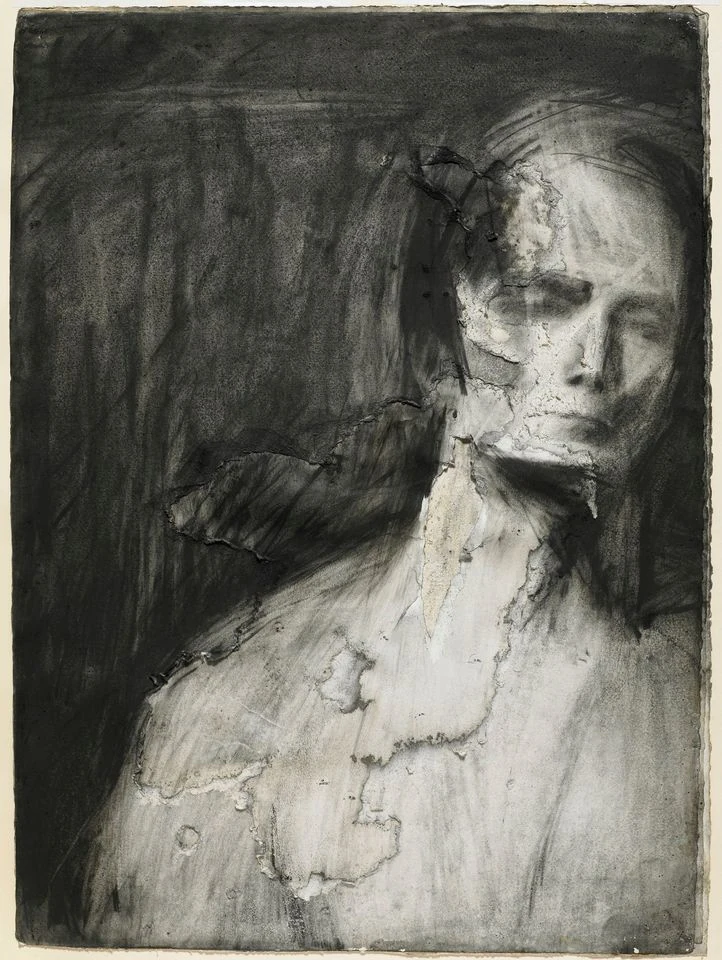
Later exhibitions included a 2001 Royal Academy show, a retrospective organised by Tate Britain and the Kunstmuseum Bonn in 2015–16, and a 2024 Courtauld Gallery exhibition of large-scale charcoal heads made in post-war London during the 1950s and early 1960s. Auerbach also worked in printmaking: his etchings and drypoints from 1954 to 2006 were shown at the Fitzwilliam Museum in 2007–08, in an exhibition that travelled to Abbot Hall Art Gallery. His work reached a broader television audience through Frank Auerbach: To the Studio, directed by Hannah Rothschild and first broadcast on Omnibus in 2001.
Family, later life and death
Auerbach met Julia Wolstenholme at the Royal College of Art. They married in 1958 and had a son, Jacob, known as Jake, that year. Their relationship included a separation lasting around a dozen years in the 1960s and 1970s; they later reconciled. Jake became a film director and made a documentary about his father’s career. Auerbach died in London on 11 November 2024, aged 93.
His reputation also extended beyond the studio and gallery. David Bowie owned Auerbach’s portrait Head of Gerda Boehm; after Bowie’s death, the work sold at auction in 2016 for £3.8 million. Auerbach’s own Mornington Crescent (1969) later sold at Sotheby’s in London for £5,565,200 in 2023. These prices register the market’s attention, but they do not describe the patient process that made the paintings.
Why Frank Auerbach deserves a place in British Legacy
Auerbach’s place in British cultural history rests on more than his adoption of London as a subject. Sent to Britain as a child in 1939, he trained and worked here, taught in British art schools, and developed a distinctive practice in close engagement with the city and its people. His biography connects forced migration and loss with a long professional life in Britain, without reducing the paintings to a simple story of adversity overcome. The work itself is the more substantial legacy: a sustained attempt to make sense of experience through close observation, revision and paint.
That practice also left a mark beyond his own canvases. His years teaching at Camberwell and elsewhere, and his practical encouragement of students, helped connect his demanding approach to later generations of artists. His exhibitions at the Hayward Gallery, the Royal Academy, Tate Britain and the Courtauld placed British painting in conversation with audiences at home and abroad. In the Camden streets he repeatedly painted, and in the familiar sitters he kept returning to, Auerbach made local observation a source of lasting artistic inquiry. British Legacy can remember him both as a German-born British painter of international standing and as an artist whose work grew from a particularly sustained relationship with London.
Sources
Adapted in part from Frank Auerbach by Wikipedia contributors, under CC BY-SA 4.0. Text has been edited and combined with the existing article; this adapted text is shared under the same licence. Contributor history.