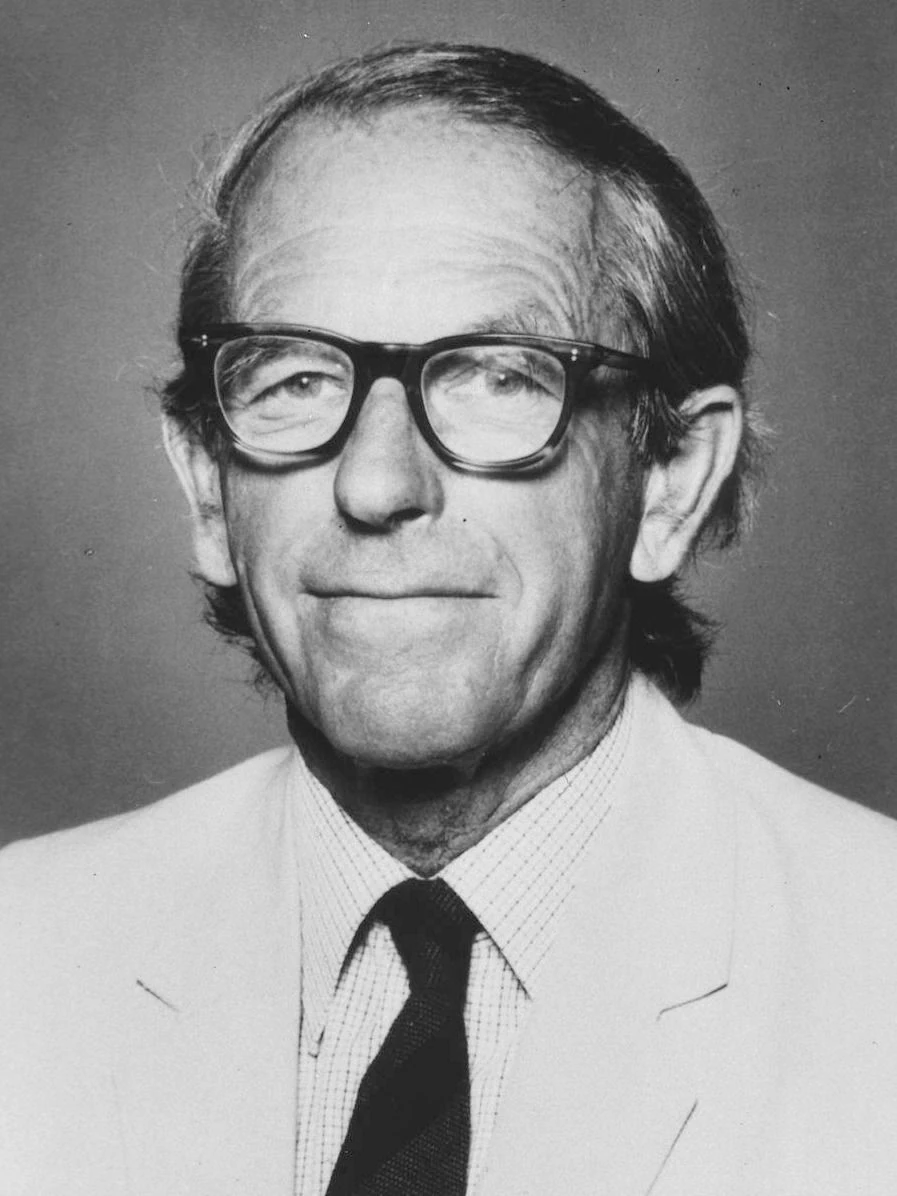
Frederick Sanger helped make the structure of life readable. His first great achievement was to determine the amino acid sequence of insulin, showing that a protein had a precise chemical structure. More than two decades later, he developed a method for sequencing DNA that made it possible to read much longer stretches of genetic material. The two advances earned him Nobel Prizes in Chemistry in 1958 and 1980, and established a career rooted in research laboratories in Cambridge.
From Gloucestershire to Cambridge
Sanger was born in Rendcomb, Gloucestershire, on 13 August 1918, the second of three children. His father, Frederick, was a doctor; his mother was Cicely, née Crewdson. The family moved to Tanworth-in-Arden in Warwickshire when Sanger was about five. His father had become a Quaker, and the children were brought up in that faith.
He attended the Downs School, a Quaker preparatory school near Malvern, and then Bryanston School in Dorset. At Bryanston, he enjoyed scientific subjects and spent time experimenting in the laboratory with his chemistry teacher, Geoffrey Ordish. That experience helped turn a general interest in science into a wish to pursue it as a career.
In 1936 Sanger entered St John’s College, Cambridge, to study natural sciences. Physics and mathematics proved difficult, so he moved towards physiology and then biochemistry. He graduated with first-class honours in biochemistry. Both his parents died of cancer during his first two years at Cambridge. His Quaker upbringing also shaped his pacifism: he was a member of the Peace Pledge Union and received exemption from military service as a conscientious objector. He undertook social-relief training and briefly worked as a hospital orderly.
For his doctorate, begun in 1940, Sanger initially investigated whether edible protein could be obtained from grass. After his first supervisor left, Albert Neuberger took over and Sanger changed his subject to the metabolism of lysine and nitrogen in potatoes. He received his PhD in 1943. That year he joined the research group of Charles Chibnall in Cambridge, where work on insulin would set the direction of his early scientific career.
Insulin and the structure of proteins
Chibnall suggested that Sanger investigate the amino groups in insulin. It was one of the few proteins then available in a pure form, and Sanger developed ways to identify and arrange the shorter fragments produced when it was broken down. His work established the amino acid sequences of insulin’s two chains, A and B, and in 1955 his group determined how the chains were linked by disulphide bonds.
The result challenged the idea that proteins were chemically amorphous. Sanger showed that insulin had a definite, ordered composition; he argued that proteins had individual amino acid sequences. This was not simply a description of one molecule. It offered a way to investigate how proteins were built and helped make the relationship between genetic information and proteins a tractable scientific problem.
In 1958 Sanger received the Nobel Prize in Chemistry for his work on the structure of proteins, especially insulin. His methods drew on chemical labelling and the separation of peptide fragments. A reagent used to mark the end of a chain became known as Sanger’s reagent. The painstaking work also established a pattern for his later research: devise a method that can distinguish and order the components of a complex biological molecule.
From RNA to DNA sequencing
Sanger’s research widened from proteins to nucleic acids. He became a member of the Medical Research Council’s external staff in 1951. When the Council’s Laboratory of Molecular Biology opened in Cambridge in 1962, he moved there and led its protein chemistry division. In parallel, he worked on methods for separating RNA fragments and identifying their nucleotide sequences.
With Kjeld Marcker, he identified formylmethionine transfer RNA, which initiates protein synthesis in bacteria. Sanger’s group later determined the sequence of 5S ribosomal RNA from Escherichia coli. These projects provided experience in analysing nucleic acids, but sequencing DNA posed a different challenge.
In 1975 Sanger and Alan Coulson published the “Plus and Minus” method, which used DNA polymerase and labelled nucleotides to generate fragments that could be separated by electrophoresis and detected by autoradiography. It improved on earlier approaches, although it remained laborious. Using it, Sanger’s group sequenced most of the 5,386 nucleotides in the single-stranded bacteriophage φX174. Published in 1977, the result was the first complete sequence of a DNA-based genome. The work also revealed that some of the virus’s coding regions overlapped.
In the same year, Sanger and his colleagues introduced the dideoxy chain-termination technique, now widely called Sanger sequencing. Modified nucleotides stop a growing DNA strand at different points; the resulting fragments can be separated by length and used to infer the sequence. The method made it possible to sequence longer stretches of DNA more rapidly and accurately. Sanger shared the 1980 Nobel Prize in Chemistry with Walter Gilbert and Paul Berg for their contributions to the determination of base sequences in nucleic acids.
Research, recognition and a Cambridge life
The method was used by Sanger’s group to sequence human mitochondrial DNA and bacteriophage λ. In time, the dideoxy approach was also used in sequencing the human genome. The significance of his work lay not only in particular sequences obtained, but in making DNA sequencing a more workable experimental task. When laboratory techniques became substantially more efficient, accurate or affordable, Sanger observed, a wider range of experiments became possible.
His research career included substantial work with other scientists and students. He supervised doctoral researchers including Rodney Porter, who later shared a Nobel Prize in Physiology or Medicine for work on antibodies, and Elizabeth Blackburn, who later shared that prize for research on telomeres and telomerase. Sanger was elected a Fellow of the Royal Society in 1954 and received numerous other scientific honours, including the Royal Medal and the Copley Medal.
He was appointed a Commander of the Order of the British Empire in 1963, but declined a knighthood, saying he did not want to be addressed as “Sir”. He accepted appointment to the Order of Merit in 1986. Sanger retired in 1983 and spent much of his later life at his home near Cambridge, where gardening became one of his pursuits. He died in Cambridge on 19 November 2013, aged 95.
Sanger married Margaret Joan Howe in 1940; they had three children. His family life remained an important part of his own account of his career: he said his wife had contributed greatly by providing a peaceful and happy home. In 1992, the Wellcome Trust and the Medical Research Council established the Sanger Centre, named in his honour. He opened it in 1993. The institute went on to play a leading role in sequencing the human genome.
Why Frederick Sanger deserves a place in British Legacy
Sanger’s place in British scientific history rests on two achievements that changed what researchers could establish about biological molecules. His determination of insulin’s amino acid sequence showed that proteins have defined structures, rather than being chemically indistinct material. His later DNA sequencing work made it possible to read much longer sequences of genetic information. These were not isolated discoveries: each depended on creating and refining methods that other scientists could use to ask further questions.
The benefits of that work are best described through the research it enabled. Sanger’s sequencing approaches expanded the range of feasible experiments in molecular biology, supported the sequencing of complete genomes and became part of the work that ultimately produced the human genome sequence. His career also connected scientific discovery to enduring British institutions: he studied and worked in Cambridge, carried out research at the Laboratory of Molecular Biology, and gave his name to the Sanger Centre, established by the Wellcome Trust and the Medical Research Council. The institute’s role in human-genome sequencing reflects the lasting value of building methods and research capacity, not simply celebrating an individual result. Sanger’s legacy is therefore both a pair of landmark scientific contributions and a practical change in the way biological research could be done.
Sources
Frederick Sanger — Wikipedia revision 1379442193
Adapted in part from Frederick Sanger by Wikipedia contributors, under CC BY-SA 4.0. Text has been edited and combined with the existing article; this adapted text is shared under the same licence. Contributor history.