
Frederick William Lanchester’s engineering career ranged from petrol engines and motor cars to the mathematics of flight and warfare. He built an early four-wheeled petrol car in 1895, helped establish a company to manufacture cars, and developed ideas that later became known as Lanchester’s Power Laws. Yet commercial success eluded him. His life is a story not only of inventive range, but of the difficulty of sustaining independent engineering work without reliable financial backing.
Education and an early engineering career
Lanchester was born on 23 October 1868 at 18 Alma Square, St John’s Wood, London. His father, Henry Jones Lanchester, was an architect; his mother, Octavia, taught Latin and mathematics. Frederick was the fourth of eight children. The family moved to Brighton when he was a year old, and he attended preparatory and boarding schools there before winning a scholarship to the Hartley Institution in Southampton. After three years, he won another scholarship, to Kensington College, now part of Imperial College. He also attended evening classes at Finsbury Technical School to supplement his engineering studies. He left education without a formal qualification.
In 1888 he began work as a draughtsman at the Patent Office. He registered a patent for an isometrograph, an instrument for hatching and shading drawings, and later that year joined the Forward Gas Engine Company in Saltley, Birmingham, as assistant works manager. He struck out a proposed employment term that would have assigned his technical improvements to the company. In 1889 he patented a pendulum governor for regulating engine speed, receiving a royalty for each one fitted to a Forward engine. A pendulum accelerometer he patented in 1890 was designed to record the acceleration and braking of road and rail vehicles.
At Forward, Lanchester became works manager and designed a larger, more powerful gas engine. He also experimented in a workshop of his own, where a small gas engine drove a dynamo that lit part of the factory. In 1893 he resigned in favour of his younger brother George, wanting more room for research. Around this time he developed a petrol engine and an innovative wick carburettor, although he did not patent the carburettor until 1905. He fitted an engine to a launch that he built at his home in Olton, Warwickshire. Launched at Oxford in 1904, it was described as Britain’s first motorboat.
Building a car and a company
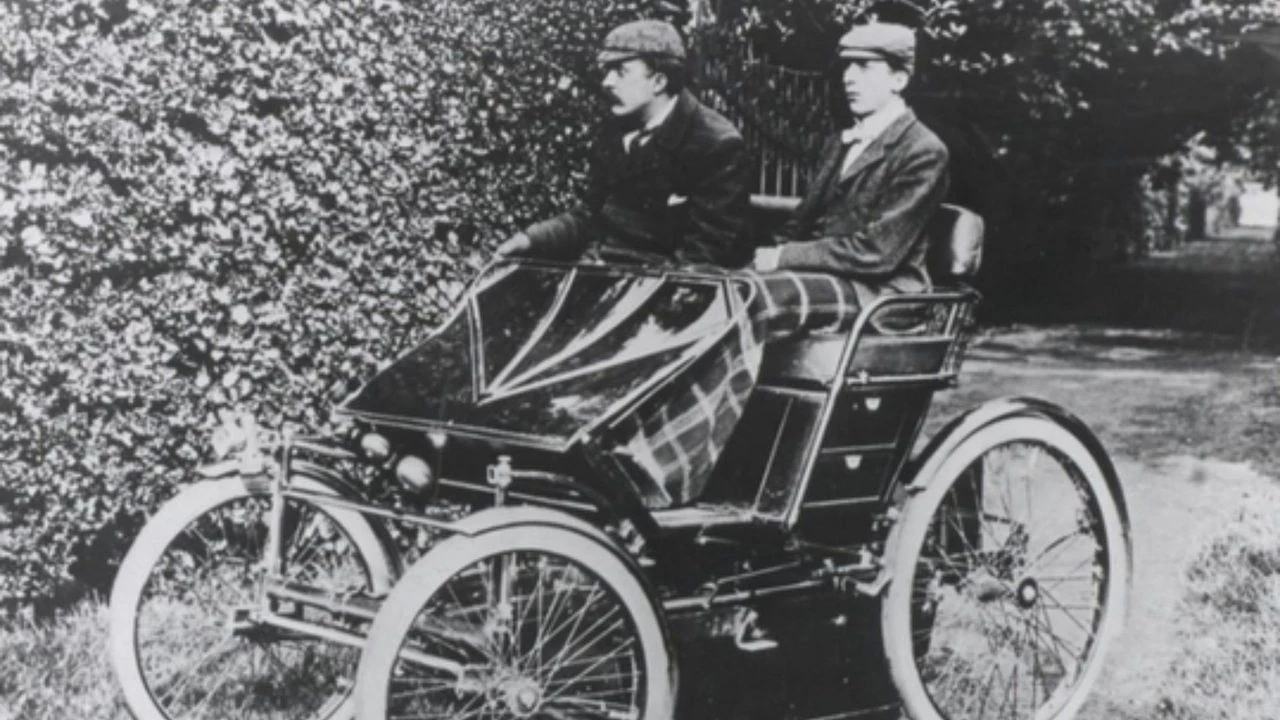
Next Lanchester turned from water to road transport. He designed a four-wheeled petrol car with a 5 horsepower engine, two crankshafts rotating in opposite directions and an epicyclic gearbox offering two forward speeds and reverse. The car was completed in 1895 and first tested in 1896, but its engine lacked power and its transmission caused problems. Lanchester reworked both: a more powerful engine and revised gearbox were fitted to the original car. A second vehicle, with his own cantilever suspension, was completed in 1898. It won a gold medal for design and performance at the Automobile Exhibition and Trials at Richmond.
In December 1899, Lanchester and his brothers formed the Lanchester Engine Company to make cars for sale. The factory, in Sparkbrook, Birmingham, became the setting for a series of design experiments. The company’s ten-horsepower car, introduced in 1901, placed its engine between the front seats and used a side-mounted tiller. Lanchester devised machinery for cutting worm gears used in its transmission, and patented the gear-cutting machine. He also used splined shafts and couplings, roller bearings in the rear axle, and a braking arrangement that clamped the clutch disc rather than using a separate brake system. He was awarded a patent for the disc brake in 1902.
His development work continued through the company’s early years. He designed four- and six-cylinder engines, studied engine vibration, and devised a torsional crankshaft vibration damper and a harmonic balancer. The firm sold about 350 cars of various designs between 1900 and 1904, but went bankrupt amid problems with its board. It was reconstituted as the Lanchester Motor Company. Lanchester experimented with fuel injection and turbochargers, and introduced features including an accelerator pedal and detachable wire wheels. In 1910, disillusioned with the directors, he resigned as general manager and remained as a part-time consultant and technical adviser.
He also worked as a technical consultant to the Daimler Company from 1909, taking part in projects that included the Daimler-Knight engine and petrol-electric vehicles. His subsequent consulting work brought him into the development of engines for agricultural tractors. His relationship with Daimler ended after the Wall Street crash of 1929. The Lanchester Motor Company also lost its overdraft and entered liquidation; BSA, which owned Daimler, completed its purchase of the company in 1931.
Studying flight and the mathematics of warfare
Lanchester began serious aeronautical study in 1892, before powered flight had succeeded. Watching gulls over the Atlantic led him to consider how birds used rising currents of air. He developed a theory of circulation and tested it with models. A paper he presented in 1897, on the soaring of birds and the possibility of mechanical flight, was rejected as too advanced for its time. He concluded that powered flight required an engine with a power-to-weight ratio beyond what was then available, but his proposed engine did not attract support.
After concentrating on car development for several years, he published Aerial Flight in two volumes: the first, on aerodynamics, appeared in 1906; the second, Aerodonetics, followed in 1908. The first volume described vortices behind wings and set out an account of lift and drag. In the second, he examined aircraft stability, including what became known as phugoid motion, and discussed oscillations and stalls. The work was not well received in England, but attracted interest in Germany, where Ludwig Prandtl mathematically confirmed his vortex theory. Lanchester’s contribution to aeronautics received wider recognition only towards the end of his life.
In 1909 he joined the government’s Advisory Committee for Aeronautics and patented contra-rotating propellers. He warned that aircraft would have an increasingly important role in warfare. In 1914 he delivered the James Forrest Lecture to the Institution of Civil Engineers on flying machines from an engineering standpoint. His interest in the military consequences of air power led to a further body of work. In articles published in 1914 and collected in Aircraft in Warfare: The Dawn of the Fourth Arm in 1916, he set out equations describing how opposing forces attrit one another. The equations, now called Lanchester’s Power Laws, showed how the effects of modern weapons and long-range combat could make force size matter in a different way than it had in earlier warfare. The ideas were later applied in the United States to logistics and developed into operations research.
Later work, recognition and financial strain
In 1925 Lanchester founded Lanchester Laboratories to undertake industrial research and development. He produced an improved radio and gramophone speaker, but the company could not market it successfully during the Great Depression. He overworked, his health failed in 1934, and the business closed. He was eventually diagnosed with Parkinson’s disease; cataracts also prevented him from carrying out official work during the Second World War.
Lanchester was elected a Fellow of the Royal Society in 1922. The Royal Aeronautical Society made him a fellow and awarded him its gold medal in 1926. He later received gold medals from the Institution of Civil Engineers in 1941 and the Institution of Mechanical Engineers in 1945. His interests extended beyond engineering: he had a fine singing voice and, under the name Paul Netherton-Herries, published two volumes of poetry.
In 1919 he married Dorothea Cooper, and in 1924 the couple moved to Dyott End, a house he designed in Moseley, Birmingham. They had no children. Lanchester had never achieved commercial success comparable with the breadth of his inventions and research. In his later years he lived in straitened circumstances and depended on charitable help to remain at home. He died at Dyott End on 8 March 1946.
Why Frederick William Lanchester deserves a place in British Legacy
Lanchester’s place in British Legacy rests on the unusually wide reach of his engineering. In Birmingham he moved between gas engines, petrol engines, cars and industrial research, developing practical mechanisms as well as the machines used to make them. His work included an early British four-wheeled petrol car, an epicyclic gearbox and a disc-braking arrangement. He did not confine himself to one successful design: he kept examining how engines, transmissions and vehicles could work better, even when the firms around him struggled commercially.
His contribution also crossed from workshop practice into scientific and strategic thinking. Aerial Flight set out ideas about vortices, lift, drag and aircraft stability; his equations on combat helped establish a way of analysing how forces diminish in battle, later applied to logistics and operations research. These achievements show a British engineer working across transport, aviation and analysis rather than belonging to a single industry. His career also gives that legacy a necessary human scale: inventive distinction did not guarantee financial security, and illness eventually ended his research work. Coventry’s university and library, as well as the Birmingham monument marking the site of his early car work, preserve tangible reminders of a life whose ideas travelled far beyond the workshop.
Sources
Frederick W. Lanchester — revision 1357433276
Adapted in part from Frederick W. Lanchester by Wikipedia contributors, under CC BY-SA 4.0. Text has been edited and combined with the existing article; this adapted text is shared under the same licence. Contributor history.
.jpg)