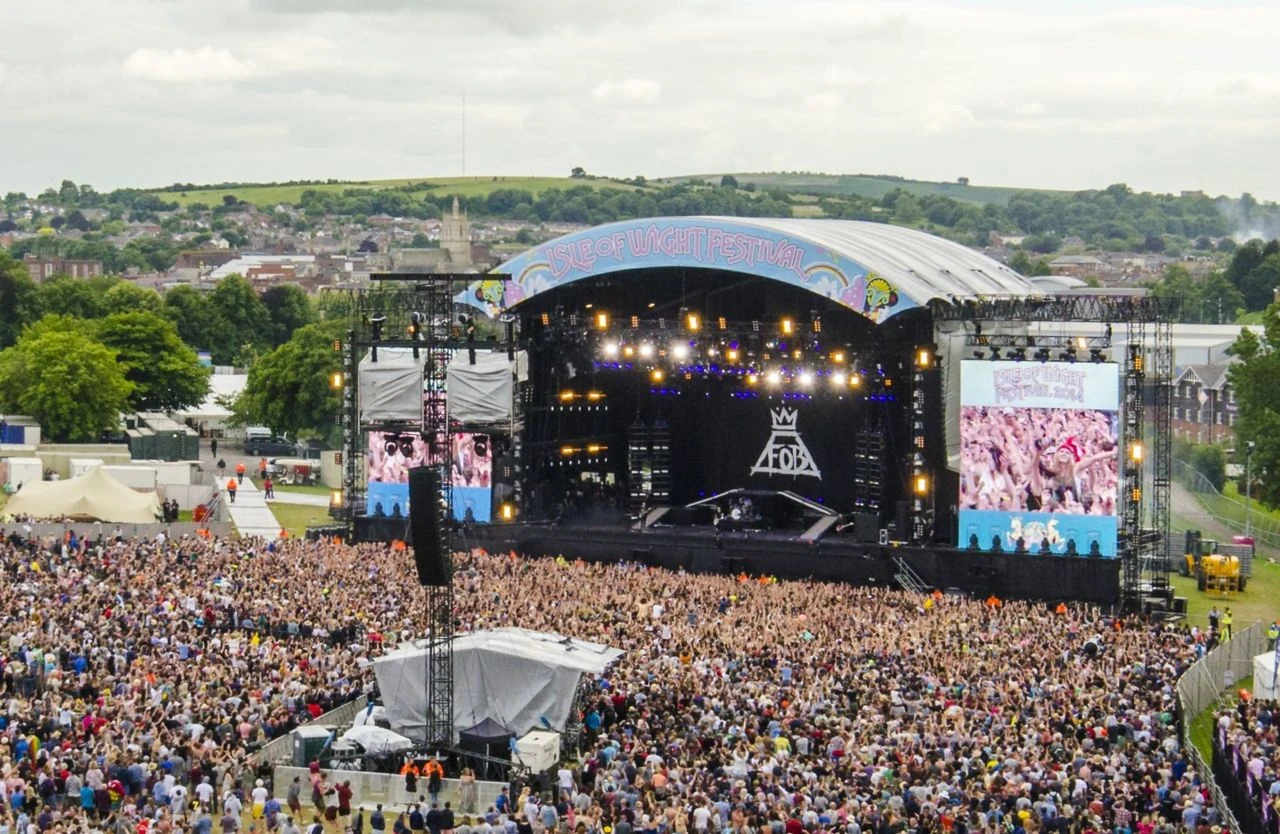
The Isle of Wight Festival began as an ambitious late-1960s gathering and became a defining event in British rock history. Its early editions drew performers including Jefferson Airplane, Bob Dylan and Jimi Hendrix; the extraordinary scale of the 1970 festival prompted new restrictions on large open-air gatherings on the island. Revived in 2002, it has since brought successive generations of artists and audiences to Newport.
Three summers that made the festival
Promoted by brothers Ron and Ray Foulk, with their younger brother Bill, the original festival ran from 1968 to 1970. Its first edition took place on 31 August and 1 September 1968 at Hells Field, Ford Farm, near Godshill. About 10,000 people attended. Jefferson Airplane headlined a bill that also included Arthur Brown, the Move, Smile, Tyrannosaurus Rex, Fairport Convention and the Pretty Things.
The festival moved to Wootton Creek for its 1969 edition, held from 29 to 31 August. Bob Dylan performed with the Band, making his first paid appearance since his 1966 motorcycle accident. The return attracted an estimated 150,000 people, with the performance drawing followers from across the world. The timing added to its significance: the festival opened eleven days after Woodstock closed, while Dylan had left Woodstock, New York, for the Isle of Wight on the day the American festival began.
For 1970, the venue was Afton Down. The bill ranged widely, bringing together more than fifty performers, among them Jimi Hendrix, Miles Davis, the Doors, the Who, Joni Mitchell, Leonard Cohen, the Moody Blues, Free, Chicago, Joan Baez and Jethro Tull. Attendance remains a point of dispute: news agencies reported 250,000 at the time, while later estimates reached 600,000 or 700,000. Promoter Ray Foulk has said he believed the total was about half those larger figures. The varying numbers matter: the festival’s scale is part of its history, but the headline figure should not be treated as settled.
From a huge crowd to a long pause
The 1970 gathering had consequences beyond its performances. In 1971, Parliament added a provision to the Isle of Wight County Council Act restricting overnight open-air gatherings of more than 5,000 people on the island without a special council licence. The early festival’s scale, and the legislation that followed, help explain why its first run ended after three summers rather than continuing uninterrupted.
Film preserved part of that brief period. A crew directed by Murray Lerner filmed the 1970 festival. After a contractual dispute between Lerner and the Foulk brothers, the footage passed to Lerner as a settlement of legal fees. He shaped it into Message to Love, released theatrically in 1996. He also made feature-length films focused on individual performances, including sets by Hendrix, the Who, Miles Davis, the Doors and Joni Mitchell.
Return to Newport
The festival returned in 2002 as Rock Island 2002, at Seaclose Park on the outskirts of Newport. After a small first revival, its audiences grew over the following years: attendance was approximately 8,000 in 2002, 35,000 in 2004 and 60,000 in 2007. The revived event established a continuing home for the festival on the island, while its programme combined established performers with newer acts.
Its line-ups show that breadth. The Who, David Bowie and the Rolling Stones appeared during the revival’s first decade; Paul McCartney, Fleetwood Mac, Blondie and the Foo Fighters were also among its performers. Later bills paired acts from different eras: in 2018, Depeche Mode and Liam Gallagher shared the Saturday headline slots, while the Killers and Manic Street Preachers headlined on Sunday. In 2023, Pulp and the Courteeners played Friday, followed by the Chemical Brothers and George Ezra on Saturday and Robbie Williams and Blondie on Sunday.
The modern run has not been uninterrupted. The 2020 event was cancelled during the COVID-19 pandemic. In 2021, it moved from its planned June dates to September, the first time the festival was held in autumn. It returned in June in 2022, with later editions continuing the annual programme. The festival has also received recognition in the UK Festival Awards, including Best Major Festival in 2007 and Best Family Festival in 2015.
Remembering the island’s festival history
The festival’s history is kept in view beyond the performance site. In 2025, island shop Triple A Records opened a permanent museum exhibition devoted to the Isle of Wight’s musical heritage, including the festival. Its objects include vintage posters, T-shirts, records and a sleeping bag from the 1970 event. The exhibition brings together material from the early gatherings and the island’s wider musical history.
In August 2026, BBC Radio 4’s The Reunion revisited the 1969 and 1970 festivals. Participants included musicians Justin Hayward, Jacqui McShee and Ian Anderson, alongside Melody Maker writer Richard Williams, island resident Terrii Telfer and two of the Foulk brothers. The programme’s return to those editions reflected their continuing place in accounts of British festival culture, while the museum offers a more tangible record of the event’s local history.
Why Isle of Wight Festival deserves a place in British Legacy
The Isle of Wight Festival deserves a place in British Legacy because its history connects musical ambition to the practical realities of hosting a mass event. The original series brought performers from different traditions to an island venue, from Jefferson Airplane and Bob Dylan to Miles Davis, Joni Mitchell and Jimi Hendrix. In 1970, the event’s reported attendance reached a scale that led Parliament to restrict large overnight open-air gatherings without a special licence. That sequence makes the festival more than a list of celebrated names: it shows how a major cultural event could alter the conditions under which later gatherings took place.
Its revival gave that history a continuing public life. Since 2002, the festival has returned to Newport with bills spanning generations and styles, while its film record, awards and island museum exhibition have preserved different parts of its story. Those records matter locally as well as nationally: the early events, subsequent legislation, modern performances and collected objects are all tied to the Isle of Wight. The festival’s British legacy lies in this specific combination of musical history, public spectacle and lasting connection to place—not in an abstract claim that any large music event is inherently transformative.
Sources
Isle of Wight Festival (revision 1375182185)
Adapted in part from Isle of Wight Festival by Wikipedia contributors, under CC BY-SA 4.0. Text has been edited and combined with the existing article; this adapted text is shared under the same licence. Contributor history.