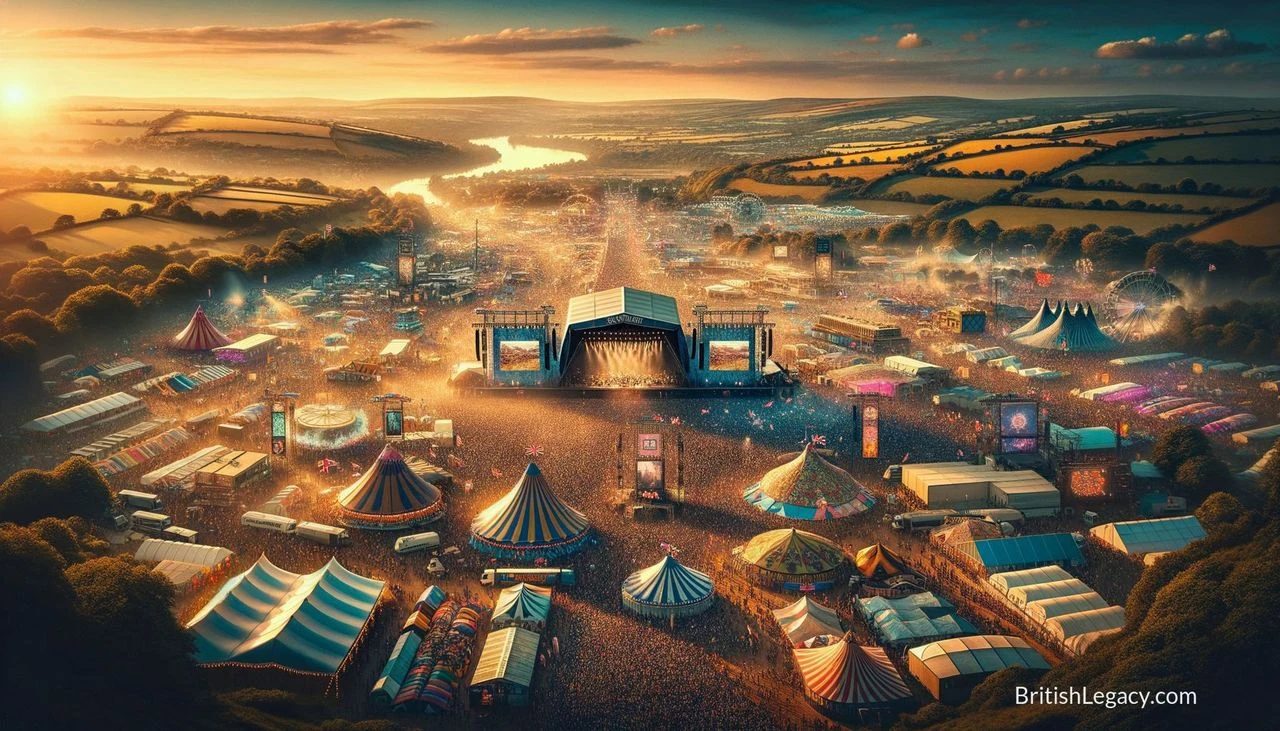
For five days in most summers, farmland near Pilton in Somerset becomes a temporary town of stages, campsites and performance spaces. The Glastonbury Festival of Contemporary Performing Arts began on a much smaller scale in 1970: 1,500 people gathered at Worthy Farm for an event hosted by local farmer Michael Eavis. Its growth into a festival attended by more than 210,000 people in 2023 has brought a different scale of organisation, but the event remains rooted in the working landscape where it began.
A farm gathering becomes a festival
The first event, held on 19 September 1970, was called the Pop, Blues & Folk Festival. Eavis had decided to organise it after seeing an open-air Led Zeppelin concert at the Bath Festival of Blues and Progressive Music. The Kinks and Wayne Fontana and the Mindbenders were originally booked as headline acts, but were replaced at short notice by Tyrannosaurus Rex, later known as T. Rex. Tickets cost £1. The combination of a rural site, live music and an inexpensive ticket offered a very different beginning from the large-scale event Glastonbury would become.
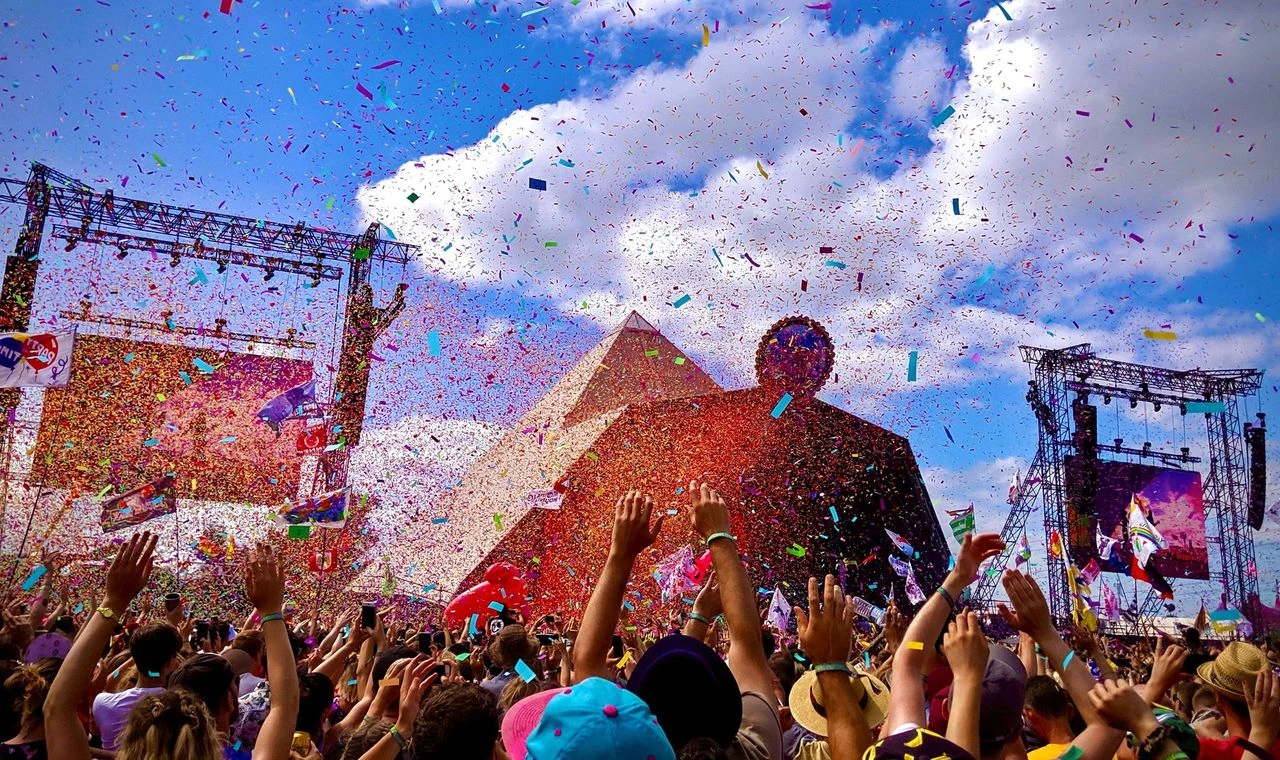
The festival's early direction was shaped by the counterculture and free-festival movements of the 1960s. The 1971 Glastonbury Fayre expanded the programme beyond concerts, embracing music, dance, poetry, theatre, lights and informal entertainment. That year also saw the first version of the Pyramid Stage, a replica of the Great Pyramid of Giza built from scaffolding and metal sheeting. The festival did not then settle into an uninterrupted annual pattern: a small, unplanned gathering took place in 1978, and the event was revived in 1979 before Eavis took sole control in 1981.
In 1981, the festival was organised in conjunction with the Campaign for Nuclear Disarmament. The new Pyramid Stage was built from telegraph poles and metal sheeting repurposed from Ministry of Defence materials; in winter it served as a hay barn and cowshed. That year Glastonbury made a profit for the first time, and Eavis donated £20,000 to the campaign. From the following years, donations went to a range of organisations. Oxfam, Greenpeace and WaterAid later became principal beneficiaries and also contributed volunteers and activities at the festival.
Growth, pressure and reinvention
Growth brought practical challenges. From 1983, large festivals needed local-authority licences, which imposed crowd limits and rules about operating hours. The capacity rose over time, and the site expanded to neighbouring Cockmill Farm in 1985. In 1990, conflict between security staff and new age travellers became known as the Battle of Yeoman's Bridge. There was no festival in 1991; when it returned in 1992, a sturdier perimeter fence and changed arrangements for entry formed part of a broader effort to manage the event.
Music at Glastonbury has changed alongside its size. In 1994, the Pyramid Stage burned down shortly before the festival, and a temporary main stage was erected in time. That year's television coverage helped bring the electronic duo Orbital's performance to viewers across the country. Their appearance gave dance music a high-profile place in the festival's programme, followed in later years by acts including the Chemical Brothers, Massive Attack and Underworld. The Dance Village opened in 1997.
Uncontrolled entry became an increasingly serious problem at the end of the 1990s. Gatecrashers contributed to an estimated attendance of 250,000 in 2000, despite only 100,000 tickets being sold, raising public-safety concerns. Organisers used the scheduled 2001 fallow year to develop measures against unauthorised entry. A substantial perimeter fence was in place when the festival returned in 2002, helping bring numbers down. In 2003, 150,000 tickets sold out before the full line-up was announced, and income for good causes from ticket and commercial-licence sales exceeded £1 million.
Rest years, known as fallow years, have also given the land and local community a break and the organisers time to prepare. The festival was not held in 2006, 2012 or 2018. Its planned 2020 and 2021 editions were cancelled because of the COVID-19 pandemic; the site instead hosted a streamed performance film, Live at Worthy Farm, in 2021. Glastonbury returned in 2022. During the 2025 festival, the Eavis family announced that the event would not be organised in 2026, allowing the natural environment to recover, with a return planned for 2027.
More than the Pyramid Stage
The Pyramid Stage is the festival's best-known focal point, but Glastonbury's programme encompasses far more than its headliners. Dance, comedy, theatre, circus, cabaret and other forms of performance run alongside contemporary music. Smaller stages and areas give space to artists across genres and at different points in their careers. The programme has included major international acts, but its breadth is also visible in the many performers who appear away from the main stage.
The Green Fields retain visible links to the festival's alternative and environmental traditions. They include areas such as Green Futures, the Stone Circle and Healing Field, alongside displays of traditional and environmentally minded crafts. Other parts of the site, including Shangri-La and Block9, are associated with visual installations and late-night performance. The mix makes Glastonbury not just a sequence of headline concerts but a varied, temporary arts environment spread across farmland.
That environment takes substantial work to sustain. The festival occupies around 1,500 acres of farmland and requires extensive arrangements for transport, water, electricity, security and sanitation. Most of its staff are volunteers, including stewards organised by Oxfam. Medical provision has been supplied by Festival Medical Services since 1979. Charities and campaign groups also run stalls or provide volunteers, with the festival directing funds to charitable organisations and local community groups.
Its environmental efforts have included waste-recycling schemes and, in 2019, a ban on plastic bottles across bars, traders and backstage areas. Water-refill kiosks had been introduced in 2014. The festival has also encouraged visitors to take their tents and belongings home: after a cow died from ingesting a discarded tent peg, organisers introduced the Love the Farm, Leave No Trace campaign. These measures sit alongside the recurring fallow years, which reflect the fact that the event's rural setting is both its defining feature and a place that needs time to recover.
Running a temporary town
Since 1981, the festival has been organised by Eavis through Glastonbury Festivals Ltd. He ran it with his wife, Jean, until her death in 1999, and later worked with their daughter Emily Eavis. Festival Republic took on logistics and security in 2002; that arrangement ended in 2012, after which the festival returned to independent operation. The organisation depends on many people and services beyond the family: volunteer teams, medical staff, food traders, charities and transport operators all contribute to the event.
Getting to Worthy Farm is part of that logistical effort. Additional trains serve Castle Cary, where shuttle buses carry passengers to the festival, and extra coach services connect the site with towns and cities around the country. The farm lies between Pilton and Pylle, around six miles east of Glastonbury. Its setting, with public rights of way and the streams that form the Whitelake River, makes the organisation of a very large gathering inseparable from the geography of the surrounding land.
Fallow years are one way the organisers balance continuity with those pressures. Breaks have been used to allow the ground to recover, give local people a rest from the annual disruption and provide time to address practical issues. The reasons for a particular pause have varied: the 2012 break, for instance, was brought forward in part because of shortages and costs associated with policing and portable toilets during the London Olympics. The pauses are therefore not simply gaps in the calendar; they form part of how an event of this size is managed.
Why Glastonbury Festival deserves a place in British Legacy
Glastonbury deserves a place in British Legacy because its history shows how a locally rooted event can grow into a major part of contemporary cultural life without becoming only a story of headline acts. The 1970 gathering at Worthy Farm was hosted by a Somerset farmer, and the festival has remained tied to that farm and its surrounding community as its audience and ambitions expanded. Its history includes the construction of the Pyramid Stage, the development of dance music's place in the programme, and the creation of space for theatre, circus, comedy, cabaret and visual art. That range helps explain why the festival is a performing-arts event as well as a music festival.
Its public significance also rests on how it has organised participation and responded to the demands of scale. Charities and volunteers have a role in the event, and profits have supported organisations including Oxfam, Greenpeace and WaterAid, as well as local community groups. Measures such as recycling, refill kiosks and the plastic-bottle ban address the impact of hosting a very large crowd on farmland. The recurring fallow years recognise that the site and its neighbours cannot be treated as an endlessly available backdrop. Glastonbury's British legacy is therefore cultural and practical: it has created a distinctive meeting place for artists and audiences while repeatedly having to negotiate the responsibilities that come with holding that gathering in a real Somerset landscape.
Sources
Glastonbury Festival (revision 1376837275)
Adapted in part from Glastonbury Festival by Wikipedia contributors, under CC BY-SA 4.0. Text has been edited and combined with the existing article; this adapted text is shared under the same licence. Contributor history.