William Holman Hunt believed that looking closely at the visible world could disclose meaning beyond it. His paintings joined unusually exact observation with elaborate symbolism, from the overgrown door in The Light of the World to the charged domestic scene of The Awakening Conscience. A founder of the Pre-Raphaelite Brotherhood, he pursued these principles across religious subjects, contemporary life, landscapes and literary themes.
A name and a new movement
Hunt was born William Hobman Hunt in Cheapside, London, on 2 April 1827. His father, William, was a warehouse manager; his mother was Sarah, daughter of William Hobman of Rotherhithe. Hunt later adopted “Holman” after discovering that a clerk had misspelled his name following his baptism at St Mary the Virgin, Ewell. He eventually entered the Royal Academy art schools, having first been rejected, but came to resist the influence of the Academy’s founder, Sir Joshua Reynolds.
In 1848, after meeting the poet and artist Dante Gabriel Rossetti, Hunt formed the Pre-Raphaelite movement with Rossetti and John Everett Millais. The three sought to renew painting through detailed observation of nature and a commitment to truth that they regarded as almost religious. They looked towards medieval art and earlier traditions rather than the artistic authority associated with Raphael and the Renaissance. The name of their brotherhood expressed that challenge; their aims were not simply a taste for decorative detail, but a different account of what art should attend to and reveal.
Hunt remained particularly committed to those ideals. His pictures’ vivid colour and minute handling of objects helped make their meanings legible, but also exposed him to criticism. His early works were not immediately successful: the art press attacked them for what it considered clumsiness and ugliness. He continued nonetheless to make works that asked viewers to examine both their subjects and the signs embedded in the composition. He also sought public visibility for his paintings, an ambition that would later help give The Light of the World an audience far beyond Britain.
Modern life, moral drama
Hunt’s subjects ranged beyond religious narratives. The Hireling Shepherd and The Awakening Conscience brought naturalistic attention to contemporary rural and urban life. The latter, painted in 1853, centres on a woman’s moment of moral and spiritual realisation. Its room is full of suggestive details: scattered sheet music, a bird trapped indoors and a mirror reflecting a garden. The natural light and objects invite close looking, while the scene’s meaning depends on how the viewer reads them together.
His interest in symbolism also shaped works based on literature and poetry. Among them were Isabella and The Lady of Shalott. In these paintings, as in his religious work, the subject is not exhausted by its narrative: specific objects, settings and gestures contribute to an argument about human choices, belief or experience. Hunt’s pictures thus demanded a kind of attention that was both visual and interpretative.
The Light of the World and the Holy Land
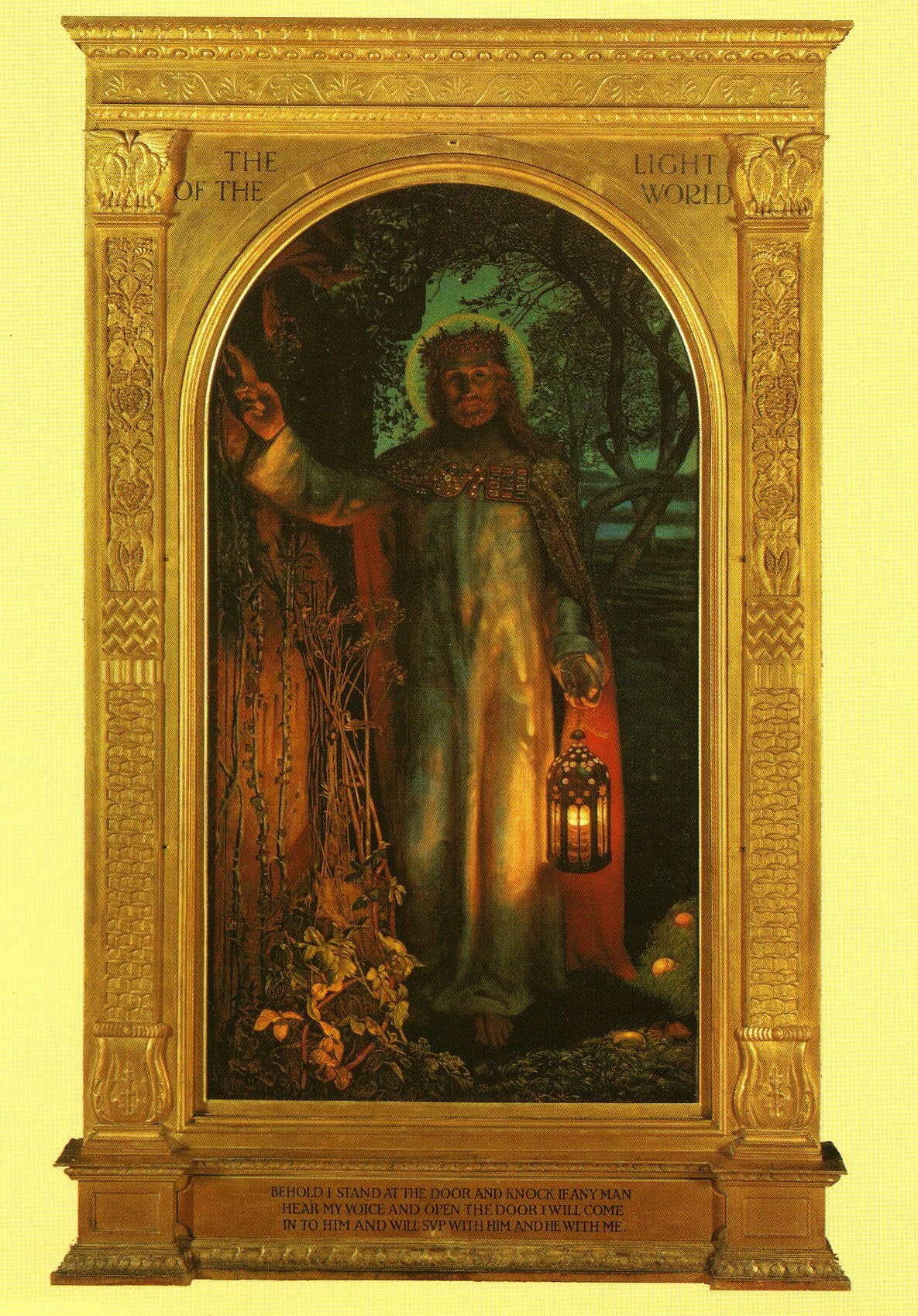
Hunt’s best-known religious painting, The Light of the World, was painted in 1851–53. It shows Christ knocking at a door overgrown with vegetation, an image understood as a symbol of the human soul. The door has no handle on the outside: entry depends on the person within opening it. Hunt’s exact rendering of the robes, foliage and other surfaces makes the symbolic subject tangible rather than abstract.
A later version, completed in 1900, toured the world and is now at St Paul’s Cathedral in London. The earlier painting is at Keble College, Oxford. The two versions belong to different stages in the picture’s public life; it was the later one that made the international tour. Hunt’s attention to the visibility and reach of his work helped turn a carefully constructed image into one of his most widely recognised paintings.
In the mid-1850s, Hunt travelled to the Holy Land to find topographical and ethnographical material for religious works and to make the history and teaching of Jesus more tangible. The journey informed The Scapegoat, The Finding of the Saviour in the Temple and The Shadow of Death, as well as numerous landscapes. He eventually built a house in Jerusalem. His use of place was part of the same method that shaped his studio work: close attention to the physical world served the larger purpose of making a subject present to the viewer.
Work, family and public standing
Hunt married Fanny Waugh in 1861. She later modelled for the figure of Isabella. She died in childbirth in Italy at the end of 1866, and Hunt sculpted her tomb at Fiesole before it was moved to the English Cemetery in Florence, beside the tomb of Elizabeth Barrett Browning. He maintained a connection with St Mark’s Church in Florence and paid for a communion chalice inscribed in her memory.
In 1875, Hunt married Edith Waugh, Fanny’s younger sister. Because British law then prohibited marriage to a deceased wife’s sister, they travelled to Neuchâtel in Switzerland to marry. The marriage caused serious conflict with members of the family, including Hunt’s former Pre-Raphaelite colleague Thomas Woolner. Hunt’s personal life, like his work, was shaped by ties between family, art and the conventions of his time.
He continued painting until failing eyesight made it impossible for him to achieve the quality he wanted. His last major works, including a large version of The Light of the World for St Paul’s, were completed with help from his assistant Edward Robert Hughes. Hunt published an autobiography in 1905; some of his later writing sought to guide the interpretation of his work. That year, King Edward VII appointed him to the Order of Merit. He died in London on 7 September 1910 and was buried at St Paul’s Cathedral. A blue plaque was added to his former home at 18 Melbury Road in 1923.
Why William Holman Hunt deserves a place in British Legacy
Hunt’s place in British cultural history rests on more than his membership of a celebrated group. As a founder of the Pre-Raphaelite Brotherhood, he helped advance a distinct approach to painting: sustained attention to nature, vivid colour and a conviction that visible particulars could carry moral or spiritual significance. His career shows that this approach was not a passing youthful revolt. Despite hostile criticism of his early work, he maintained its demands across paintings of modern life, religious subjects, landscapes and literature.
His achievement is also visible in the continuing life of his pictures. The Awakening Conscience turns a domestic interior into a scene whose meaning depends on looking closely at its objects. The Light of the World gives religious thought a memorable physical form; its later version’s international tour and present home at St Paul’s connect Hunt’s work with audiences well beyond the art world. His journey to the Holy Land, undertaken to ground religious painting in observed places, further demonstrates the seriousness of his method. Together, these achievements enrich Britain’s artistic inheritance: they offer viewers paintings to encounter as images and as carefully constructed arguments, while preserving a record of how one Victorian artist tried to make observation, belief and public communication work together.
Sources
William Holman Hunt — Wikipedia revision
Adapted in part from William Holman Hunt by Wikipedia contributors, under CC BY-SA 4.0. Text has been edited and combined with the existing article; this adapted text is shared under the same licence. Contributor history.