Damien Hirst’s best-known work places a tiger shark in a glass tank of formaldehyde and gives it a title that makes the viewer confront the gap between death and the idea of death. The work is direct in its materials and difficult to forget. It also captures the questions that have followed Hirst’s career: what an artwork is, who makes it, how it acquires value, and whether spectacle can prompt serious thought.
Hirst emerged from London’s art schools and artist-run exhibitions to become one of the most prominent figures associated with the Young British Artists (YBAs). His work ranges from preserved animals and medicine cabinets to spot paintings and a diamond-covered skull. It has attracted enthusiastic attention, sharp criticism and record-breaking sales. His career is not a settled story of artistic triumph, but an unusually public argument about contemporary art.
From Leeds to Freeze
Hirst was born in Bristol on 7 June 1965 as Damien Steven Brennan and grew up in Leeds. Drawing was the subject in which he did best at school. He attended Jacob Kramer College after first being refused a place, then studied fine art at Goldsmiths College in London from 1986 to 1989. Before Goldsmiths, he spent two years working on London building sites. A placement at a mortuary during his art studies later informed his engagement with death and the materials of the body.
In July 1988, while in his second year at Goldsmiths, Hirst organised Freeze, an independent exhibition in a disused Port of London Authority building in London’s Docklands. Its financial backing came from the London Docklands Development Corporation. Hirst’s contribution was a group of cardboard boxes painted with household paint; the exhibition’s wider importance lay in bringing together work by him and other young artists. Among its visitors were the collector Charles Saatchi, Royal Academy exhibitions secretary Norman Rosenthal and Tate director Nicholas Serota.
Freeze was an early gathering point for the artists who became associated with the YBAs, rather than a one-person show or a movement created by Hirst alone. He continued to organise exhibitions. With Carl Freedman and Billee Sellman, he curated Modern Medicine and Gambler in 1990, in a former biscuit factory in Bermondsey known as Building One. Saatchi bought Hirst’s installation A Thousand Years after seeing it at Gambler. The work put maggots, flies and a cow’s head inside a glass case, turning the processes of feeding and decay into a contained spectacle.
Death in the gallery
In 1991 Saatchi offered to fund an artwork of Hirst’s choosing. The result, The Physical Impossibility of Death in the Mind of Someone Living, was shown in 1992 in the first Young British Artists exhibition at the Saatchi Gallery. A tiger shark, caught by a fisherman commissioned in Australia, hangs in formaldehyde inside a clear display case. The title asks viewers to consider mortality; the shark makes that question physical. It was this combination of a recognisable image, an imposing object and an unsettling idea that established the work as Hirst’s signature piece.
The shark was not the end of the subject. In Mother and Child Divided, presented at the Venice Biennale in 1993, a cow and calf were cut into sections and placed in separate vitrines. Away from the Flock (1994) placed a sheep in a formaldehyde tank. The works put animals in a gallery as both bodies and objects of attention, asking viewers to look at what they might otherwise turn away from. Their stark presentation has helped make Hirst’s art accessible to a wide audience, while also leaving it open to the charge that shock and display can overwhelm meaning.
Other recurring forms gave his practice a different register. Medicine cabinets arrange pharmaceutical products with the order of a shop display, bringing medical imagery into the gallery. Spot paintings use grids of coloured circles. Hirst’s work includes painting as well as sculpture and installation, and his use of assistants to produce works has been part of a wider debate about authorship: whether an artwork’s defining act lies in its conception, its execution or both.
Recognition, criticism and the art market
Hirst was nominated for the Turner Prize in 1992, after the Young British Artists exhibition, but the prize went to Grenville Davey. He won the Turner Prize in 1995. Two years later, his work appeared in Sensation at the Royal Academy in London, an exhibition that was widely seen as bringing the YBAs into the cultural establishment. Not all the exhibition’s controversy centred on Hirst, but it helped put the artists and the arguments around them before a much larger public.
His reception has never been unanimous. Some critics have praised his capacity to command attention and draw audiences towards contemporary art; others have questioned the ideas, craft or originality of particular works, or argued that his career has become too closely linked with commerce. Hirst’s use of assistants and disputes over appropriation have also fed questions about how his work is made and where its ideas come from. Those disagreements form part of the public record around his practice, rather than a verdict that resolves it.
That relationship between art and money became especially visible in September 2008. For Beautiful Inside My Head Forever, Hirst sold a complete show of new works through Sotheby’s in London, bypassing the galleries that would ordinarily have handled such a sale. The two-day auction raised £111 million across 218 lots, setting a record for a one-artist auction at the time. Its scale made the sale a major event in the art market, as well as an experiment in how artists might sell work. It also intensified questions about whether the market was supporting art or becoming part of the spectacle surrounding it.
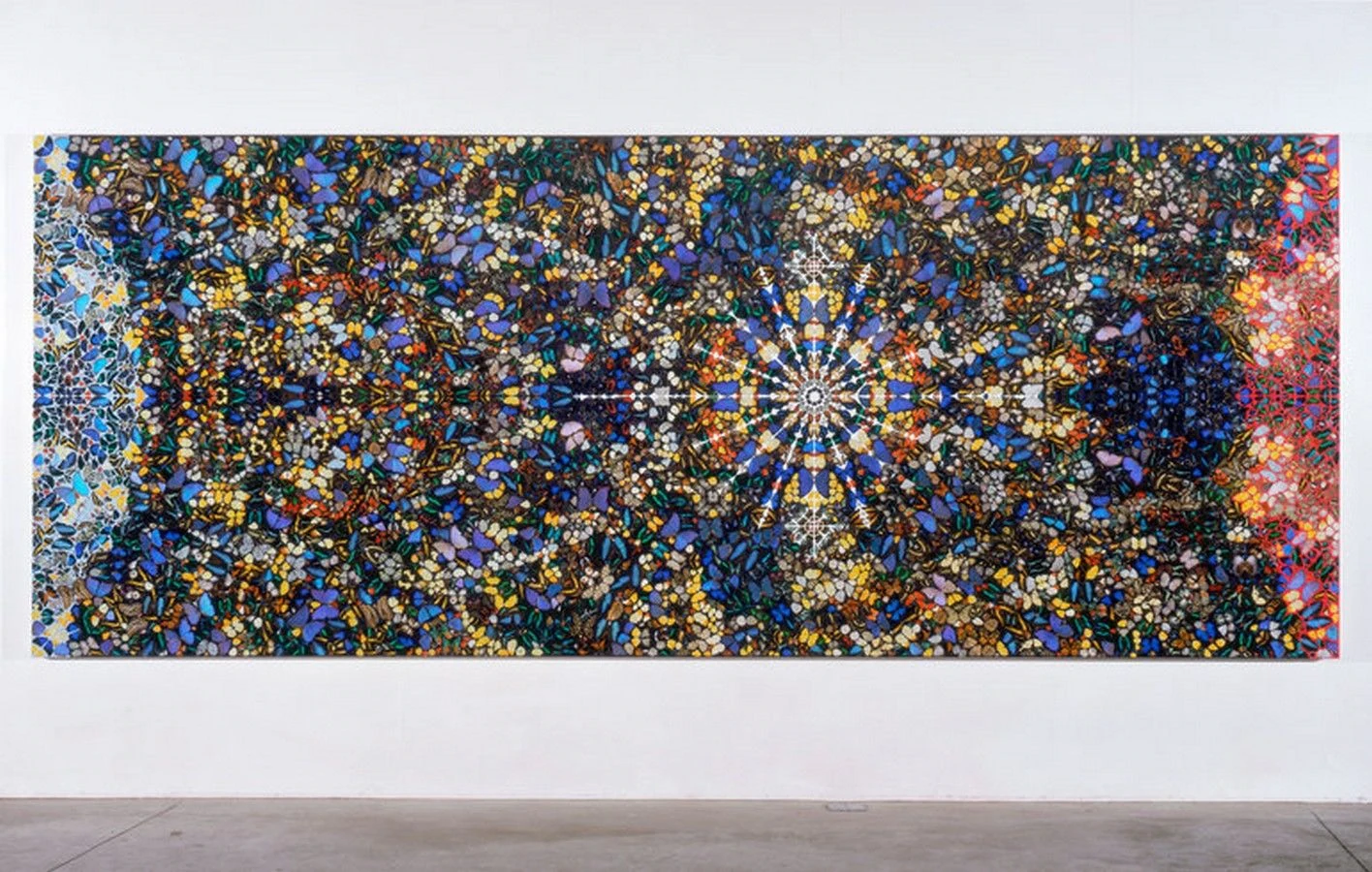
Other works have extended his use of familiar images and extravagant materials. For the Love of God (2007) is a human skull recreated in platinum and set with diamonds. In 2017, Hirst presented Treasures from the Wreck of the Unbelievable in Venice: an exhibition of elaborate objects framed as recovered ancient treasures. Its mixture of historical appearance, contemporary production and theatrical presentation continued his interest in how objects acquire meaning and value.
A collection and a gallery
Hirst is also an art collector. His collection, known as the murderme collection, spans artists from different generations. Some of it was shown publicly at the Serpentine Gallery in 2006. In 2007 he donated several works to Tate, including sculptures from 1991 and an exhibition copy of Mother and Child Divided.
His London gallery project gave the collection a more permanent public presence. Newport Street Gallery opened in Vauxhall in October 2015 in former theatre carpentry and scenery workshops redesigned by architects Peter St John and Adam Caruso. The gallery was conceived to show works from Hirst’s collection. It is a substantial contribution to the city’s gallery landscape, though a private collection and its exhibition programme are not, by themselves, evidence of a wider charitable mission or a commitment to fostering new artists.
Why Damien Hirst deserves a place in British Legacy
Hirst’s place in British cultural history rests partly on the way he helped make the YBAs visible. Freeze was an independently organised student exhibition in a disused London building, but it drew influential visitors and helped bring a group of artists into public view. Hirst’s subsequent role in organising exhibitions showed that his importance was not limited to the objects he made: he also helped create occasions in which new work could be seen and discussed. His Turner Prize win and the appearance of YBA work at the Royal Academy marked stages in the movement’s passage from an emerging scene to a subject of national attention.
His own work has kept that attention focused on questions that matter beyond the art market. The shark, the animal vitrines, the medicine cabinets and the spot paintings use readily legible forms to raise problems of mortality, medicine, authorship and value. Viewers do not have to agree that every work succeeds to recognise the force of the questions, or the extent to which Hirst has made contemporary art a subject of public argument. The 2008 Sotheby’s sale, meanwhile, exposed the mechanics of the market as part of that argument. His London gallery and the public presentation of his collection add a further, concrete connection to British cultural life. Taken together, these achievements make Hirst a significant and contested figure: not a simple emblem of artistic consensus, but a maker and organiser whose career brought contemporary British art into wider view.
Sources
Damien Hirst (revision 1376804249)
Adapted in part from Damien Hirst by Wikipedia contributors, under CC BY-SA 4.0. Text has been edited and combined with the existing article; this adapted text is shared under the same licence. Contributor history.