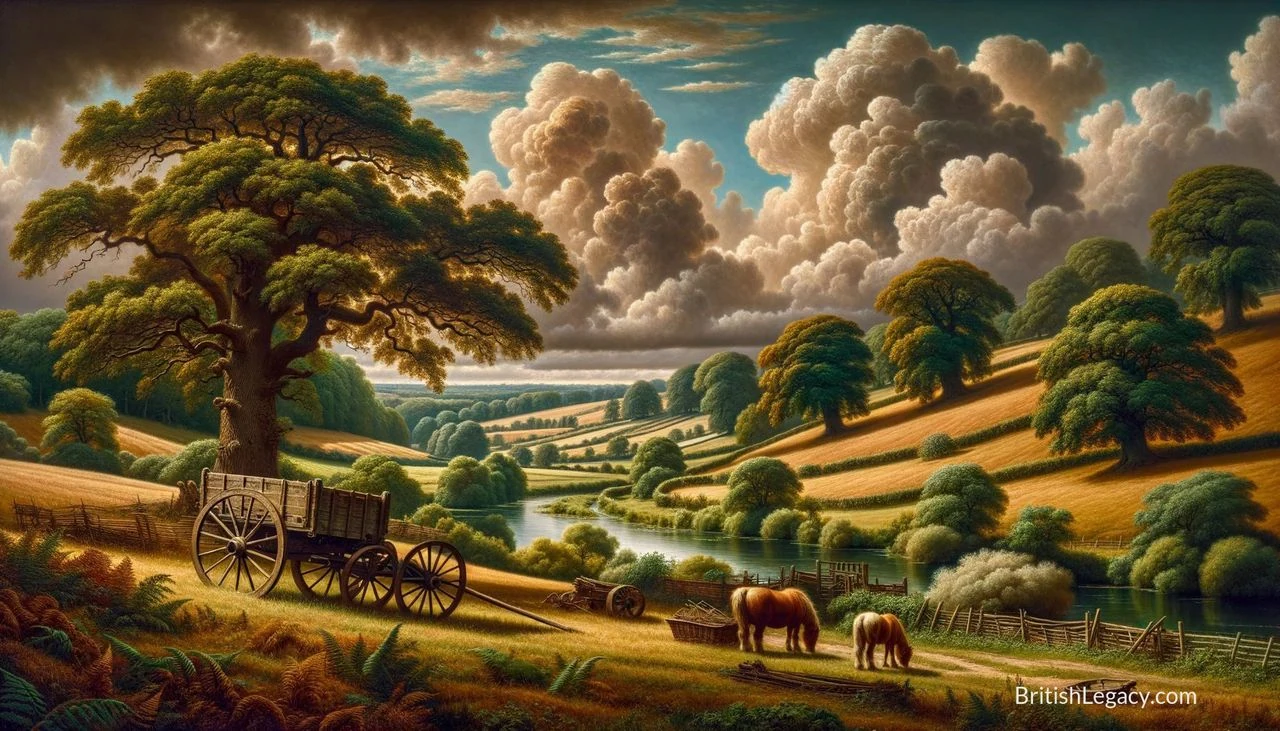
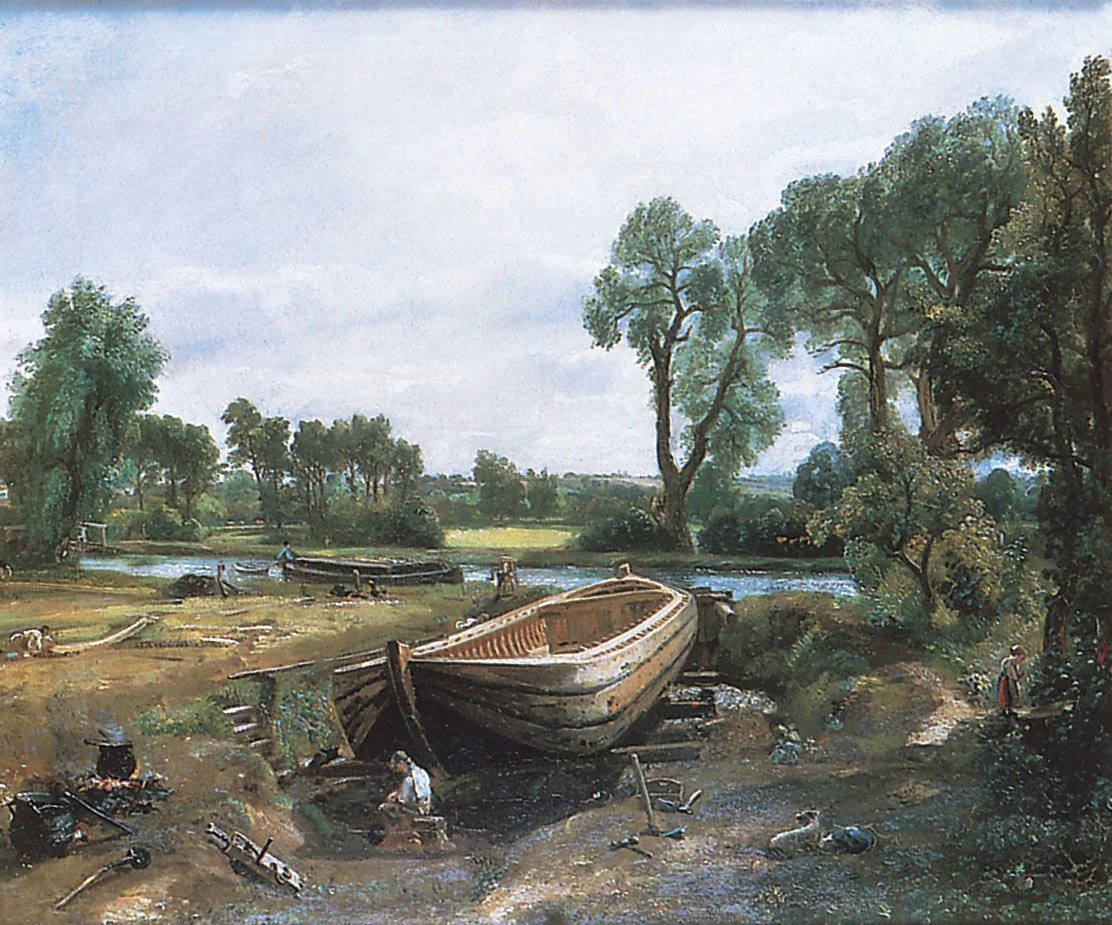
John Constable built his art around places he knew: the fields, mills and waterways of Suffolk and north Essex. Rather than inventing an ideal landscape from earlier pictures, he studied nature directly, recording changes in weather and light in swift outdoor sketches and carrying that close observation into his large exhibition paintings. The Hay Wain, now one of his best-known works, grew from this sustained attention to the River Stour and its working countryside.
A Suffolk childhood, and a choice of career
Constable was born in East Bergholt, Suffolk, on 11 June 1776. His father, Golding Constable, was a wealthy corn merchant who owned Flatford Mill and later Dedham Mill. John was expected to enter the family business. After school he worked in the corn trade, while making sketches of the surrounding Suffolk and Essex countryside. These familiar scenes would become the principal subject of his art.
His route into painting was not immediate. The collector George Beaumont showed him a landscape by Claude Lorrain, and the artist John Thomas Smith offered advice, though he urged Constable to remain in business. In 1799, Constable persuaded his father to let him pursue art. He entered the Royal Academy Schools as a probationer and studied under Joseph Farington, copying older masters and attending life classes. Works by artists including Thomas Gainsborough, Claude Lorrain and Jacob van Ruisdael informed his early study, but Constable was determined to develop a practice based on looking at nature for himself.
In 1802 he turned down a post as drawing master at Great Marlow Military College. That year he wrote of his determination to become a professional landscape painter and objected to work that tried to surpass nature rather than represent it truthfully. He began exhibiting at the Royal Academy in 1803. Landscape painting was then less prestigious than historical or mythological subjects, and his early pictures struggled for attention among the larger works crowded onto the exhibition walls. He supported himself at times by painting portraits and country houses, alongside his landscapes.
Learning to paint the Stour
Constable’s subject was not a remote wilderness but the countryside around home: farms, churches, cottages, rivers and the structures used to work the land. He spent winters in London and summers at East Bergholt, returning to the Stour valley to sketch. He painted outdoors and made careful studies of particular places before developing them into finished pictures. In a letter to his friend John Fisher, he wrote, “I should paint my own places best”; for him, painting was closely tied to feeling for a place.
He was alert to the way a landscape changed from hour to hour. Constable made numerous studies of clouds and skies, sometimes noting the weather, light and time of day on the back. He considered the sky essential to a landscape’s effect and drew on contemporary meteorological writing, including the work of Luke Howard on cloud classification. His oil sketches, made directly from the subject, used vigorous, broken brushwork to suggest movement and shifting light. They were studies, not merely small versions of finished pictures: Constable also produced large preliminary sketches to test the composition of his major paintings.
This close observation did not mean copying a view mechanically. He worked from familiar landscapes but shaped them through composition and brushwork. His skies could take up much of a canvas; his marks could make water, foliage or passing weather feel immediate. In works such as Seascape Study with Rain Cloud, made around 1824 at Brighton, dark strokes convey a rain shower at sea. His watercolour Stonehenge (1835), with its double rainbow, shows the breadth of his work beyond the Stour valley.
The large landscapes and a French breakthrough
In 1817 Constable began Flatford Mill (Scene on a Navigable River), his largest rural painting to that point. It did not find a buyer when shown at the Royal Academy, but its reception encouraged him to work on an ambitious scale. The success of The White Horse, sold in 1819 to his friend John Fisher, brought both income and election as an associate of the Royal Academy. It also helped set in motion the monumental Stour landscapes later known as the “six-footers”.
The series includes Stratford Mill (1820), The Hay Wain (1821), View on the Stour near Dedham (1822), The Lock (1824) and The Leaping Horse (1825). Their scale helped them command attention in the competitive Royal Academy exhibitions. The Hay Wain, depicting a cart crossing the water near Flatford Mill, did not sell at its first exhibition. In 1824, however, it was bought by the dealer John Arrowsmith and shown in Paris alongside another Constable landscape. The French reception was striking: the painting received a gold medal from Charles X, and Eugène Delacroix later wrote approvingly of Constable’s colour. Constable’s work influenced French artists and the Barbizon school; in France, he sold more paintings than he did in England.
Recognition abroad did not make his career financially secure. He sold relatively few pictures at home, and a later venture to publish prints after his landscapes, made with the mezzotinter David Lucas, failed to attract enough subscribers to succeed commercially. Constable also lost his French outlet after falling out with Arrowsmith. The contrast between the acclaim his paintings could receive and the difficulty of earning from them remained a feature of his career.
Family life, loss and public teaching
Constable married Maria Elizabeth Bicknell in 1816, after a long friendship. Her family opposed the match, in part over the couple’s financial prospects. They had seven children. When Maria’s health deteriorated, the family spent time in Brighton from 1824, hoping the sea air would help her. Constable painted coastal subjects there as well as continuing to work on large canvases. Maria died in 1828, aged 41. Constable was left to care for their children, and his later paintings include some of his most emotionally forceful work, among them Hadleigh Castle (1829) and Salisbury Cathedral from the Meadows (1831).
In 1829, aged 52, he was elected a full member of the Royal Academy. He later served as a Visitor at the Academy and delivered public lectures on the history of landscape painting. In those lectures he argued that painting was both scientific and poetic, and that imagination alone could not produce art equal to reality. In his final lecture to Royal Academy students, in 1835, he praised Raphael and described the Academy as the “cradle of British art”. He died in London on 31 March 1837 and was buried with Maria at St John-at-Hampstead.
Why John Constable deserves a place in British Legacy
Constable’s place in British cultural history rests not simply on familiar images of a green and peaceful countryside, but on how closely he studied the places he painted. The fields and waterways around the Stour were working landscapes, shaped by mills, farms and everyday human activity. By treating these familiar surroundings as subjects worthy of large, ambitious paintings, he helped expand what landscape art could do. His practice joined sustained observation to experiment: outdoor studies of skies and weather informed finished works, while his energetic sketches opened up new possibilities for representing movement and light.
That influence travelled beyond England. The Paris exhibition of The Hay Wain and other paintings in 1824 brought a major public success, and Constable’s work affected Delacroix and the Barbizon school. His own path was less triumphant than the reputation of his paintings might suggest: recognition did not ensure commercial ease, and his print venture with David Lucas failed financially. That tension makes his story more, not less, instructive. Constable combined a distinctly local subject with a practice that changed how artists elsewhere approached landscape. His paintings preserve close attention to particular places while showing how observation, technique and feeling can make those places matter to viewers far beyond their original setting.
Sources
John Constable — Wikipedia revision 1378342042
Adapted in part from John Constable by Wikipedia contributors, under CC BY-SA 4.0. Text has been edited and combined with the existing article; this adapted text is shared under the same licence. Contributor history.