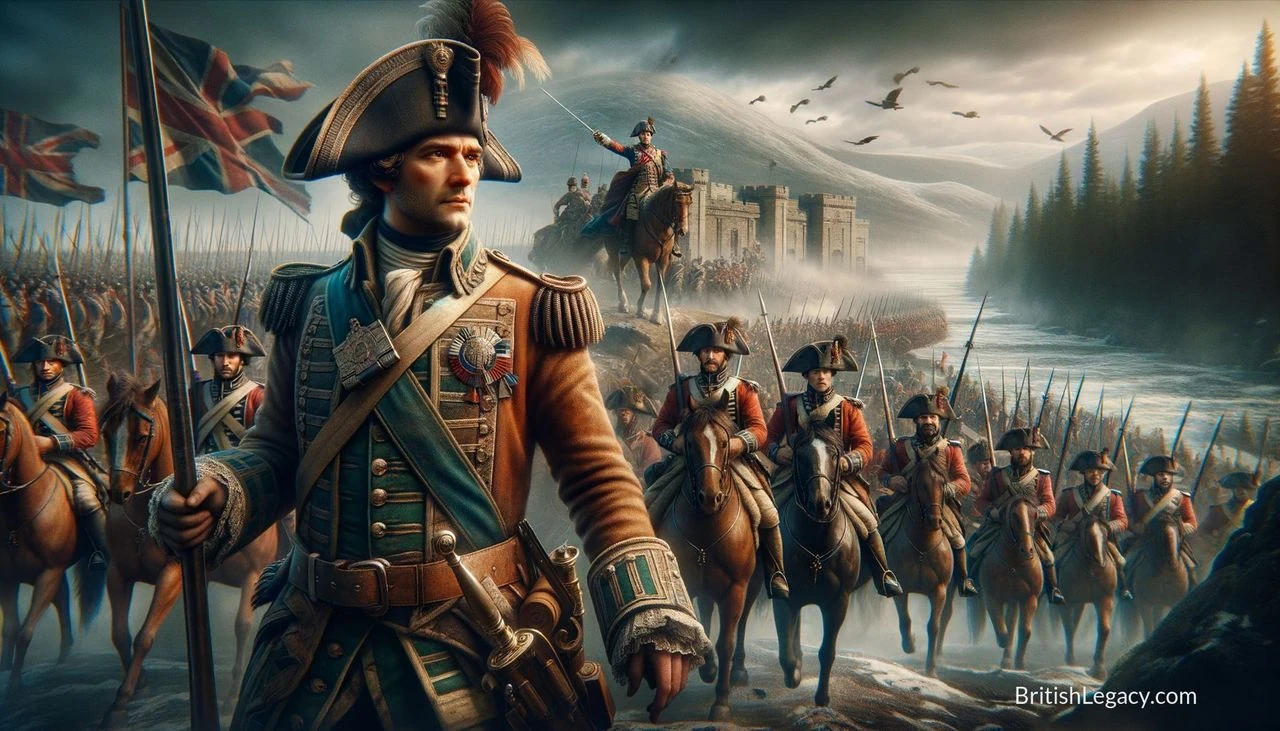
James Wolfe’s victory at Quebec in 1759 made him one of the most celebrated British commanders of the Seven Years’ War. The battle lasted only about 15 minutes. Wolfe was wounded by three musket balls and died as the French forces gave way. His success helped Britain capture Quebec, but the story is not simply one of a daring assault: it grew from years of military service, including campaigns in Europe and Scotland, and from a siege that had left both armies under pressure.
A military life begun early
Wolfe was born in Westerham, Kent, on 2 January 1727, the elder of two sons of Edward Wolfe, a career soldier, and Henrietta Thompson. The family later moved to Greenwich. He entered his father’s regiment as a volunteer at 13 and received his first commission the following year. His early service took him to Europe during the War of the Austrian Succession. At Dettingen in 1743, his regiment suffered heavy casualties and his horse was shot from beneath him. He later fought at Lauffeld, where he was badly wounded.
During the Jacobite rising of 1745, Wolfe served in Scotland, including at Culloden. The campaign was followed by years of garrison duty in the Highlands. He became a major and took command of the 20th Regiment before being confirmed as its lieutenant-colonel in 1750. He was already a brigade major at 18 and a lieutenant-colonel by 23, but advancement did not mean uninterrupted action: the 1748 peace treaty brought a long period of peacetime service.
Wolfe used those years to study military matters, write pamphlets and develop his command. He learned French, taught himself Latin and mathematics, and worked to improve his swordsmanship. His health was often poor. When war with France resumed, he was stationed in England and trained his troops, even as he worried about the army’s readiness and his own prospects.
From Rochefort to Louisbourg
In 1757, Wolfe joined an expedition against Rochefort on the French Atlantic coast. The raid ended without an attack on the town: after taking an offshore island, the British force withdrew. Wolfe had urged the commander to press on and had gone ashore to examine the terrain. The failure frustrated him, but it brought him to the attention of William Pitt the Elder, who was turning the focus of British operations towards North America.
Promoted to brigadier general in 1758, Wolfe served under Jeffrey Amherst at the siege of Louisbourg, a French fortress on Cape Breton Island guarding the approach to the St Lawrence. He helped prepare the assault and took part in the landing and advance of the siege batteries. The French capitulated in June. The success established Wolfe’s reputation and helped prepare the way for a renewed attempt to take Quebec the following year. He also served in the Gulf of St Lawrence campaign, including the expulsion of Acadians.
The siege and the Plains of Abraham
Pitt chose Wolfe to lead the assault on Quebec in 1759. The city’s position above the St Lawrence and the French defences made it a formidable target. Wolfe’s force arrived to find a difficult campaign ahead: the French commander, the Marquis de Montcalm, had strengthened the approaches, and the British had only a limited window before winter ice would make the river unusable.
The British besieged the city for three months. An assault at Beauport failed against French positions, while Amherst’s separate advance towards Montreal made too little progress to offer Wolfe timely support. The campaign also brought hardship to the civilian population. Wolfe’s manifesto threatened destruction of crops, homes and livestock; rather than simply persuading inhabitants to remain neutral, it helped strengthen resistance to the British.
In the early hours of 13 September, Wolfe led about 4,400 men by boat to a landing west of Quebec. They climbed the steep riverbank and reached the Plains of Abraham, surprising the French. The armies met there in a short, decisive engagement. Wolfe was hit in the arm and shoulder before a third wound to the chest proved fatal. Montcalm was also mortally wounded and died the next day. Wolfe’s victory enabled British forces to take Quebec; the following year, the capture of Montreal ended French rule in Canada outside Louisiana and the small islands of Saint-Pierre and Miquelon.
A victory remembered and contested
Wolfe’s body was returned to Britain and buried in the family vault at St Alfege Church, Greenwich. His death at the moment of victory became central to his public image. Benjamin West’s painting The Death of General Wolfe helped make the episode familiar far beyond Britain, while the ballad “Brave Wolfe” carried the story into popular song. The image of a commander dying in triumph helped turn a complex military campaign into a powerful national legend.
Memorials preserve that memory in Britain and Canada. Wolfe is commemorated at Westminster Abbey, in Greenwich and in his birthplace of Westerham. In Quebec, an obelisk marks the battlefield; its inscription was changed from “Here Died Wolfe Victorious” to “Here Died Wolfe” to avoid offending French Canadians. The contrast captures the different meanings his victory can carry: a celebrated British military success, and a decisive moment in the extension of British rule over French Canada.
Why James Wolfe deserves a place in British Legacy
Wolfe’s place in British history rests first on a specific achievement. His command at Quebec helped secure a British victory in the Seven Years’ War and made possible the capture of Montreal the next year, bringing French rule in Canada to an end. That outcome reshaped the political future of North America. It also explains why his name became a lasting part of British public memory, represented in art, song and memorials on both sides of the Atlantic.
His career offers more than a battlefield legend. Wolfe served across several campaigns, from Dettingen and Lauffeld to Culloden, Rochefort and Louisbourg. His rise through the army included years of garrison duty and study, as well as setbacks and poor health. Remembering those stages gives substance to the achievement at Quebec: it was the culmination of a military career, not a solitary moment of inspiration. A British legacy that includes Wolfe should also acknowledge the consequences of his victory and the differing ways it is remembered in Canada. Together, the campaign and its memorial history show how military success can shape both political borders and the stories later generations tell about them.
Sources
James Wolfe — Wikipedia revision 1379810243 · James Wolfe — Wikipedia
Adapted in part from James Wolfe by Wikipedia contributors, under CC BY-SA 4.0. Text has been edited and combined with the existing article; this adapted text is shared under the same licence. Contributor history.