General Sir Edmund Allenby: The Scourge of the Ottoman Empire and The Liberator of Jerusalem
In the annals of British military history, few names conjure images of strategic brilliance and heroic leadership quite like that of General Sir Edmund Henry Hynman Allenby. Born on 23rd April 1861, Allenby's military career spanned numerous campaigns, yet it was his command of the Egyptian Expeditionary Force during World War I that cemented his legacy as one of Britain's finest military leaders. His decisive actions in the Middle East not only altered the course of the Great War but also reshaped the geopolitical landscape, leaving an indelible mark on British history and its global influence.
Early Life and Military Career
Raised in a time of burgeoning British imperialism, Allenby was steeped in the values of duty, honour, and service. Educated at Clifton College and the Royal Military College, Sandhurst, his military career began in 1882 when he was commissioned into the 6th (Inniskilling) Dragoons. Allenby's early years in the army were marked by experiences in the Second Boer War, where he first demonstrated his aptitude for commanding large formations and his talent for rapid, decisive action.
The Egyptian Expeditionary Force
By the time the Great War engulfed Europe, Allenby had already risen through the ranks, gaining a reputation as an effective and dynamic leader. His appointment as the commander of the Egyptian Expeditionary Force in June 1917 occurred at a critical juncture. The mission: to break the Ottoman hold over Palestine and Syria, thereby weakening an essential ally to the Central Powers.
The Palestine Campaign and the Capture of Jerusalem
Under Allenby's command, the Egyptian Expeditionary Force became a formidable and highly mobile army capable of executing intricate manoeuvres across challenging terrain. One of Allenby's most significant achievements was the orchestration and successful execution of the Third Battle of Gaza in October 1917. This victory paved the way for the subsequent advance into the heart of Ottoman-held territories.
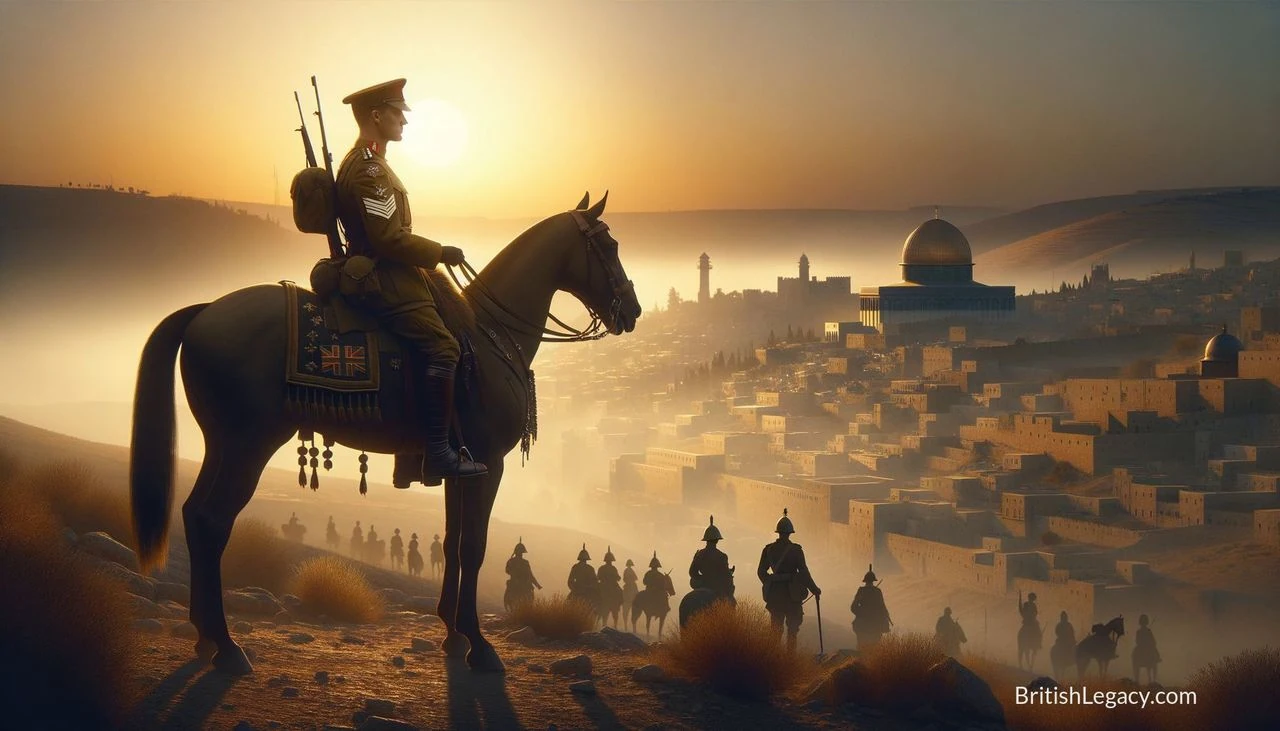
The pinnacle of Allenby's campaign came with the capture of Jerusalem in December 1917. His entry into the city was marked by an act of profound respect: dismounting from his horse, Allenby walked through the Jaffa Gate, symbolising a liberator rather than a conqueror. This act resonated globally, underscoring Britain's commitment to safeguarding the city's religious significance to Judaism, Christianity, and Islam.
The capture of Jerusalem was not merely a strategic victory but a masterstroke of diplomatic sensitivity. Allenby’s respect for the diverse religious traditions within Jerusalem earned British forces the cooperation of local populations, which was crucial for maintaining control and ensuring peace in the newly liberated territories.
Post-War Legacy and Impact
After the war, Allenby's contributions continued to shape the Middle East. As High Commissioner for Egypt and the Sudan, he navigated the complex political landscape during Egypt's transition towards independence. His diplomatic skills were instrumental in mitigating conflicts and fostering stability within the region.
On the home front, Allenby’s impact was celebrated with numerous honours. He was created a Field Marshal in 1919, reflecting his esteemed status within the British military hierarchy. His leadership principles and the successful campaigns he commanded became case studies in military academies around the world, shaping modern military doctrines.
Wrap-Up
General Sir Edmund Allenby remains an emblem of British dedication, strategic acumen, and respectful diplomacy. His contributions during World War I, especially the liberation of Jerusalem, were pivotal not only in the defeat of the Ottoman Empire but also in reinforcing Britain's influence in the Middle East. His legacy is imprinted in the annals of history, a testament to the profound and enduring impact of effective leadership. For those delving into the British heritage, Allenby’s story offers a compelling narrative of how one man’s resolve can redefine the destiny of nations and leave a lasting legacy on the world stage.