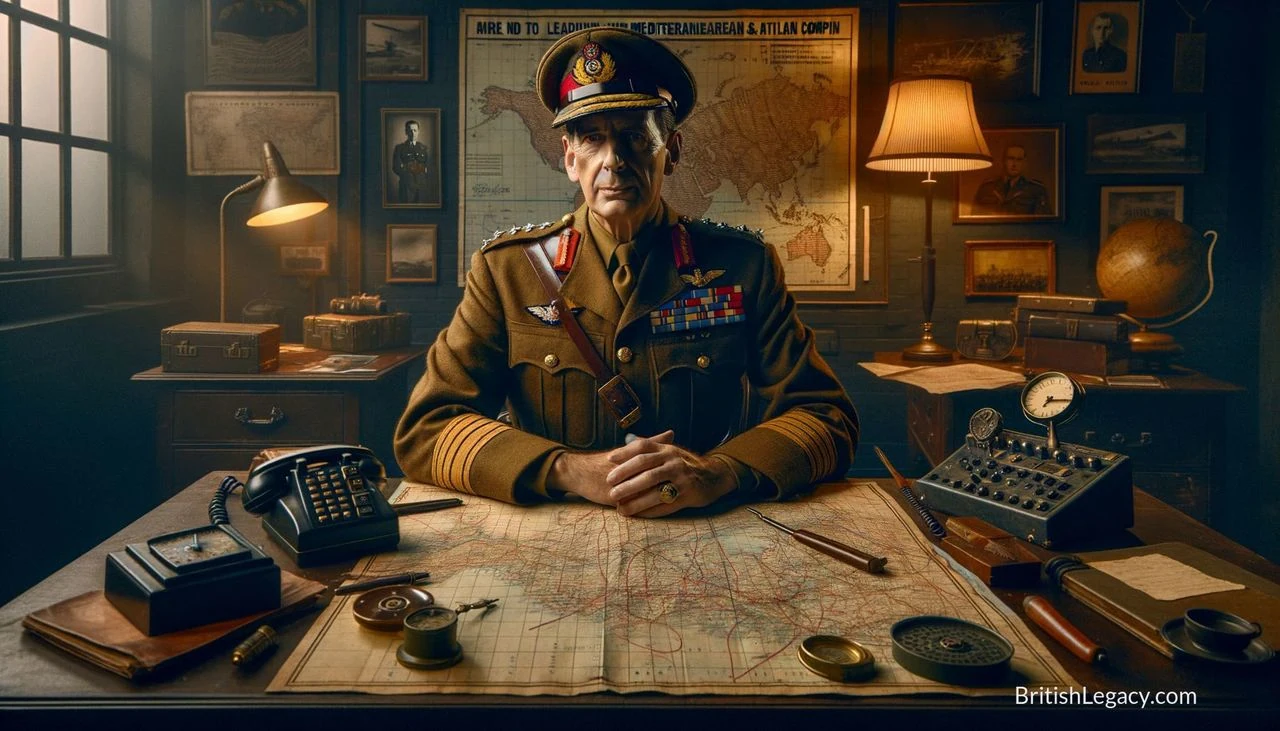
Harold Alexander’s wartime record stretched from the desert campaigns of North Africa to the Allied advance through Italy. As a senior British commander, he worked within multinational forces at moments when coordination between armies mattered as much as battlefield decisions. After the war, he took on a very different public role as Governor General of Canada.
Education and service in the First World War
Harold Rupert Leofric George Alexander was born in London on 10 December 1891. He was educated at Harrow and the Royal Military College, Sandhurst, before being commissioned into the Irish Guards. His service in the First World War brought him the Military Cross and the Distinguished Service Order.
Those decorations marked the beginning of a military career that would bring him into senior command during the next world war. Alexander’s later responsibilities would involve more than directing British troops: in the Mediterranean, he had to work with forces from several Allied nations and manage campaigns across difficult terrain.
North Africa and the Mediterranean
In 1942, Alexander succeeded General Sir Claude Auchinleck as Commander-in-Chief Middle East. He held that post during the Second Battle of El Alamein, where British forces under General Bernard Montgomery halted and reversed the Axis advance in North Africa. Alexander’s role was one of senior command and coordination; the battle formed a turning point in the campaign.
In 1943, he took command of Allied operations in the Italian campaign. These included the invasion of Sicily and the fighting around Monte Cassino. The campaign was arduous: Allied forces faced German defences and difficult terrain as they pressed north through Italy. Alexander directed a multinational force that included British, American and Canadian troops. The account of his command emphasises the scale of the coordination involved, rather than attributing the campaign’s progress to one commander alone.
Allied forces entered Rome in June 1944. The advance through Italy formed part of the wider European war, while the invasion of Normandy was under way. Alexander’s Mediterranean command therefore belonged to a larger Allied effort, conducted across more than one front.
From field command to public service
After the war, Alexander’s career continued in public life. He was appointed Governor General of Canada in 1946, a role that placed him at the head of the Canadian state’s vice-regal administration. The appointment connected his British military service with a constitutional position in another country of the Commonwealth.
Also in 1946, Alexander was elevated to Field Marshal. He was later created Viscount Alexander of Tunis. He died on 16 June 1969. His career thus encompassed military service in two world wars, senior Allied command in the Mediterranean, and a post-war appointment in Canada.
Why Harold Alexander deserves a place in British Legacy
Alexander’s place in British Legacy rests on the responsibilities he held during the Second World War and the settings in which he exercised them. In North Africa, he served as Commander-in-Chief Middle East during the campaign that included the Second Battle of El Alamein. In Italy, he directed Allied operations involving troops from several nations, from the invasion of Sicily through the fighting at Monte Cassino and the advance to Rome. These campaigns were not the work of a single commander, but Alexander’s senior role placed him among the British leaders charged with coordinating the Allied effort.
His post-war appointment as Governor General of Canada gives that military record a further dimension. Alexander’s public service extended beyond the battlefield into a constitutional role in the Commonwealth, while his elevation to Field Marshal and creation as Viscount Alexander of Tunis marked his standing in British military and public life. Remembering him offers a way to consider both the complexity of coalition command and the transition from wartime leadership to post-war service. That specific combination, rather than a general claim of heroism, explains his relevance to British history.