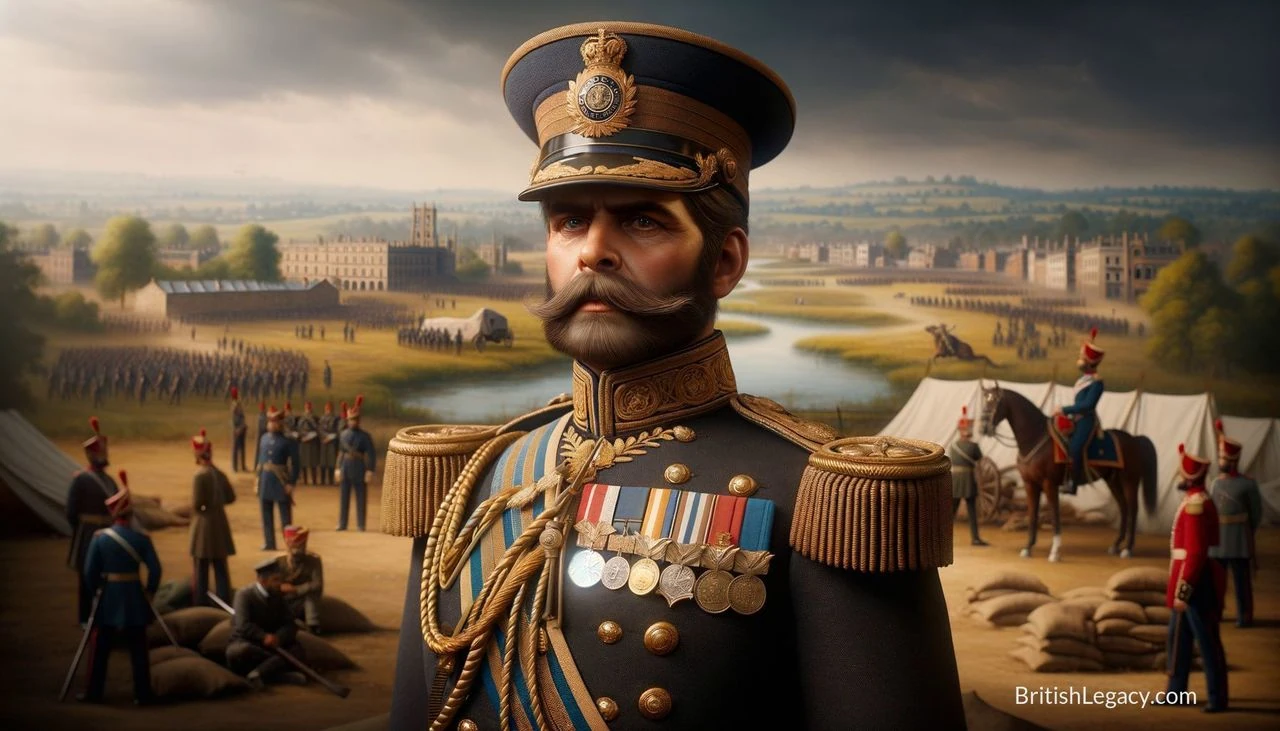
Henry Havelock’s military career took him from the Rifle Brigade to campaigns in Afghanistan, Burma and the Punjab before the Indian Rebellion of 1857 made him known for his part in the relief of Lucknow. His record includes both the advance that reached the besieged city and the renewed siege in which he later died. Statues in Sunderland and London mark how his name was commemorated in Britain; his tomb remains in Lucknow, where his service and death unfolded.
From Sunderland to the army
Havelock was born on 5 April 1795 at Ford Hall, Bishopwearmouth, now part of Sunderland. His father, William, was a shipbuilder; his mother was Jane, daughter of a solicitor. The family moved to Ingress Park in Kent while Henry was a child. He attended Dartford Grammar School and then Charterhouse, leaving at 17. His father’s financial losses changed the family’s circumstances, and Havelock abandoned his legal studies at the Middle Temple, where he had entered in 1813 and studied under Joseph Chitty.
On 30 July 1815, aged 20, Havelock received a commission as a second lieutenant in the 95th Regiment of Foot, the Rifle Brigade. He served in Britain for several years, studying military history and the theory of war. Seeking active service, he transferred to the 13th Regiment of Foot in 1822 and sailed for India the following January. Before leaving, he studied Persian and Hindustani. He served in the First Anglo-Burmese War of 1824–26, then returned to England and married Hannah Shepherd Marshman, daughter of Baptist missionaries. He became a Baptist and later promoted Bible distribution and study among soldiers.
Campaigns across South and Central Asia
Havelock’s service took him through several conflicts before 1857. In the First Anglo-Afghan War, he was present at the capture of Ghazni in 1839 and the occupation of Kabul. In 1841 he joined Sir Robert Sale’s force; after the siege of Jalalabad, the column defeated Akbar Khan’s forces in a sortie on 7 April 1842. Havelock later took part in the fighting at Jagdalak and Tezeen and in the release of British prisoners at Kabul.
He served in the Gwalior campaign and the First Anglo-Sikh War, including the battles of Mudki, Ferozeshah and Sobraon in 1845. Alongside his military service, he wrote analytical reports on battles and skirmishes. After a period in England, he returned to India in 1852. He became quartermaster-general, was promoted to full colonel, and was appointed adjutant-general of India in November 1854. In 1856 he commanded a division during the Anglo-Persian War. The peace with Persia brought that campaign to an end just as rebellion broke out in India.
The advance to Lucknow
In 1857, Havelock was chosen to command a column tasked with suppressing the disturbances, supporting the British forces at Lucknow and Cawnpore, and pursuing rebel forces. During August he led his soldiers north through Oudh, in present-day Uttar Pradesh. His force faced opponents who greatly outnumbered it. Havelock had to weigh the urgency of relieving Lucknow against the cost of continuing with troops weakened by battle and disease.
He advanced towards the city three times, twice holding back rather than risk an attack with an exhausted force. Reinforcements eventually arrived under Sir James Outram, who assumed command. Havelock led the assault, and the relief of Lucknow was achieved on 25 September 1857. But reaching the besieged Residency did not secure the city: a second rebel force arrived, and Havelock and the troops with him were trapped inside the blockade. His role was therefore significant but not a simple, final breaking of the siege.
Havelock died at Lucknow on 24 November 1857 of dysentery, a few days after the siege was lifted. He lived long enough to hear that he was to be made a baronet for the first three battles of the campaign, but not of the major-generalship conferred shortly afterwards. His death came before news of further appointments could reach England. The baronetcy passed to his eldest son, and Parliament voted pensions for his widow and son.
Faith, commemoration and contested memory
Havelock’s Baptist faith shaped his life in the army. After his conversion, he distributed Bibles to soldiers and established study classes open to all ranks, as well as services outside the church. Such details help explain the place religion held in his military life without requiring the unsupported claim that his conduct made him universally admired or that his forces gave him unwavering loyalty.
His memory was marked on both sides of the subcontinent. His family erected a tomb monument in the Chander Nagar–Alambagh area of Lucknow. In London, William Behnes’s statue of Havelock stands in Trafalgar Square; its inscription commemorates him and his companions in the 1857 campaign. Behnes also designed the statue in Mowbray Park, Sunderland, close to the city where Havelock was born. Its inscription records his birth at Ford Hall and death at Lucknow.
The London statue became the subject of public debate in 2000, when the mayor, Ken Livingstone, proposed replacing it and the statue of General Charles James Napier with figures he considered more relevant. The debate reflects the difficulty of treating imperial-era memorials as uncomplicated celebrations. Havelock’s career was conducted in the service of British power in India, and the rebellion against that power was a conflict with deep consequences for those who lived there. Remembering his military record need not obscure that colonial context.
Why General Sir Henry Havelock deserves a place in British Legacy
Havelock belongs in British Legacy as a figure whose career connects British military institutions with the history of the subcontinent. His service began with a commission in the Rifle Brigade and continued through campaigns in Burma, Afghanistan, the Punjab and Persia. Those experiences preceded his command during the Indian Rebellion, where the relief of Lucknow became the best-known episode of his life. The detail matters: the relief involved repeated advances, exhausted troops and the arrival of reinforcements under Outram. Havelock led the assault, but the city was besieged again, and he died there. Acknowledging the sequence preserves the achievement without turning it into a simpler victory story.
His legacy also has a tangible geography. Sunderland, his birthplace, and London, the seat of a prominent memorial, preserve his name in Britain; Lucknow holds his tomb and the setting of both his campaign and his death. These memorials offer a way to examine not only whom Britain chose to commemorate, but also the imperial history behind that choice. Havelock’s soldierly career, religious commitments and public remembrance provide specific points of entry into that history. His place in British Legacy rests not on claims of an inherent national character, but on the documented connections between British military service, colonial conflict and the enduring debate over how that past should be represented.
Sources
Henry Havelock — Wikipedia, revision 1379814979 · Henry Havelock — Wikipedia
Adapted in part from Henry Havelock by Wikipedia contributors, under CC BY-SA 4.0. Text has been edited and combined with the existing article; this adapted text is shared under the same licence. Contributor history.