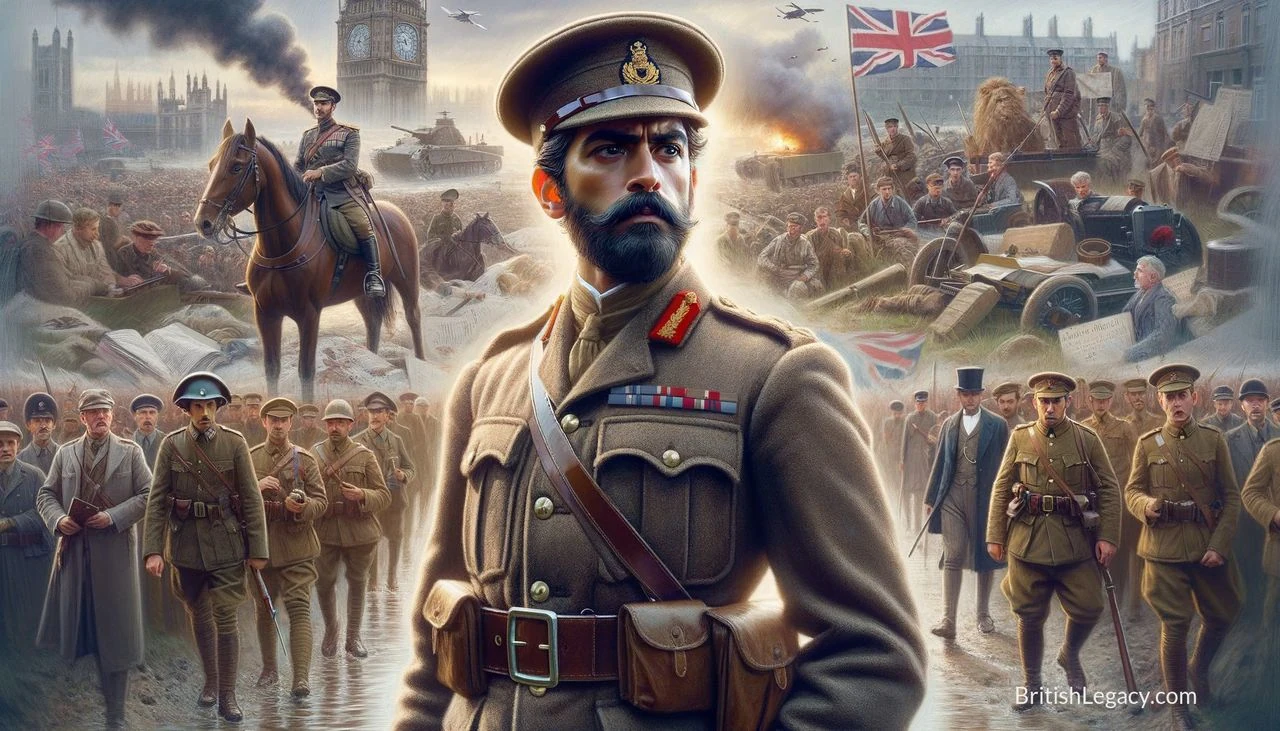
Herbert Kitchener’s public image came to represent Britain’s wartime call to arms, but his career had already been shaped by the Anglo-Egyptian campaign in Sudan. His command at Omdurman in 1898 established his military prominence; as Secretary of State for War from 1914, he became a central figure in expanding Britain’s army. These achievements sit alongside the controversy of Gallipoli, making his place in British history one of influence and consequence rather than uncomplicated acclaim.
Omdurman and the Sudan campaign
Kitchener’s rise to prominence came during the Mahdist War, in which British interests and control in Sudan were challenged. As commander of the Anglo-Egyptian forces, he led an expedition against the Mahdist forces that culminated in the Battle of Omdurman on 2 September 1898. The victory strengthened Anglo-Egyptian power in the region and was followed by the establishment of Anglo-Egyptian Sudan.
The battle became the defining achievement of this part of his career. It demonstrated the reach of the force under his command and helped establish his reputation, while also extending British influence in Africa. The campaign was not simply a personal military success: it formed part of Britain’s imperial history, with consequences for the region beyond the battlefield. Remembering Kitchener’s role therefore means recognising both the military outcome and the expansion of imperial power it helped bring about.
Secretary of State for War
In 1914, at the start of the First World War, Kitchener became Secretary of State for War. He judged that the conflict would be prolonged and that Britain would need a far larger army. His role in organising the military response placed him at the centre of a major expansion of the forces available for the war.
The recruitment poster bearing his image and the words “Your Country Needs YOU” became one of the conflict’s most recognisable symbols. It linked a public appeal to a national figure and helped make military recruitment visible in everyday life. The existing account credits Kitchener’s campaign with galvanising thousands of volunteers, though it does not establish that the poster alone produced that response. His contribution to mobilisation is clearer when understood as part of the wider effort to enlarge the army and sustain operations across multiple fronts.
Gallipoli and a contested reputation
Kitchener was also involved in the Gallipoli campaign, an attempt to secure a strategic maritime route to the Ottoman Empire. The operation failed to achieve its objective and came at heavy cost in lives and resources. Its difficulties exposed weaknesses in planning and command. The account available here does not specify Kitchener’s individual decisions or assign him sole responsibility for the campaign’s outcome, so his involvement should not be confused with sole authorship of its failures.
Gallipoli complicates a story otherwise often told through military achievement and wartime mobilisation. It places the limits of authority and planning beside the capacity to organise a much larger army. Kitchener’s career consequently invites consideration of both what British military leadership could accomplish and the human costs of its decisions. His record includes decisive success at Omdurman, a prominent public role during the First World War and association with a disastrous campaign; none of these elements alone accounts for the whole.
Why Herbert Kitchener deserves a place in British Legacy
Kitchener deserves a place in British Legacy because his career brings together two important episodes in Britain’s military history. At Omdurman, he commanded Anglo-Egyptian forces in a victory that helped establish Anglo-Egyptian Sudan and extend British influence in Africa. In 1914, as Secretary of State for War, he recognised the need for a larger army and took a leading role in organising Britain’s response to a war expected to last. The recruitment image associated with him became a lasting public symbol of that mobilisation.
That legacy should include its costs and its limits. Gallipoli failed to achieve its objective and brought heavy loss of life, while the Sudan campaign formed part of Britain’s imperial expansion. Including these consequences avoids reducing Kitchener either to a heroic image or to a single failure. His story gives British Legacy a way to examine how military authority, public persuasion and imperial power intersected in his time, and why the results of leadership must be remembered alongside its ambitions.